Yes! Send me the FREE digital editions of Spa Business and Spa Business insider magazines and the FREE weekly Spa Business and Spa Business insider ezines and breaking news alerts!
Higher resolution displays are enabling the creation of stunning virtual journeys, while the power of visualisations is advancing. We ask what’s new in dome projection technology
By Jason Holland | Published in Attractions Management 2015 issue 2
Interview: Marty Sklar
Retired Disney Legend Marty Sklar
reveals the secrets of Imagineering,
the legacy of the 1964 World’s Fair
and the lessons he learned as
Walt Disney’s “keeper of the keys”
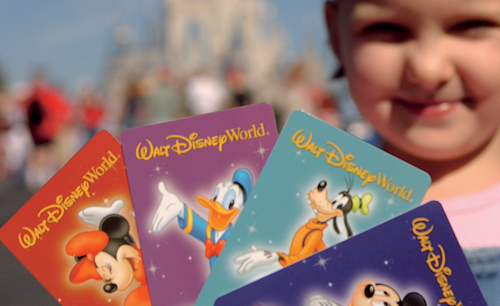
Talking Point: The $100 Barrier
As a Walt Disney World day ticket
enters three-digit territory for
the first time, we ask what this
means for pricing in the sector
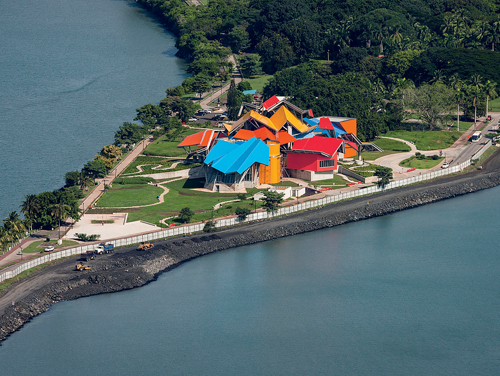
Museums: Biomuseo
Panama has opened the world’s first
museum of biodiversity, an ambitious
building by architect Frank Gehry. We
meet the team behind the project
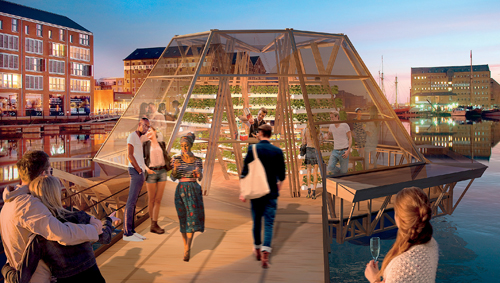
Expos: Food for Thought
Expo Milano 2015 launches in Italy,
aiming to bring the planet’s most
pressing problems to the fore, not least
how to provide food for everybody
Zoos & Aquariums: On the SAFE Side
AZA chair Dennis Pate explains a new
initiative designed to help endangered
animals, and offers some tips from
his world-class Henry Doorly zoo
Promotional feature: IDEATTACK
IDEATTACK is a creative maverick with a
new perspective, bringing custom-made
one-of-a-kind attractions typologies to
a world that needs something di�fferent
Rides: The Ride Makers
In the third part of our series, we look at
the enduring appeal of wooden coasters
Ticketing: Dream Tickets
Ticketing systems are advancing to
improve the guest’s experience and the
operator’s profit. We investigate the
sector’s current and upcoming trends
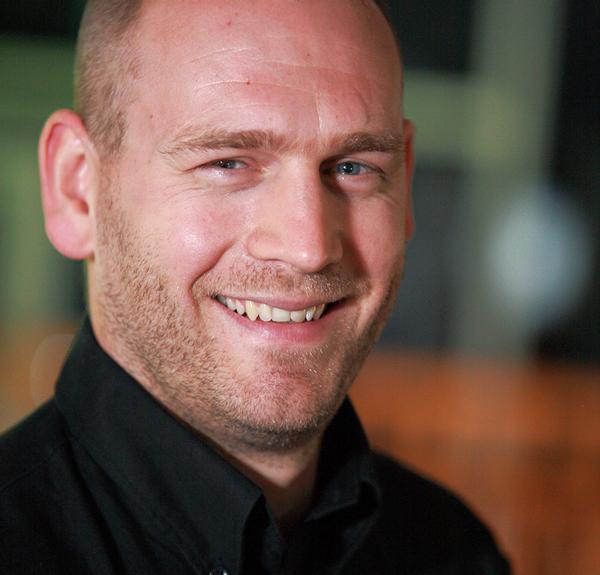
Sky-Skan Creating crystal clear images for all budget types After pioneering fulldome displays using a pair of then new 4K venue projectors 10 years ago, the next logical step for Sky-Skan was to use more of them to achieve 8K resolution on a dome, according to Glenn Smith, managing director of the US-headquartered company.
“Projectors are more compact today so we can more easily integrate the technology into the dome theatre architecture. As such we can even offer smaller domes an 8K configuration for about the same price as 4K cost a few years ago,” he says.
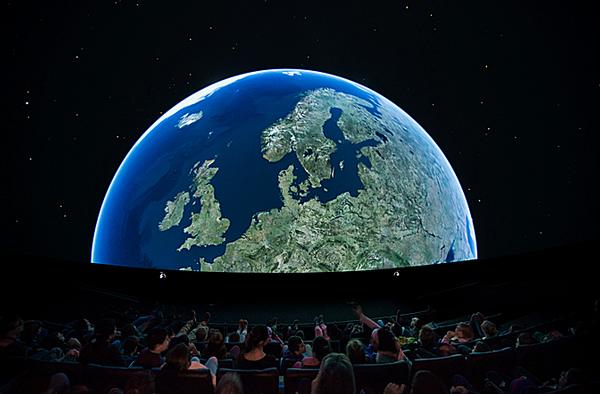
Austria’s Planetarium Klagenfurt is the first to take advantage, with its 12.5-metre dome theatre reopening with an 8K display based on six Sony GT-100 projectors. 8K dome displays are closer than ever to reaching the visual acuity of the human eye, says Smith, resulting in a sharp, crisp image. Dome theatres are known for movie content, but the real-time visualisation systems that Sky-Skan builds also generate images in the display’s native resolution.
“Our heritage is planetariums and a beautiful starry sky is all the more realistic and impressive in 8K. It draws gasps from our customers when they see it the first time,” says Smith. “The resolution also finally represents a viable alternative to an opto-mechanical star projector for those projects where a realistic night sky is important but perhaps budgets don’t allow for a mix of technologies.”
Very high resolution images can also be displayed, and long, slow zooms can be performed to investigate the smallest of details. With the general public accustomed to high resolutions in devices such as televisions and computers, a dome theatre must provide an experience that exceeds what they can get at home.
Another recent installation fulfilling this objective was at Prague Planetarium, Czech Republic, which has a 23-metre dome. Having installed a 4K system there about four years ago, Sky-Skan was challenged to raise the resolution to 8K by adding four more 4K projectors to the system.
“Prague and Klagenfurt both place a heavy emphasis on astronomy and science education,” he says. “Their new systems allow them to bring in the latest astronomical and scientific data and visualise it on the dome in a setting not possible in a classroom or other environment.”
Both planetariums offer a wide variety of programmes, and host cultural events such as lectures, book readings and concerts, so the display systems also come in handy in providing interesting backdrops and interactivity on these occasions.
In an industry that never stands still, Smith says the next logical step will be a doubling of the visual resolution. “We’re already identifying the challenges and solutions and it won’t be long before we’ll be able to demonstrate a working system.”
Glenn Smith
Zeiss Historic German planetarium lit up by futuristic tech When Munich’s Deutsches Museum celebrated the opening of its new planetarium in late February 2015, it was relying on two unique technologies provided by Zeiss.
The German company installed the high-performance projection system for the 15-metre dome, which holds 160 visitors. It consists of Zeiss’ classical opto-mechanical star projector, Skymaster ZKP4, synchronised with its six channel digital fulldome system, Velvet.
The new system has a lot to live up to – the world’s first projection planetarium went into operation at the Deutsches Museum 90 years ago on 7 May 1925.
“Skymaster is equipped with fibre-optic projectors for the projection of the starry sky, including fixed stars, nebulas, star clusters and other deep sky objects. Each of the thousands of fixed stars and each sky object is provided by one single optical fibre, using LED illumination systems as light sources,” says Wilfried Lang, vice president at Carl Zeiss, Planetarium Division.
The combination of LED and fibre-optics provides a starry sky that’s as natural as possible, because of both the brightness of the stars and the high colour temperature.
“The Velvet fulldome system, due to the absolute black image background, fits ideally to this starry sky avoiding any greyish frame behind the image content.”
Lang says it’s only the patented Velvet projector, with its extremely high on/off contrast ratio (2,500,000:1), that can deliver this performance – a good thing considering the Deutsches Museum will use the dome for teaching astronomy, with four to six public shows per day.
“An advantage we have is the sharpness of the images because of the so-called checkerboard contrast, which is four times higher than standard video projectors,” he says. “That’s why Velvet is able to separate a white from a black pixel with a sharp line in between, aided by our specially developed lenses for this projector.”
The result is that an image with the same number of pixels will appear much sharper with Velvet – a 2K Velvet projector is at least as sharp as any standard 4K projector, Lang says. This means a lower computer capacity can achieve the same result.
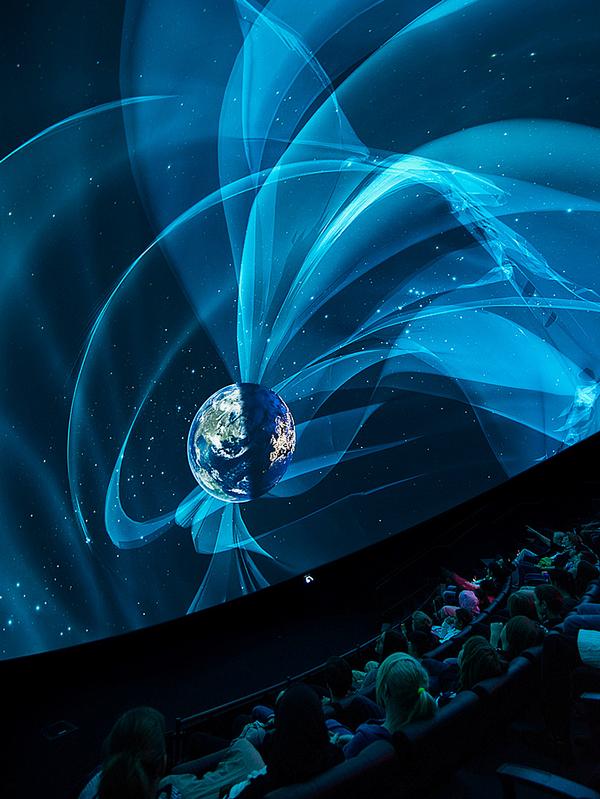
At the Deutsches Museum, Zeiss technology offers a plethora of opportunities. It can show not only illuminated dots, but also images and entire shows, and Lang says even virtual journeys through space are possible. Visitors can cover the 13.7 billion light years to the edges of the visible universe in just 10 minutes, fly by the planets of our solar system, or view the Milky Way from the outside in incredible detail.
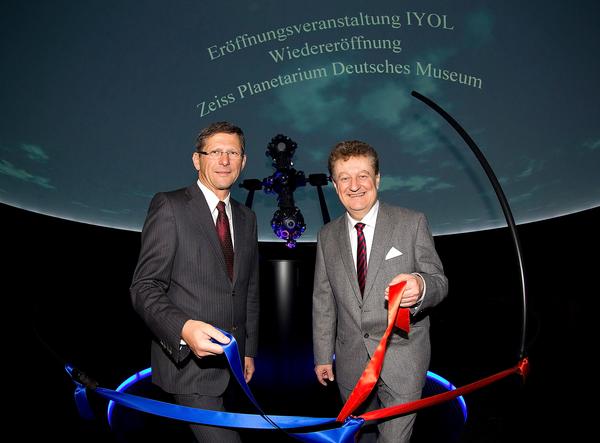
Zeiss CEO Michael Kaschke (left) and Wolfgang Heckl, director general of Deutsches Museum
Sciss Dome visualisation that gives guests lasting memories Sweden’s Sciss has created a new way for experts – whether astronauts, astronomers or neuroscientists – to tell their unique stories live to audiences in dome theatres around the world simultaneously.
“We build these beautiful, modern theatres and we equip them with powerful visualisation capabilities. And we know from past experience that audiences react extremely well to live and interactive visualisations, especially when presented by the very scientists whose data we’re using,” says Staffan Klashed, principal of Sciss, explaining the idea.
The result is Domecasting, a feature inside the company’s software Uniview, which is the beating heart of its Colorspace line of high end hardware and display systems. Domecasting packages data visualisation in a redistributable form, and synchronises presentations and interactions with this data over the internet. The technology uses state synchronisation to ensure the visualisation is the same in all participating theatres.
“Domecasting allows a presenter to broadcast interactive visualisations to multiple dome theatres at the same time,” says Klashed. “The presenter can reach a much larger audience with a single presentation than he or she would by travelling to a particular site, and dome theatres can offer a more exciting and varied type of programming to their audiences.”
In early March, the Adler Planetarium in Chicago, Illinois, hosted an intriguing Domecasting event. Michael E. Brown, the 2012 Kavli Prize Laureate in Astrophysics, delivered a presentation there, entitled Tales from the Outer Solar System. The special event was Domecasted live to three other dome theatres in the US – the planetariums of the Denver Museum of Nature and Science in Colorado, the Peoria Riverfront Museum in Illinois, and the Flandrau Science Center in Tucson, Arizona – meaning the same presentation was given to dome theatres using four completely different display systems, including the true 8K display at the Adler.
Another feature offered by Sciss is Neurotours, a presentation which uses three-dimensional neuroscientific data from scientists to give visitors unusual and thrilling dome-format film experiences, such as wandering through neurons or climbing the surface facets of the cerebral cortex.
“Display systems are growing increasingly powerful. We’ve now seen digital theatre systems that rival the quality of film,” says Klashed. “The area where we really want to excel is when we bring the beauty and power of interactive, live visualisation into these high-end systems. That’s when our theatres become gateways to understanding and appreciating science. That’s when education and entertainment meet and we leave audiences with lasting memories, wanting to come back for more.”
Staffan Klashed
Uniview is a feature-rich astronomical visualization and universal data exploration platform
Sciss theatres become gateways to understanding and appreciating science, says Staffan Klashed
7th sense Behind-the-scenes solution powers creative visions UK-based 7thSense’s Delta Media Server system delivers fully uncompressed media playback for dome displays and is available in a range of hardware and software configurations, enabling the company to support multi-channel display layouts.
Many planetariums worldwide are powered by Delta Media Server, including the Morrison Planetarium at the California Academy of Sciences in the US, Moscow Planetarium in Russia, and the Hayden Planetarium in New York, US. Its technologies have also been supplied to a number of non-planetarium dome projects, such as the National Military Museum in the Netherlands and the Marvel Experience, a dome attraction touring North America.
“What’s unique about Delta is that we’re now able to drive multiple projectors from a single server,” says company director Matt Barton. “In the past, you’d need at least one server per projector, and then another machine to control the other machines. This set-up is still in play for the really high resolution and meaty systems, or those needing advanced production capability, but the new simpler configuration of a single box makes things more affordable and manageable for many venues wanting to play content to their audiences.”
7thSense’s systems come with Full Dome Mode as part of the software package. This enables simple workflow of uncompressed, native fisheye dome masters with full warp, blend, auto-alignment and slicing.
“For content creators, this allows their media to be shown the way it was intended, and with no introduction of compression artefacts, loss of visual quality or detail,” says Barton. “For theatres, this gives them an incredibly reliable, fast, high-performance media solution.”
7thSense recently completed projects at the ShowDome at Our Dynamic Earth in Edinburgh and the National Space Centre in Leicester, both in the UK – each had custom systems with new features and capabilities. The company typically works with and supplies its technologies to specialist integrators, but occasionally works direct with theatres. “A common trend is that many customers come to us with very specific needs and requests, and we often add new features to help the customer achieve what they are after,” says Barton.
7thSense is increasingly seeing 8K 60fps dome displays as content catches up with system potential. The company believes the next step in dome display technology will be making the planetarium experience even more realistic and immersive, encouraging more audience involvement in how data visualisation is shaped.
Matt Barton
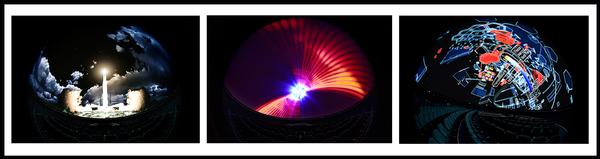
We Are Aliens is a new 360° digital planetarium show from NSC Creative
Photos: NSC Creative
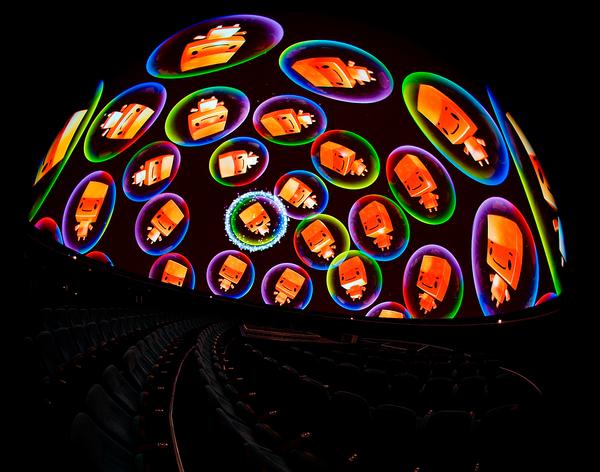
7thSense’s Delta Media Server used with content by NSC Creative, a computer animation studio specialising in immersive fulldome experiences
In a world where imbalance often accumulates quietly, Wildsmith unveils its newest
wellbeing innovation: Silent Loads, an approach designed to meet the needs of modern spa
guests with precision and depth. [more...]
The Spa Life UK Convention returns from 21–23 June 2026 at Whittlebury Park Hotel, Spa &
Golf Resort, bringing together spa managers, directors and owners for two days of focused
education, meaningful connection and commercial insight. [more...]
+ More featured suppliers
COMPANY PROFILES
Immunocologie Skincare
As a cancer survivor, I started Immunocologie to promote skin health, and to do that, I made sure ev [more...]
Omnisens
Rooted in nature and guided by a holistic philosophy, Omnisens' treatments and products are crafted [more...]
Higher resolution displays are enabling the creation of stunning virtual journeys, while the power of visualisations is advancing. We ask what’s new in dome projection technology
By Jason Holland | Published in Attractions Management 2015 issue 2
Interview: Marty Sklar
Retired Disney Legend Marty Sklar
reveals the secrets of Imagineering,
the legacy of the 1964 World’s Fair
and the lessons he learned as
Walt Disney’s “keeper of the keys”
Talking Point: The $100 Barrier
As a Walt Disney World day ticket
enters three-digit territory for
the first time, we ask what this
means for pricing in the sector
Museums: Biomuseo
Panama has opened the world’s first
museum of biodiversity, an ambitious
building by architect Frank Gehry. We
meet the team behind the project
Expos: Food for Thought
Expo Milano 2015 launches in Italy,
aiming to bring the planet’s most
pressing problems to the fore, not least
how to provide food for everybody
Zoos & Aquariums: On the SAFE Side
AZA chair Dennis Pate explains a new
initiative designed to help endangered
animals, and offers some tips from
his world-class Henry Doorly zoo
Promotional feature: IDEATTACK
IDEATTACK is a creative maverick with a
new perspective, bringing custom-made
one-of-a-kind attractions typologies to
a world that needs something di�fferent
Rides: The Ride Makers
In the third part of our series, we look at
the enduring appeal of wooden coasters
Ticketing: Dream Tickets
Ticketing systems are advancing to
improve the guest’s experience and the
operator’s profit. We investigate the
sector’s current and upcoming trends
Sky-Skan Creating crystal clear images for all budget types After pioneering fulldome displays using a pair of then new 4K venue projectors 10 years ago, the next logical step for Sky-Skan was to use more of them to achieve 8K resolution on a dome, according to Glenn Smith, managing director of the US-headquartered company.
“Projectors are more compact today so we can more easily integrate the technology into the dome theatre architecture. As such we can even offer smaller domes an 8K configuration for about the same price as 4K cost a few years ago,” he says.
Austria’s Planetarium Klagenfurt is the first to take advantage, with its 12.5-metre dome theatre reopening with an 8K display based on six Sony GT-100 projectors. 8K dome displays are closer than ever to reaching the visual acuity of the human eye, says Smith, resulting in a sharp, crisp image. Dome theatres are known for movie content, but the real-time visualisation systems that Sky-Skan builds also generate images in the display’s native resolution.
“Our heritage is planetariums and a beautiful starry sky is all the more realistic and impressive in 8K. It draws gasps from our customers when they see it the first time,” says Smith. “The resolution also finally represents a viable alternative to an opto-mechanical star projector for those projects where a realistic night sky is important but perhaps budgets don’t allow for a mix of technologies.”
Very high resolution images can also be displayed, and long, slow zooms can be performed to investigate the smallest of details. With the general public accustomed to high resolutions in devices such as televisions and computers, a dome theatre must provide an experience that exceeds what they can get at home.
Another recent installation fulfilling this objective was at Prague Planetarium, Czech Republic, which has a 23-metre dome. Having installed a 4K system there about four years ago, Sky-Skan was challenged to raise the resolution to 8K by adding four more 4K projectors to the system.
“Prague and Klagenfurt both place a heavy emphasis on astronomy and science education,” he says. “Their new systems allow them to bring in the latest astronomical and scientific data and visualise it on the dome in a setting not possible in a classroom or other environment.”
Both planetariums offer a wide variety of programmes, and host cultural events such as lectures, book readings and concerts, so the display systems also come in handy in providing interesting backdrops and interactivity on these occasions.
In an industry that never stands still, Smith says the next logical step will be a doubling of the visual resolution. “We’re already identifying the challenges and solutions and it won’t be long before we’ll be able to demonstrate a working system.”
Glenn Smith
Zeiss Historic German planetarium lit up by futuristic tech When Munich’s Deutsches Museum celebrated the opening of its new planetarium in late February 2015, it was relying on two unique technologies provided by Zeiss.
The German company installed the high-performance projection system for the 15-metre dome, which holds 160 visitors. It consists of Zeiss’ classical opto-mechanical star projector, Skymaster ZKP4, synchronised with its six channel digital fulldome system, Velvet.
The new system has a lot to live up to – the world’s first projection planetarium went into operation at the Deutsches Museum 90 years ago on 7 May 1925.
“Skymaster is equipped with fibre-optic projectors for the projection of the starry sky, including fixed stars, nebulas, star clusters and other deep sky objects. Each of the thousands of fixed stars and each sky object is provided by one single optical fibre, using LED illumination systems as light sources,” says Wilfried Lang, vice president at Carl Zeiss, Planetarium Division.
The combination of LED and fibre-optics provides a starry sky that’s as natural as possible, because of both the brightness of the stars and the high colour temperature.
“The Velvet fulldome system, due to the absolute black image background, fits ideally to this starry sky avoiding any greyish frame behind the image content.”
Lang says it’s only the patented Velvet projector, with its extremely high on/off contrast ratio (2,500,000:1), that can deliver this performance – a good thing considering the Deutsches Museum will use the dome for teaching astronomy, with four to six public shows per day.
“An advantage we have is the sharpness of the images because of the so-called checkerboard contrast, which is four times higher than standard video projectors,” he says. “That’s why Velvet is able to separate a white from a black pixel with a sharp line in between, aided by our specially developed lenses for this projector.”
The result is that an image with the same number of pixels will appear much sharper with Velvet – a 2K Velvet projector is at least as sharp as any standard 4K projector, Lang says. This means a lower computer capacity can achieve the same result.
At the Deutsches Museum, Zeiss technology offers a plethora of opportunities. It can show not only illuminated dots, but also images and entire shows, and Lang says even virtual journeys through space are possible. Visitors can cover the 13.7 billion light years to the edges of the visible universe in just 10 minutes, fly by the planets of our solar system, or view the Milky Way from the outside in incredible detail.
Zeiss CEO Michael Kaschke (left) and Wolfgang Heckl, director general of Deutsches Museum
Sciss Dome visualisation that gives guests lasting memories Sweden’s Sciss has created a new way for experts – whether astronauts, astronomers or neuroscientists – to tell their unique stories live to audiences in dome theatres around the world simultaneously.
“We build these beautiful, modern theatres and we equip them with powerful visualisation capabilities. And we know from past experience that audiences react extremely well to live and interactive visualisations, especially when presented by the very scientists whose data we’re using,” says Staffan Klashed, principal of Sciss, explaining the idea.
The result is Domecasting, a feature inside the company’s software Uniview, which is the beating heart of its Colorspace line of high end hardware and display systems. Domecasting packages data visualisation in a redistributable form, and synchronises presentations and interactions with this data over the internet. The technology uses state synchronisation to ensure the visualisation is the same in all participating theatres.
“Domecasting allows a presenter to broadcast interactive visualisations to multiple dome theatres at the same time,” says Klashed. “The presenter can reach a much larger audience with a single presentation than he or she would by travelling to a particular site, and dome theatres can offer a more exciting and varied type of programming to their audiences.”
In early March, the Adler Planetarium in Chicago, Illinois, hosted an intriguing Domecasting event. Michael E. Brown, the 2012 Kavli Prize Laureate in Astrophysics, delivered a presentation there, entitled Tales from the Outer Solar System. The special event was Domecasted live to three other dome theatres in the US – the planetariums of the Denver Museum of Nature and Science in Colorado, the Peoria Riverfront Museum in Illinois, and the Flandrau Science Center in Tucson, Arizona – meaning the same presentation was given to dome theatres using four completely different display systems, including the true 8K display at the Adler.
Another feature offered by Sciss is Neurotours, a presentation which uses three-dimensional neuroscientific data from scientists to give visitors unusual and thrilling dome-format film experiences, such as wandering through neurons or climbing the surface facets of the cerebral cortex.
“Display systems are growing increasingly powerful. We’ve now seen digital theatre systems that rival the quality of film,” says Klashed. “The area where we really want to excel is when we bring the beauty and power of interactive, live visualisation into these high-end systems. That’s when our theatres become gateways to understanding and appreciating science. That’s when education and entertainment meet and we leave audiences with lasting memories, wanting to come back for more.”
Staffan Klashed
Uniview is a feature-rich astronomical visualization and universal data exploration platform
Sciss theatres become gateways to understanding and appreciating science, says Staffan Klashed
7th sense Behind-the-scenes solution powers creative visions UK-based 7thSense’s Delta Media Server system delivers fully uncompressed media playback for dome displays and is available in a range of hardware and software configurations, enabling the company to support multi-channel display layouts.
Many planetariums worldwide are powered by Delta Media Server, including the Morrison Planetarium at the California Academy of Sciences in the US, Moscow Planetarium in Russia, and the Hayden Planetarium in New York, US. Its technologies have also been supplied to a number of non-planetarium dome projects, such as the National Military Museum in the Netherlands and the Marvel Experience, a dome attraction touring North America.
“What’s unique about Delta is that we’re now able to drive multiple projectors from a single server,” says company director Matt Barton. “In the past, you’d need at least one server per projector, and then another machine to control the other machines. This set-up is still in play for the really high resolution and meaty systems, or those needing advanced production capability, but the new simpler configuration of a single box makes things more affordable and manageable for many venues wanting to play content to their audiences.”
7thSense’s systems come with Full Dome Mode as part of the software package. This enables simple workflow of uncompressed, native fisheye dome masters with full warp, blend, auto-alignment and slicing.
“For content creators, this allows their media to be shown the way it was intended, and with no introduction of compression artefacts, loss of visual quality or detail,” says Barton. “For theatres, this gives them an incredibly reliable, fast, high-performance media solution.”
7thSense recently completed projects at the ShowDome at Our Dynamic Earth in Edinburgh and the National Space Centre in Leicester, both in the UK – each had custom systems with new features and capabilities. The company typically works with and supplies its technologies to specialist integrators, but occasionally works direct with theatres. “A common trend is that many customers come to us with very specific needs and requests, and we often add new features to help the customer achieve what they are after,” says Barton.
7thSense is increasingly seeing 8K 60fps dome displays as content catches up with system potential. The company believes the next step in dome display technology will be making the planetarium experience even more realistic and immersive, encouraging more audience involvement in how data visualisation is shaped.
Matt Barton
We Are Aliens is a new 360° digital planetarium show from NSC Creative
Photos: NSC Creative
7thSense’s Delta Media Server used with content by NSC Creative, a computer animation studio specialising in immersive fulldome experiences
Global Wellness Day (GWD) will mark its 15th anniversary on Saturday 13 June 2026, with the
theme: #JoyMagenta – a celebration of the healing qualities of simple gestures and activities
that spark joy.
Global luxury hospitality brand, Six Senses, has partnered with longevity healthcare provider,
HUM2N, to launch a clinic at Six Senses London, at The Whiteley.
As part of its first hotel partnership, Mayrlife – the medical health resort company known for its
site in Altaussee, Austria – has launched a day clinic at the Rosewood Vienna.
Premium London health club, KX Chelsea, will imminently unveil its most significant
redevelopment since its launch in 2002 to create an integrated wellness model combining
training, recovery and relaxation.
Rosewood Le Guanahani St Barth, on the northeast coast of Saint Barthélemy in the French
West Indies, is offering a programme of ocean-inspired yoga classes between 8-14 June to
celebrate Global Wellness Day (GWD).
Hotel de France, located on the British Isle of Jersey, has created a wellness retreat package
that includes a hot yoga session that will take place in Jersey Zoo’s butterfly sanctuary.
The Ritz-Carlton, Langkawi, in Malaysia, has revealed a schedule for Global Wellness Day
(GWD) that includes guided rainforest walks, mindful movement and guided coastal meditation
experiences.
Longevitix, a clinical platform for preventive and longevity medicine, has launched its AI-
powered intelligence system to help physicians deliver continuous, personalised longevity-
focused care at scale.
Atmantan Wellness Centre, an integrative wellness destination in Mulshi, near Pune in India, is
expanding its portfolio by adding a new centre in Hyderabad that will launch between 2028 and
2029.
A recent survey by the UK Spa Association (UKSA) into the industry’s approach to cancer care
has revealed that almost half of participating respondents (46 per cent) are unaware that
cancer is a disability and guests with a cancer diagnosis must be given
In a world where imbalance often accumulates quietly, Wildsmith unveils its newest
wellbeing innovation: Silent Loads, an approach designed to meet the needs of modern spa
guests with precision and depth. [more...]
The Spa Life UK Convention returns from 21–23 June 2026 at Whittlebury Park Hotel, Spa &
Golf Resort, bringing together spa managers, directors and owners for two days of focused
education, meaningful connection and commercial insight. [more...]
+ More featured suppliers
COMPANY PROFILES
Immunocologie Skincare As a cancer survivor, I started Immunocologie to promote skin health, and to do that, I made sure ev [more...]