Described as a toucan sitting on the horizon,
Panama has pulled out all the stops to create
the world’s first museum of biodiversity.
We speak to the team who made it happen
By Kath Hudson | Published in Attractions Management 2015 issue 2
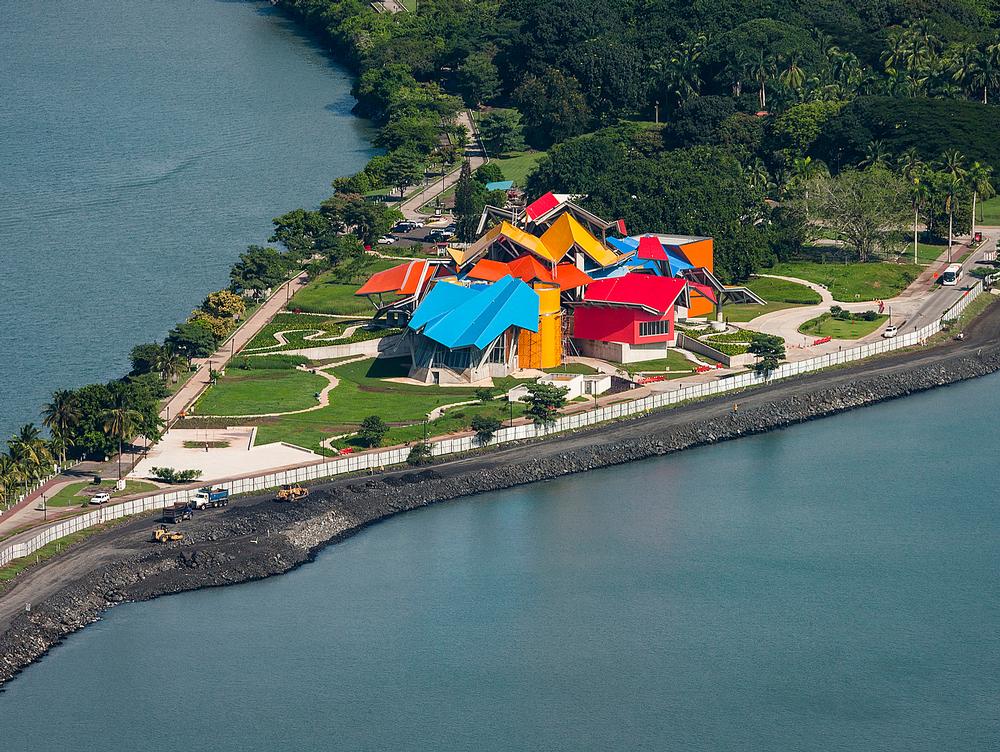
the world’s first museum of biodiversity / PHOTO: Fernando Alda
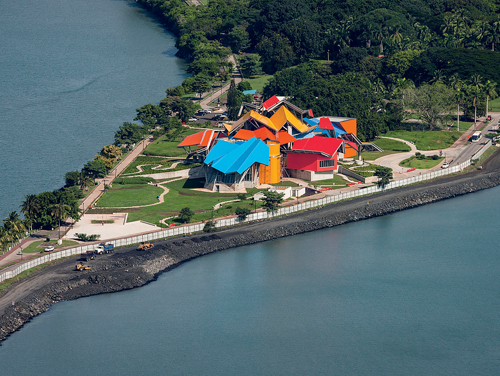
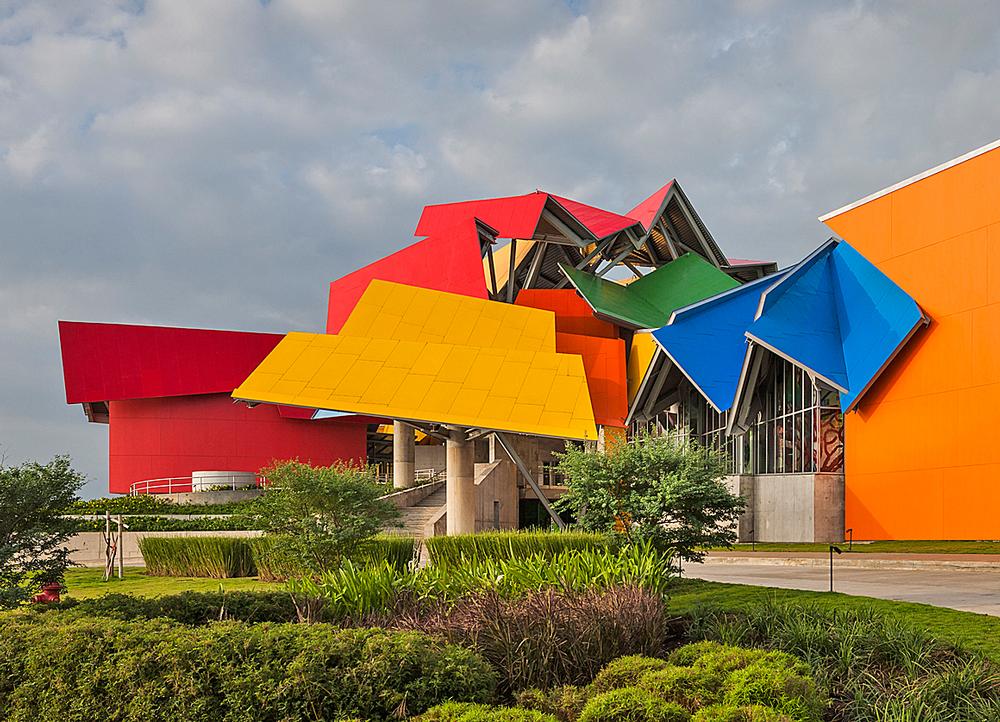
Biomuseo is a piece of statement architecture, rising from the Panama Canal in a concertina of primary colours. Designed by internationally renowned architect Frank Gehry, whose wife is Panamanian, the natural history museum focuses on the importance of the isthmus and its biodiversity.
The scientific content was researched and curated by teams from the Smithsonian Institute and the University of Panama, and the galleries were created by Bruce Mau Design.
Read more from this issue of Spa Business magazine
Interview: Marty Sklar
Retired Disney Legend Marty Sklar
reveals the secrets of Imagineering,
the legacy of the 1964 World’s Fair
and the lessons he learned as
Walt Disney’s “keeper of the keys”
Talking Point: The $100 Barrier
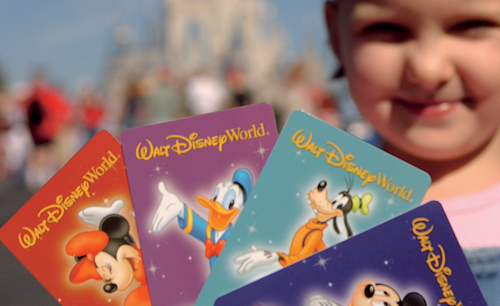
As a Walt Disney World day ticket
enters three-digit territory for
the first time, we ask what this
means for pricing in the sector
Museums: Biomuseo
Panama has opened the world’s first
museum of biodiversity, an ambitious
building by architect Frank Gehry. We
meet the team behind the project
Expos: Food for Thought
Expo Milano 2015 launches in Italy,
aiming to bring the planet’s most
pressing problems to the fore, not least
how to provide food for everybody
Zoos & Aquariums: On the SAFE Side
AZA chair Dennis Pate explains a new
initiative designed to help endangered
animals, and offers some tips from
his world-class Henry Doorly zoo
Promotional feature: IDEATTACK
IDEATTACK is a creative maverick with a
new perspective, bringing custom-made
one-of-a-kind attractions typologies to
a world that needs something di�fferent
Rides: The Ride Makers
In the third part of our series, we look at
the enduring appeal of wooden coasters
Ticketing: Dream Tickets
Ticketing systems are advancing to
improve the guest’s experience and the
operator’s profit. We investigate the
sector’s current and upcoming trends
When was Biomuseo first mooted? Back in 1998, Panama was going to receive a batch of land from the Canal zone, so the government organised a series of workshops to determine how best to incorporate those lands into Panama City.
We knew we wanted an architectural building, so a team of international designers was brought in, including Frank Gehry. He was invited to propose a series of projects along the Canal to be the cherry on top of the cake.
As this was four years after the Guggenheim Bilbao opened, everyone in the world was aware of the power that an architectural masterpiece could have to breathe new life into a city.
Unfortunately the project was shelved the following year when there was a change of government, but at that point the Amador Foundation was formed by Panamanian and foreign businesspeople, who still wanted to bring the project to fruition. They lobbied the new government and eventually convinced them to support it; they have also organised the funding.
What’s the relationship with the Smithsonian Institute? The Smithsonian Institute has had a research base in Panama for 100 years and this has generated most of the content for the exhibits. We worked very closely with both the Smithsonian Institute and the University of Panama and have become the only Smithsonian-affiliated museum outside the US.
What story does Biomuseo tell? The museum aims to be a showcase to bring the scientific knowledge generated in Panama to the general public.
It tells the story of the isthmus of Panama: the different geological processes which made Panama rise out of the ocean. We see Panama as a bridge between two continents, but also as a barrier which split the tropical ocean in two.
We look at the consequences that event had locally, regionally and globally. We look at how Panama changed the world, such as redirecting the Gulf Stream, so Europe has milder winters than North America.
Panama rising caused Africa to change from a continent of forests to one of savannahs. Some palaeontologists believe that this led to the formation of the human race, as primates had to come down from the trees and had to be more gregarious to survive.
How is the story presented? Unlike most science museums, we didn’t have a collection of specimens to put on show. Instead, we decided the museum would be a collection of concepts.
Each gallery tells a story relating to Panama. Instead of exhibit cases we have large murals, sculptures and interactive elements. This approach meant that with every gallery we had to start afresh, because nothing is repeated.
The story is told in large items, which represent large ideas, and are complemented with small, detailed elements which will tell the whole story.
What were the main challenges? The main challenge is the complexity of building a building with North American quality control, but with Panamanian labour. The style in Panama is usually fast and cheap, so a lot of processes took longer because of the learning curve and these delays cost money.
What stage is the museum at now? The first five galleries opened in October and we had more than 60,000 visits in the first six months: 60 per cent of which were from Panama. We’re still fundraising for the final three galleries, which are architectural spaces currently being used for temporary exhibits. They are the most expensive ones, and will house an aquarium.
It is a very expensive project. Was it the right move to be so bold? Thinking big and aiming high are what has made this museum successful.
It’s true that having an architectural masterpiece makes Biomuseo relevant to whole sections of the public who wouldn’t otherwise be interested in biodiversity. The building is the bridge between the science world and the art world. It’s been difficult, but it’s undeniably been worth it.
"Thinking big and aiming high are what has made this museum successful. The building is the bridge between the science world and the art world"
Bruce MauExhibition designerBruce mau design
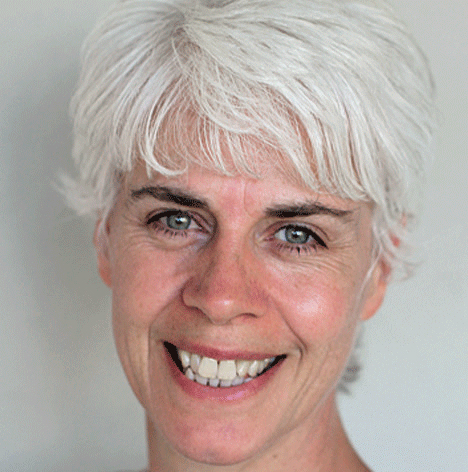
Bruce Mau
How did you get involved with the project? I’ve worked closely with Frank Gehry on several projects. Frank’s wife is Panamanian and one day she handed me a dossier and said: “You have to go to Panama.”
Why did the project appeal to you? Firstly, Frank is always an absolute dream. It’s also a spectacular site, at the entrance to the Panama Canal, with the backdrop of the city. It couldn’t get more impressive. And, this is the most important subject we could address at this moment: biodiversity is the future of life.
The boldness of this project was another draw: the investment it represents for Panama is the equivalent of the US building 63 Getty centres all at once.
How did the design process develop? We started the design process from the inside out and Frank worked from the outside in. In essence, Panama itself is the museum and we are building the lobby. In some parts of the museum, the landscape you are looking at outside is the content.
There was a three part mandate: to educate; to change the way people understand things so they see the world differently; and to protect biodiversity.
I didn’t want to lecture people, but engage and inspire them. Once people are inspired, they learn things. It’s delightful when you get that mechanism going. Panama is full of wonderful stories, such as fish evolving differently in the two oceans and some bird species believing they still live on an island. Our job was to pull out those stories, creating a wonderful experience which inspires you, makes you wonder and then satisfies the wonder.
How were each of the galleries given their own identity? We found the key concepts we wanted people to walk away with and we broke it down to eight stories. If you get the eight ideas, you’ll understand the impact of Panama on the planet and biodiversity.
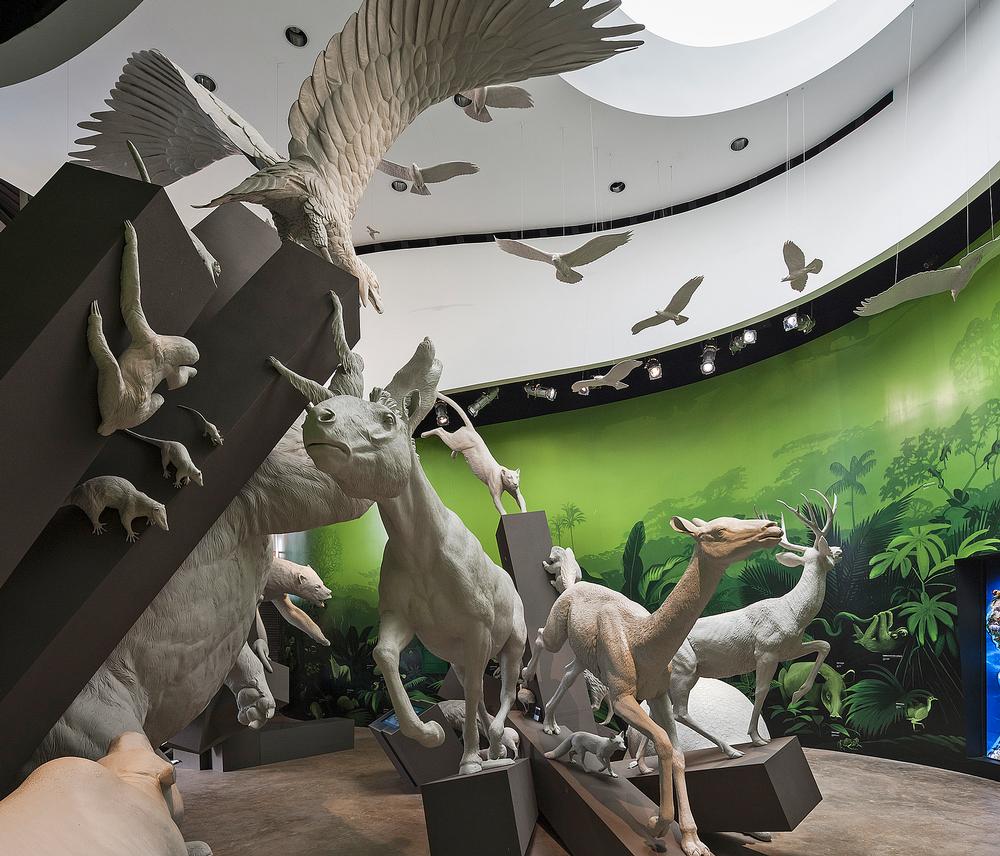
One gallery is the Great Biotic Interchange. When Panama formed it connected two island ecologies. Two islands became one land mass, and one ocean became two. Life from the north went south and life from the south went north.
Some species flourished and others became extinct. That event is still taking place, with slow-moving things like moss, mushrooms and grasses still migrating.
In the gallery we create a stampede, so people walk in and wonder what on earth is going on. We create a state of wonder, then they are ready to absorb information.
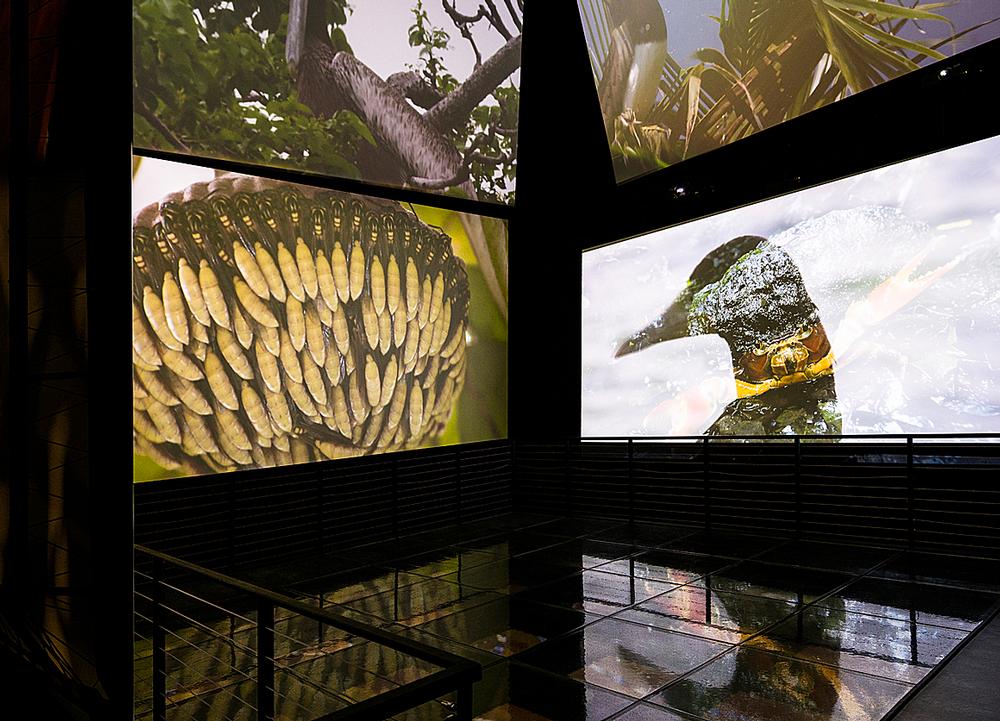
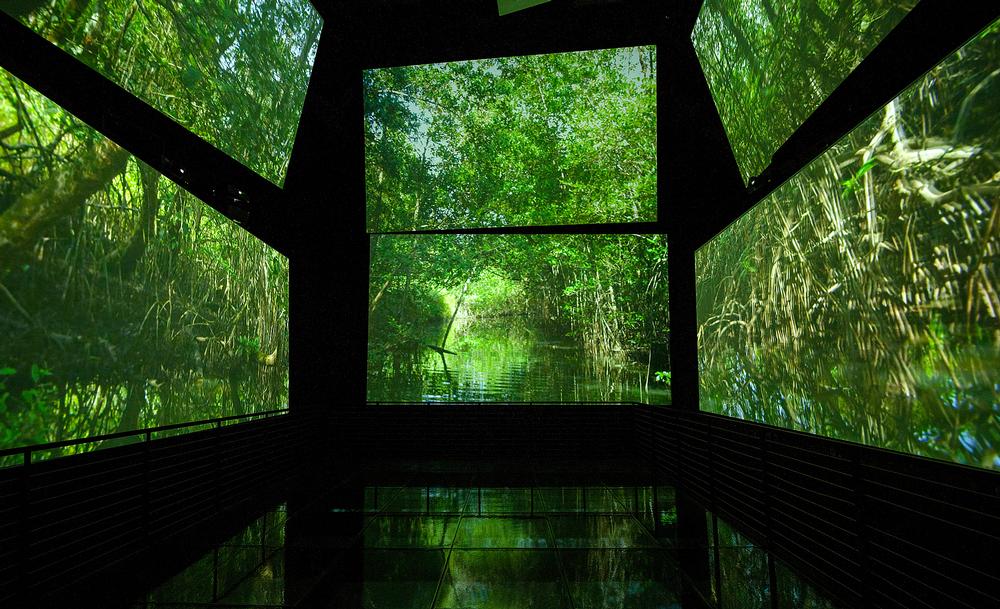
What is your favourite show piece? Panamarama, which is a cube of cinema. Visitors stand on a glass floor, so the cinema is below and all around them. It takes them into the ocean – a whale shark passes underneath – along the shore, to the mangroves, then the jungle, then the canopy and across Panama, showing the range of environments and species. People applaud when they see it. The children go crazy and adults sit on the floor, like kids.
What are you most proud of? It’s an intersection of art, science and design. We had to make a declaration. It couldn’t be a modest building; it had to be something people would see and want to know what it was. Frank made that happen.
Anand DevarajanPartnerGehry Partners, LLP
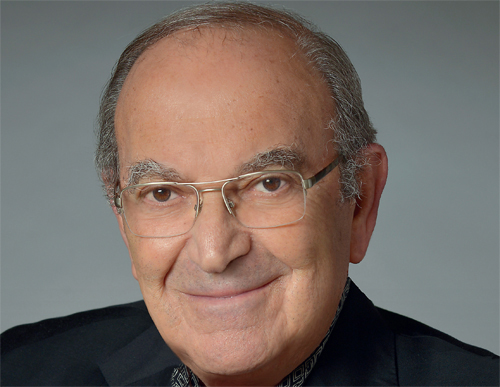
Anand Devarajan
What appealed to Gehry Architects about this project? Frank had a strong tie to Panama through his wife Berta and was intrigued by the various landscapes and cultures within the region. When the client communicated to us the intent of building a museum for Panamanians to highlight the biodiversity of the region and advocating its conservation, the museum’s mission became very interesting to our office. Additionally, the site they had chosen in Amador, overlooking the Panama Canal and Panama City, was incredible and primed for a special project.
Where did the inspiration come from for the architecture? The expression for the architecture emerged as a synthesis of multiple things, including the story lines of the museum’s narrative, a response to the amazing site location and understanding existing built structures in the region.
How does the architecture relate to both Panama and the museum content? The architecture relates to Panama in a series of ways. The colours became a distinctive element that evoked a connection to the vibrant imagery we saw in Panama City on the busses and industrial structures, the built landscape of Colon, as well as the local textiles of the indigenous Indians. The roof shapes work similarly in principle to the naturally ventilated structures built in the local climate – albeit with a geometry that is far more expressive. The volumes and roofs of the museum create views of the dramatic surroundings – the islands beyond Amador, the Bay of Panama and the canal entry, high-rises in Panama City, the bridge of the Americas, as well as the hills beyond.
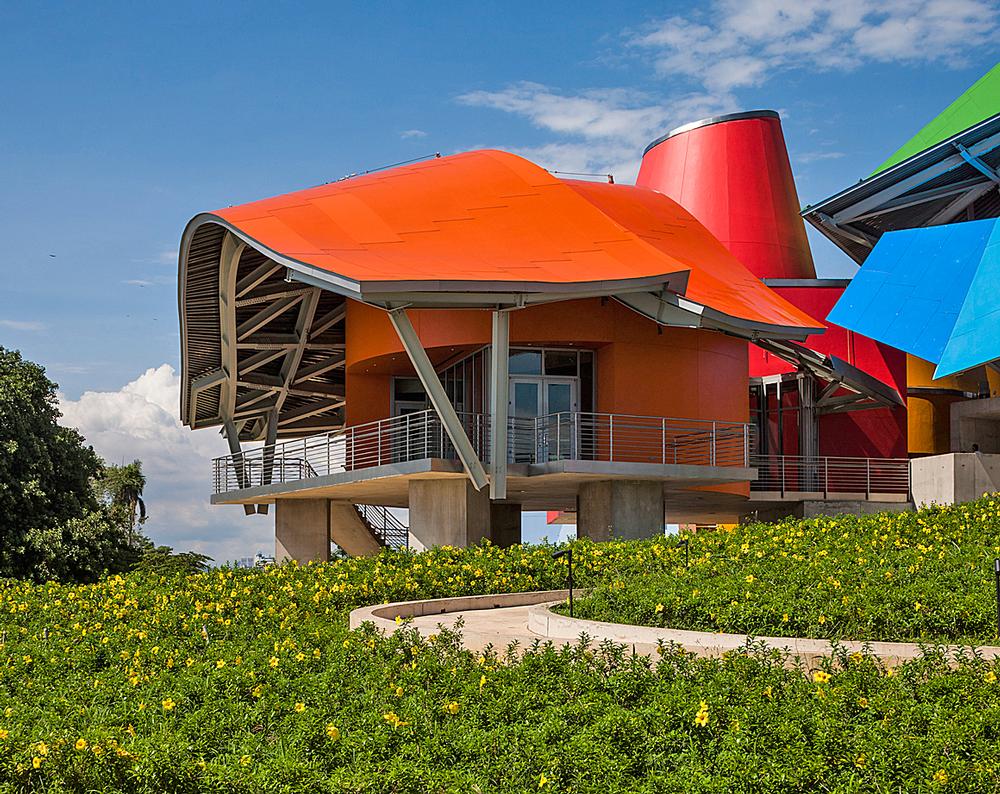
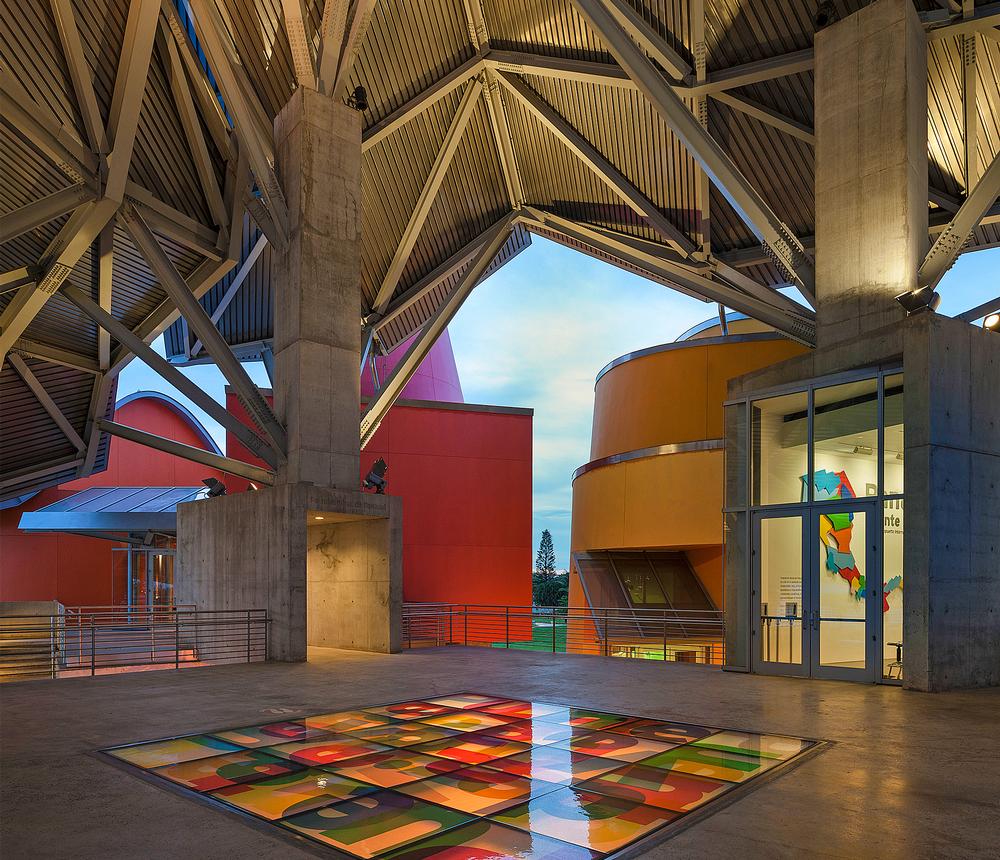
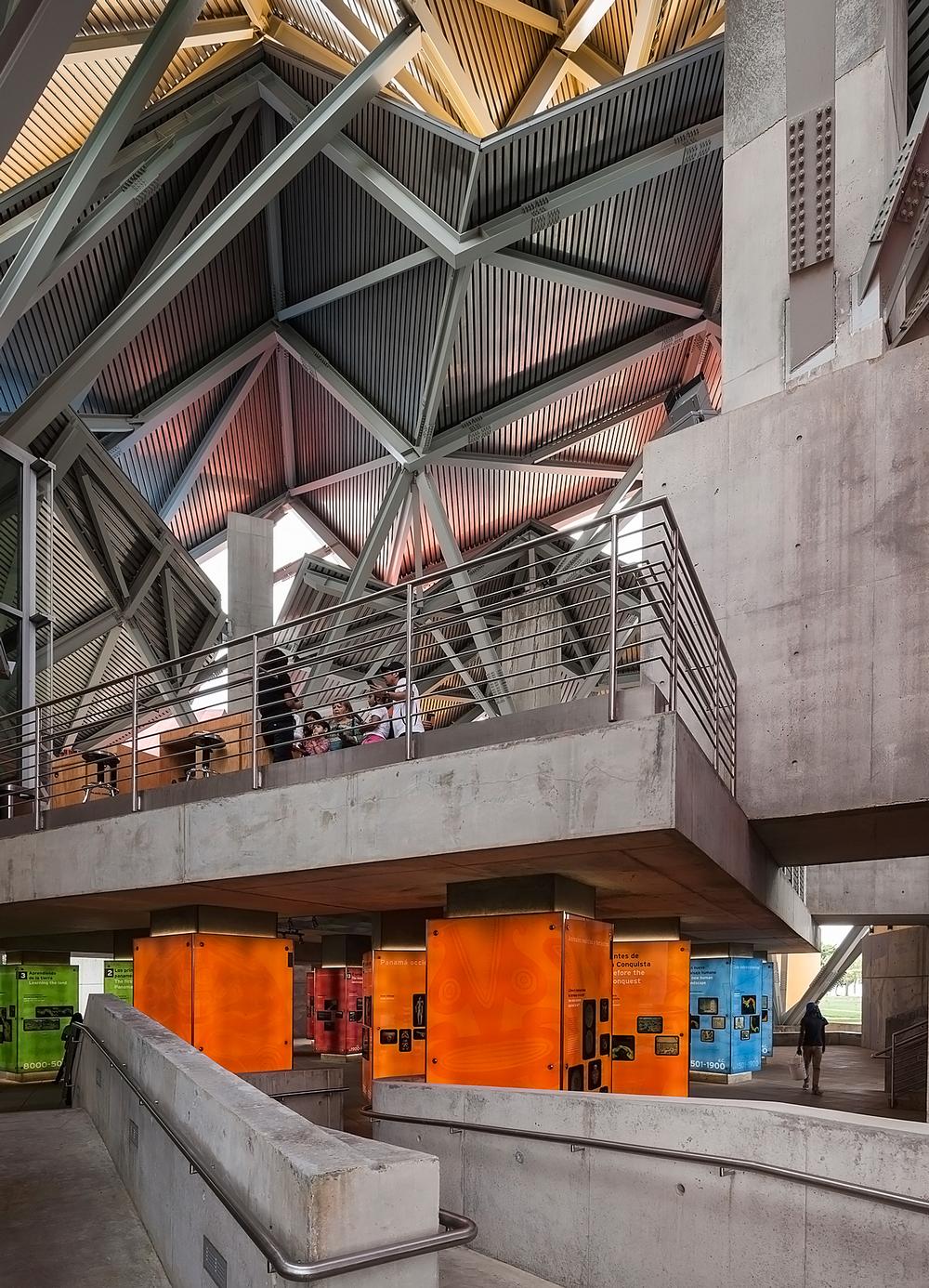
Additionally, the use of corrugated metal roofing, plaster walls, and exposed concrete for the building’s exterior were chosen to relate to local building materials we saw used in Panama City.
We wanted to express the museum’s narrative in the architectural design. Each gallery and programme element took a unique architectural identity on the museum’s exterior – responding to the internal exhibit contents as well as to space programme requirements.
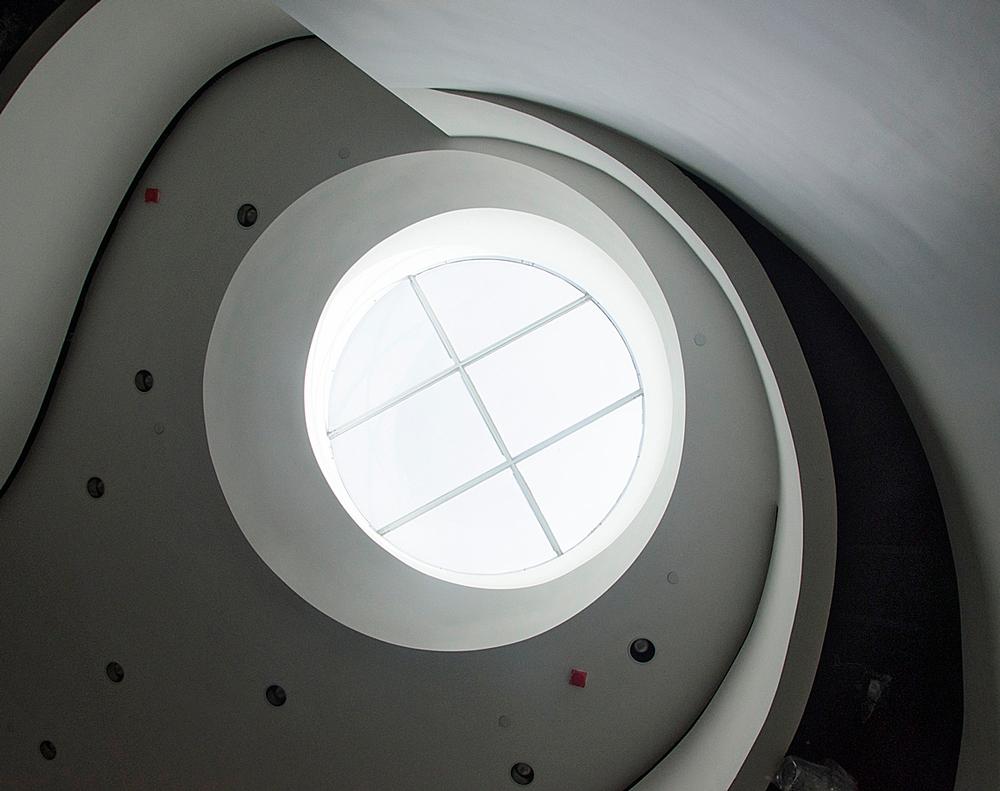
We saw the park and the museum’s setting as its own exhibition element with connections to the narratives of the galleries inside and wanted to blur that interior/exterior distinction. That required that we organise the building to create opportunities for museum visitors to reconnect to their surroundings and ways for landscape elements to engage the central atrium.
What were the challenges with this project? The path to completing the project was very challenging and took a long time. The process and procedures of constructing a project in Panama was very different than what we would expect in other locales. The unique geometry and quality control procedures required a steep learning curve from the team building the project.
Which aspect of the project are you most proud of? One of the key design elements was the atrium. We imagined it as an exhilarating open-air civic space for Panamanians and are pleased about the way the space turned out. The way the exhibition elements knit together with the architecture has been fascinating to see, and it is very pleasing to hear responses from the museum staff about school groups getting excited by and engaged with the concept of biodiversity.
Can you talk us through the design process – did you spend time in Panama and get to know the area and culture before you began? Since Frank had been visiting Panama with his family for many years prior to engaging on the project, he had a good amount of knowledge of the place. The rest of the design team learned about Panama during the process. As with all of our projects, the design process is highly iterative, testing out hundreds of design schemes while homing in on a unique response for the project. During the design process, Gehry Partners and Bruce Mau’s team had a great group of collaborators, such as the Smithsonian Tropical Research Institute and local executive architect Patrick Dillon, who knew the region very well and participated in design decisions.
"The architecture emerged as a synthesis of multiple things, including the story lines of the museum’s narrative and the amazing site location "
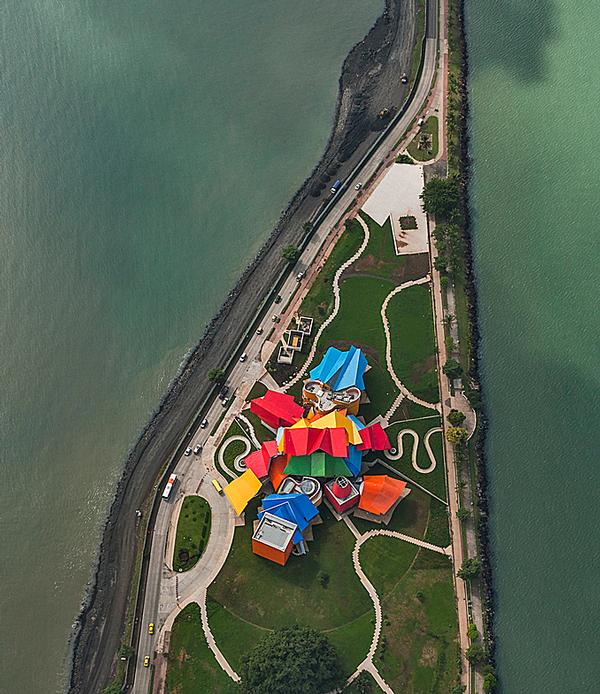
The site of Biomuseo on the Panama Canal. The Canal itself is undergoing an expansion project to double its capacity by 2016
Biomuseo, by architect Frank Gehry, is located on the Amador Causeway at the entrance to the Panama Canal in the Pacific Ocean / PHOTO: Fernando Alda
Biomuseo, by architect Frank Gehry, is located on the Amador Causeway at the entrance to the Panama Canal in the Pacific Ocean / PHOTO: Victoria Murillo
Biomuseo, by architect Frank Gehry, is located on the Amador Causeway at the entrance to the Panama Canal in the Pacific Ocean / PHOTO: Fernando Alda
Biomuseo, by architect Frank Gehry, is located on the Amador Causeway at the entrance to the Panama Canal in the Pacific Ocean / PHOTO: Fernando Alda
The permanent exhibition is titled Panama: Bridge of Life, and consists of eight galleries / PHOTO: Fernando Alda
The Worlds Collide gallery illustrates the exchange of species when the isthmus closed / PHOTO: Fernando Alda
Panamarama is a cube-like cinema that completely immerses the visitor in the experience / PHOTO: Fernando Alda
Corrugated metal roofing, plaster walls and exposed concrete were chosen by Gehry Partners / PHOTO: Fernando Alda
In today’s premium spa environment, every detail shapes the guest experience – right down to
the softness of towels and the freshness of linens. [more...]
Described as a toucan sitting on the horizon,
Panama has pulled out all the stops to create
the world’s first museum of biodiversity.
We speak to the team who made it happen
By Kath Hudson | Published in Attractions Management 2015 issue 2
the world’s first museum of biodiversity / PHOTO: Fernando Alda
Biomuseo is a piece of statement architecture, rising from the Panama Canal in a concertina of primary colours. Designed by internationally renowned architect Frank Gehry, whose wife is Panamanian, the natural history museum focuses on the importance of the isthmus and its biodiversity.
The scientific content was researched and curated by teams from the Smithsonian Institute and the University of Panama, and the galleries were created by Bruce Mau Design.
Read more from this issue of Spa Business magazine
Interview: Marty Sklar
Retired Disney Legend Marty Sklar
reveals the secrets of Imagineering,
the legacy of the 1964 World’s Fair
and the lessons he learned as
Walt Disney’s “keeper of the keys”
Talking Point: The $100 Barrier
As a Walt Disney World day ticket
enters three-digit territory for
the first time, we ask what this
means for pricing in the sector
Museums: Biomuseo
Panama has opened the world’s first
museum of biodiversity, an ambitious
building by architect Frank Gehry. We
meet the team behind the project
Expos: Food for Thought
Expo Milano 2015 launches in Italy,
aiming to bring the planet’s most
pressing problems to the fore, not least
how to provide food for everybody
Zoos & Aquariums: On the SAFE Side
AZA chair Dennis Pate explains a new
initiative designed to help endangered
animals, and offers some tips from
his world-class Henry Doorly zoo
Promotional feature: IDEATTACK
IDEATTACK is a creative maverick with a
new perspective, bringing custom-made
one-of-a-kind attractions typologies to
a world that needs something di�fferent
Rides: The Ride Makers
In the third part of our series, we look at
the enduring appeal of wooden coasters
Ticketing: Dream Tickets
Ticketing systems are advancing to
improve the guest’s experience and the
operator’s profit. We investigate the
sector’s current and upcoming trends
When was Biomuseo first mooted? Back in 1998, Panama was going to receive a batch of land from the Canal zone, so the government organised a series of workshops to determine how best to incorporate those lands into Panama City.
We knew we wanted an architectural building, so a team of international designers was brought in, including Frank Gehry. He was invited to propose a series of projects along the Canal to be the cherry on top of the cake.
As this was four years after the Guggenheim Bilbao opened, everyone in the world was aware of the power that an architectural masterpiece could have to breathe new life into a city.
Unfortunately the project was shelved the following year when there was a change of government, but at that point the Amador Foundation was formed by Panamanian and foreign businesspeople, who still wanted to bring the project to fruition. They lobbied the new government and eventually convinced them to support it; they have also organised the funding.
What’s the relationship with the Smithsonian Institute? The Smithsonian Institute has had a research base in Panama for 100 years and this has generated most of the content for the exhibits. We worked very closely with both the Smithsonian Institute and the University of Panama and have become the only Smithsonian-affiliated museum outside the US.
What story does Biomuseo tell? The museum aims to be a showcase to bring the scientific knowledge generated in Panama to the general public.
It tells the story of the isthmus of Panama: the different geological processes which made Panama rise out of the ocean. We see Panama as a bridge between two continents, but also as a barrier which split the tropical ocean in two.
We look at the consequences that event had locally, regionally and globally. We look at how Panama changed the world, such as redirecting the Gulf Stream, so Europe has milder winters than North America.
Panama rising caused Africa to change from a continent of forests to one of savannahs. Some palaeontologists believe that this led to the formation of the human race, as primates had to come down from the trees and had to be more gregarious to survive.
How is the story presented? Unlike most science museums, we didn’t have a collection of specimens to put on show. Instead, we decided the museum would be a collection of concepts.
Each gallery tells a story relating to Panama. Instead of exhibit cases we have large murals, sculptures and interactive elements. This approach meant that with every gallery we had to start afresh, because nothing is repeated.
The story is told in large items, which represent large ideas, and are complemented with small, detailed elements which will tell the whole story.
What were the main challenges? The main challenge is the complexity of building a building with North American quality control, but with Panamanian labour. The style in Panama is usually fast and cheap, so a lot of processes took longer because of the learning curve and these delays cost money.
What stage is the museum at now? The first five galleries opened in October and we had more than 60,000 visits in the first six months: 60 per cent of which were from Panama. We’re still fundraising for the final three galleries, which are architectural spaces currently being used for temporary exhibits. They are the most expensive ones, and will house an aquarium.
It is a very expensive project. Was it the right move to be so bold? Thinking big and aiming high are what has made this museum successful.
It’s true that having an architectural masterpiece makes Biomuseo relevant to whole sections of the public who wouldn’t otherwise be interested in biodiversity. The building is the bridge between the science world and the art world. It’s been difficult, but it’s undeniably been worth it.
"Thinking big and aiming high are what has made this museum successful. The building is the bridge between the science world and the art world"
Bruce MauExhibition designerBruce mau design
Bruce Mau
How did you get involved with the project? I’ve worked closely with Frank Gehry on several projects. Frank’s wife is Panamanian and one day she handed me a dossier and said: “You have to go to Panama.”
Why did the project appeal to you? Firstly, Frank is always an absolute dream. It’s also a spectacular site, at the entrance to the Panama Canal, with the backdrop of the city. It couldn’t get more impressive. And, this is the most important subject we could address at this moment: biodiversity is the future of life.
The boldness of this project was another draw: the investment it represents for Panama is the equivalent of the US building 63 Getty centres all at once.
How did the design process develop? We started the design process from the inside out and Frank worked from the outside in. In essence, Panama itself is the museum and we are building the lobby. In some parts of the museum, the landscape you are looking at outside is the content.
There was a three part mandate: to educate; to change the way people understand things so they see the world differently; and to protect biodiversity.
I didn’t want to lecture people, but engage and inspire them. Once people are inspired, they learn things. It’s delightful when you get that mechanism going. Panama is full of wonderful stories, such as fish evolving differently in the two oceans and some bird species believing they still live on an island. Our job was to pull out those stories, creating a wonderful experience which inspires you, makes you wonder and then satisfies the wonder.
How were each of the galleries given their own identity? We found the key concepts we wanted people to walk away with and we broke it down to eight stories. If you get the eight ideas, you’ll understand the impact of Panama on the planet and biodiversity.
One gallery is the Great Biotic Interchange. When Panama formed it connected two island ecologies. Two islands became one land mass, and one ocean became two. Life from the north went south and life from the south went north.
Some species flourished and others became extinct. That event is still taking place, with slow-moving things like moss, mushrooms and grasses still migrating.
In the gallery we create a stampede, so people walk in and wonder what on earth is going on. We create a state of wonder, then they are ready to absorb information.
What is your favourite show piece? Panamarama, which is a cube of cinema. Visitors stand on a glass floor, so the cinema is below and all around them. It takes them into the ocean – a whale shark passes underneath – along the shore, to the mangroves, then the jungle, then the canopy and across Panama, showing the range of environments and species. People applaud when they see it. The children go crazy and adults sit on the floor, like kids.
What are you most proud of? It’s an intersection of art, science and design. We had to make a declaration. It couldn’t be a modest building; it had to be something people would see and want to know what it was. Frank made that happen.
Anand DevarajanPartnerGehry Partners, LLP
Anand Devarajan
What appealed to Gehry Architects about this project? Frank had a strong tie to Panama through his wife Berta and was intrigued by the various landscapes and cultures within the region. When the client communicated to us the intent of building a museum for Panamanians to highlight the biodiversity of the region and advocating its conservation, the museum’s mission became very interesting to our office. Additionally, the site they had chosen in Amador, overlooking the Panama Canal and Panama City, was incredible and primed for a special project.
Where did the inspiration come from for the architecture? The expression for the architecture emerged as a synthesis of multiple things, including the story lines of the museum’s narrative, a response to the amazing site location and understanding existing built structures in the region.
How does the architecture relate to both Panama and the museum content? The architecture relates to Panama in a series of ways. The colours became a distinctive element that evoked a connection to the vibrant imagery we saw in Panama City on the busses and industrial structures, the built landscape of Colon, as well as the local textiles of the indigenous Indians. The roof shapes work similarly in principle to the naturally ventilated structures built in the local climate – albeit with a geometry that is far more expressive. The volumes and roofs of the museum create views of the dramatic surroundings – the islands beyond Amador, the Bay of Panama and the canal entry, high-rises in Panama City, the bridge of the Americas, as well as the hills beyond.
Additionally, the use of corrugated metal roofing, plaster walls, and exposed concrete for the building’s exterior were chosen to relate to local building materials we saw used in Panama City.
We wanted to express the museum’s narrative in the architectural design. Each gallery and programme element took a unique architectural identity on the museum’s exterior – responding to the internal exhibit contents as well as to space programme requirements.
We saw the park and the museum’s setting as its own exhibition element with connections to the narratives of the galleries inside and wanted to blur that interior/exterior distinction. That required that we organise the building to create opportunities for museum visitors to reconnect to their surroundings and ways for landscape elements to engage the central atrium.
What were the challenges with this project? The path to completing the project was very challenging and took a long time. The process and procedures of constructing a project in Panama was very different than what we would expect in other locales. The unique geometry and quality control procedures required a steep learning curve from the team building the project.
Which aspect of the project are you most proud of? One of the key design elements was the atrium. We imagined it as an exhilarating open-air civic space for Panamanians and are pleased about the way the space turned out. The way the exhibition elements knit together with the architecture has been fascinating to see, and it is very pleasing to hear responses from the museum staff about school groups getting excited by and engaged with the concept of biodiversity.
Can you talk us through the design process – did you spend time in Panama and get to know the area and culture before you began? Since Frank had been visiting Panama with his family for many years prior to engaging on the project, he had a good amount of knowledge of the place. The rest of the design team learned about Panama during the process. As with all of our projects, the design process is highly iterative, testing out hundreds of design schemes while homing in on a unique response for the project. During the design process, Gehry Partners and Bruce Mau’s team had a great group of collaborators, such as the Smithsonian Tropical Research Institute and local executive architect Patrick Dillon, who knew the region very well and participated in design decisions.
"The architecture emerged as a synthesis of multiple things, including the story lines of the museum’s narrative and the amazing site location "
The site of Biomuseo on the Panama Canal. The Canal itself is undergoing an expansion project to double its capacity by 2016
Biomuseo, by architect Frank Gehry, is located on the Amador Causeway at the entrance to the Panama Canal in the Pacific Ocean / PHOTO: Fernando Alda
Biomuseo, by architect Frank Gehry, is located on the Amador Causeway at the entrance to the Panama Canal in the Pacific Ocean / PHOTO: Victoria Murillo
Biomuseo, by architect Frank Gehry, is located on the Amador Causeway at the entrance to the Panama Canal in the Pacific Ocean / PHOTO: Fernando Alda
Biomuseo, by architect Frank Gehry, is located on the Amador Causeway at the entrance to the Panama Canal in the Pacific Ocean / PHOTO: Fernando Alda
The permanent exhibition is titled Panama: Bridge of Life, and consists of eight galleries / PHOTO: Fernando Alda
The Worlds Collide gallery illustrates the exchange of species when the isthmus closed / PHOTO: Fernando Alda
Panamarama is a cube-like cinema that completely immerses the visitor in the experience / PHOTO: Fernando Alda
Corrugated metal roofing, plaster walls and exposed concrete were chosen by Gehry Partners / PHOTO: Fernando Alda
Global Wellness Day (GWD) will mark its 15th anniversary on Saturday 13 June 2026, with the
theme: #JoyMagenta – a celebration of the healing qualities of simple gestures and activities
that spark joy.
Global luxury hospitality brand, Six Senses, has partnered with longevity healthcare provider,
HUM2N, to launch a clinic at Six Senses London, at The Whiteley.
As part of its first hotel partnership, Mayrlife – the medical health resort company known for its
site in Altaussee, Austria – has launched a day clinic at the Rosewood Vienna.
Premium London health club, KX Chelsea, will imminently unveil its most significant
redevelopment since its launch in 2002 to create an integrated wellness model combining
training, recovery and relaxation.
Rosewood Le Guanahani St Barth, on the northeast coast of Saint Barthélemy in the French
West Indies, is offering a programme of ocean-inspired yoga classes between 8-14 June to
celebrate Global Wellness Day (GWD).
Hotel de France, located on the British Isle of Jersey, has created a wellness retreat package
that includes a hot yoga session that will take place in Jersey Zoo’s butterfly sanctuary.
The Ritz-Carlton, Langkawi, in Malaysia, has revealed a schedule for Global Wellness Day
(GWD) that includes guided rainforest walks, mindful movement and guided coastal meditation
experiences.
Longevitix, a clinical platform for preventive and longevity medicine, has launched its AI-
powered intelligence system to help physicians deliver continuous, personalised longevity-
focused care at scale.
Atmantan Wellness Centre, an integrative wellness destination in Mulshi, near Pune in India, is
expanding its portfolio by adding a new centre in Hyderabad that will launch between 2028 and
2029.
A recent survey by the UK Spa Association (UKSA) into the industry’s approach to cancer care
has revealed that almost half of participating respondents (46 per cent) are unaware that
cancer is a disability and guests with a cancer diagnosis must be given
In today’s premium spa environment, every detail shapes the guest experience – right down to
the softness of towels and the freshness of linens. [more...]