The global wellness economy has grown by 10.6 per cent, according to data from the latest Global Wellness Economy Monitor. Ophelia Yeung highlights the key findings from recent studies
By Ophelia Yeung | Published in Spa Business 2017 issue 1
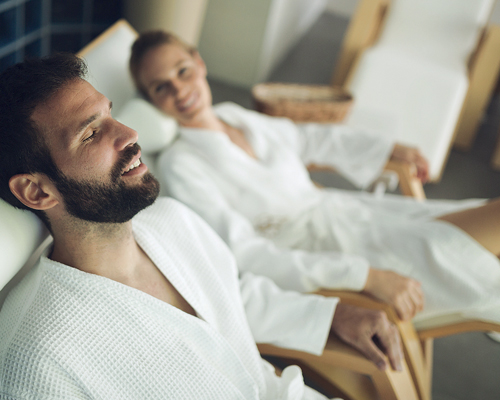
Rising disposable income and an emerging global middle class are helping to fuel the growth in spa and wellness / shutterstock
The latest figures unveiled in the 2016 Global Wellness Economy Monitor show that the global spa and thermal/mineral springs industries continue to grow and evolve with consumer preferences in a dynamic wellness economy. The current and future state of the wellness economy is strong, propelled by consumer and demographic trends that are fuelling increased spending on both health and wellbeing.
Research study 1
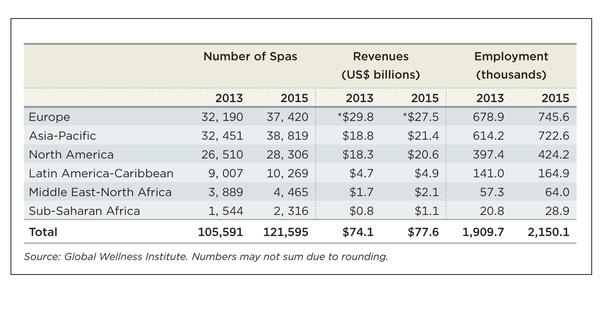
The spa economy The Global Wellness Institute estimates that there were 121,595 spas operating around the world in 2015, earning US$77.6bn (€70.1bn, £50.8bn) in revenue and employing more than 2.1 million workers. When measured in US dollars, industry revenue has expanded by only 2.3 per cent annually since 2013 (adding US$3.5bn over the period 2013-2015).
However, revenue growth was a phenomenal 11.9 per cent annually from 2013-2015 when the figure is reported in Euros (growing from €56.0bn to €70.1bn). The difference in these growth rates is due to the significant appreciation of the US dollar against the Euro during this time. So to grasp the scale of the industry’s growth, it might be easier to note the addition of 16,005 spas to the global market and the 237,424 new workers who joined the industry since 2013.
The largest growth in the number of spas and revenues occurred in the hotel/resort spas category. This is because most 4-star properties and many 3-star properties have been adding spa services as they have quickly become an amenity expected by guests, even at the mid-tier level. In many of the mature spa markets, the growth in the number of spas reflects the addition of spas to existing hotel/resort properties as much or more than openings of entirely new properties. This trend is also decreasing the average size of a spa, as those targeting the mid-tier market tend to be smaller than the flagship spas in higher-end properties.
While Europe continues to lead in overall spa revenues, Asia-Pacific boasts the greatest number of spa establishments and also added the most new spas from 2013-2015. Not surprisingly, China led the charge, while other emerging markets such as India, Indonesia, Vietnam, and Thailand continued to expand. In the mature markets in North America and Europe, spas have continued to grow in number and revenues (when expressed in local currencies). Meanwhile, Africa, the Middle East, and Latin America also showed robust growth, fuelled by a rising middle class with more disposable income. However, security concerns have put a damper on growth in several Middle Eastern and North African countries.
The solid spa market growth rates should not mask the challenges faced by many spas today. Even with an expanding customer base, existing spas are faced with rising operating costs, shortages of skilled labour, and competition from both new spas and non-spa entities.
At the same time, spas need to navigate a complex landscape in which consumers demand value, quality, specialisation, one-stop convenience, authenticity, differentiation, evidence, and results.
We project spa facility revenues will rise at a 6 per cent annual rate over the next few years, reaching an estimated US$104bn (€99.4bn, £84.7bn) by 2020. The industry is likely to employ 2.8 million workers by then, and will need an additional 400,000 trained spa therapists and 70,000 experienced spa managers and directors by that time in order to accommodate this growth.
Spa growth also drives a broader spa economy, which encompasses not just spas themselves, but also other sectors that support and enable spa businesses, such as spa education, consulting, capital investment, associations, media, and events. These related sectors added US$21.0bn (€20bn, £17bn) on top of the US$77.6bn (€74.2bn, £63.2bn) spa revenues, to create a US$98.6bn (94.2bn, £80.3bn) global spa economy.
Research study 2
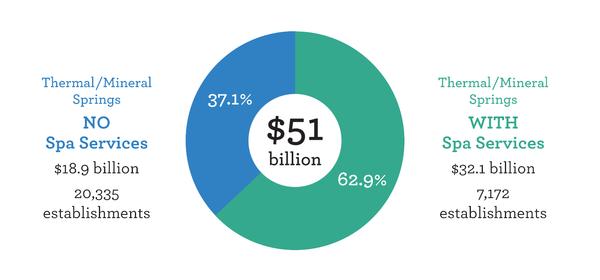
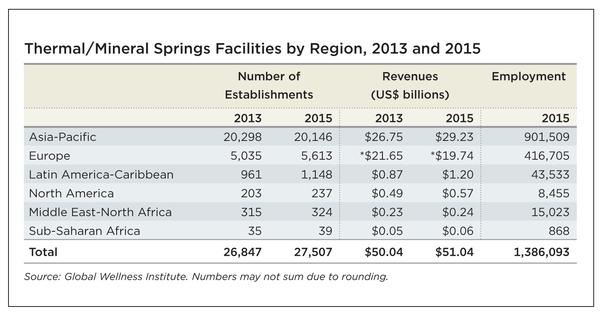
Thermal/mineral springs In 2015, we estimate there were 27,507 establishments built around thermal/mineral springs for wellness, recreational, and therapeutic purposes. These facilities are located in 109 countries and earned US$51.0bn (€46.1bn, £33.4bn) in revenues in 2015. Our research indicates that there is rapidly rising consumer, investor, and government interest in springs-based activities, with most establishments experiencing solid growth in both attendance and revenues. Measured in US dollars, the industry added $1bn in revenues from 2013-2015 (growing from US$50.0bn in 2013 to US$51.0bn in 2015); however, this modest growth trend is deceptive because it is dampened by the recent currency fluctuations. The areas with the largest thermal/mineral springs industries – especially Europe and Japan – saw major currency depreciation against the US dollar from 2013-2015, and so the revenue growth rates in these countries were much higher in local currency than in US dollars. Converting industry revenues to Euros, the thermal/mineral springs industry grew by a robust 10.4 per cent annually between 2013-2015 – from €37.9bn in 2013 to €46.1bn in 2015.
Most of the world’s thermal/mineral springs industry is concentrated in Asia-Pacific and Europe (94 per cent of establishments and 96 per cent of industry revenues). Japan alone, with its estimated 17,328 onsen, is home to nearly two-thirds of all establishments. But because of their typically small size, they earn less revenues than China’s hot springs resorts (numbering 2,200). Other top markets include many European countries with long-standing traditions of using thermal/mineral waters for therapeutic purposes. The decline in government subsidies for bathing as cure is driving many businesses to invest in better facilities to attract a younger, self-paying clientele.
The world’s thermal/mineral springs establishments include a mix of rustic, traditional bathing facilities; hot springs resorts; hotels with thermal water bathing; thermal waterparks; and thermal/mineral water-based sanatoria/health resorts. Not surprisingly, establishments that offer value-added spa services (eg, massage, facials, hydrotherapy, other treatments) earn much higher revenues than those that offer bathing only. Springs that offer such services (about a quarter of them) tend to be more developed and higher-end, and they account for nearly two-thirds of the industry’s revenues.
Overall, the thermal/mineral springs industry is positioned for rising investment and growth, as consumers increasingly seek out the healing and relaxing properties of water and nature. We project industry revenues to grow at 4.8 per cent annually from 2015-2020, driven by rising consumer interest. We estimate that there are at least three dozen new international-scale thermal/mineral springs projects and major refurbishments/renovations slated to open over the next few years in multiple markets – Japan, New Zealand, Italy, Latvia, Morocco, Brazil, the United States, and many others. Many countries are also including thermal/mineral springs as a major pillar in their wellness tourism marketing and development strategies, such as Greece, Turkey, China, Japan, Chile, and Uruguay, among others.
The wellness economy The wellness economy encompasses industries that enable consumers to incorporate wellness activities and lifestyles into their daily lives. In addition to spas and thermal/mineral springs, the GWI provides original data for the size of the global wellness tourism industry, workplace wellness, and wellness real estate. These five industries, combined with five other wellness sectors we measure using secondary sources, comprise the global wellness economy, a US$3.7tr (€3.5tr, £3.0tr) market in 2015.
The wellness economy now represents more than 5 per cent of global economic output, and it is almost half the size of global health expenditures, which reached US$7.6tr (€7.3tr, £6.2tr) in 2014. From 2013-2015, the wellness economy grew by 10.6 per cent (from US$3.4tr to US$3.7tr), while during the same period, the global economy shrank by -3.6 per cent.
Wellness economy growth is robust and resilient because it is positioned at the intersection of several major global trends: rising disposable incomes; the emerging global middle class; the mounting global health crisis; growing interest in travel, authenticity, and new experiences; and an emerging collective consciousness about the wellbeing of people and the planet.
Opportunities are particularly strong for businesses and sectors that aim to help people integrate wellness into their daily lives, instead of thinking of it as a luxury activity. As more people around the world turn to wellness-focused activities and lifestyles to mitigate their mounting stress and deteriorating health, we project that spas, thermal/mineral springs, and other wellness sectors will continue expanding at a healthy pace – faster than global GDP growth – in the coming years.
Read more from this issue of Spa Business magazine
Interview: Jeremy McCarthy
Mandarin Oriental’s group director
of spa and wellness discusses mental
wellness, spas and technology
Promotional feature: Beautyworld Middle East
Set to take place May 14-16, 2017 in Dubai, Beautyworld Middle East is billed as “three days to rediscover wellness and shake up the industry.”
Promotional feature: ESPA
ESPA has been a leader in the field of therapeutic skincare and luxury spa design and management for 25 years. Founder Susan Harmsworth explains how the company’s recent brand evolution will make ESPA even more relevant to the future of wellness
Promotional feature: Riceforce
Rice Force is set to make further inroads into the spa market in 2017 with the
launch of its new aromatic oils and treatment protocol
Promotional feature: Oakworks
Oakworks’ new Masters’ Collection range, which will consist of over 15 models by the end of 2017, has been designed to offer spa operators the ultimate in modern styling, with solutions and functionality that address each spa’s practical needs
Spa Facilities by Region, 2013 and 2015 * Note that the decline in US$ revenues for Europe from 2013-2015 is due to the significant appreciation of the US dollar against the Euro and other major European currencies, and not an actual decline in the market. When converted to Euros, Europe’s spa revenues grew from €22.7b in 2013 to €24.9b in 2015.
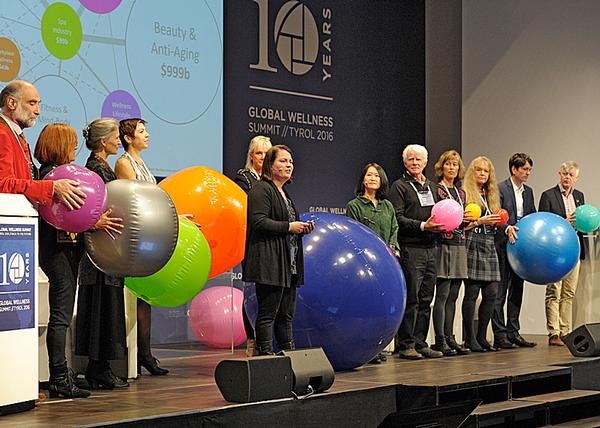
Presenting the data At the Global Wellness Summit, different sized balls are used to visually represent the 10 sectors that make up the US$3.7tr global wellness economy
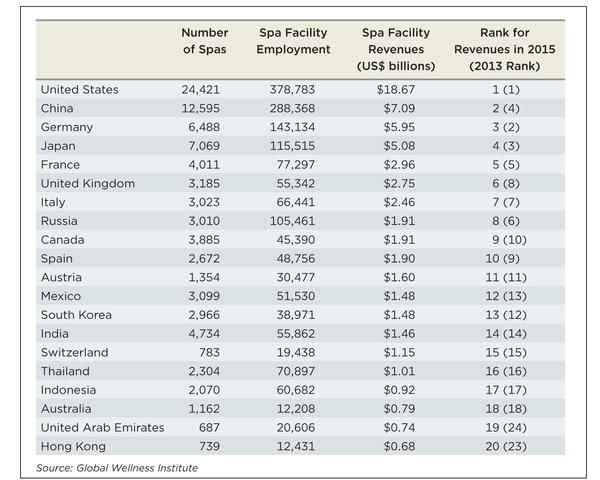
Top Twenty Spa Markets, 2015
Thermal/Mineral Springs
Thermal/Mineral Springs Facilities by Region, 2013 and 2015 * Note that the decline in US$ revenues for Europe from 2013-2015 is due to the significant appreciation of the US dollar against the Euro and other major European currencies, and not an actual decline in the market. When converted to Euros, Europe’s thermal/mineral springs revenues grew from €16.5 billion in 2013 to €17.9 billion in 2015.
Ophelia Yeung
Ophelia Yeung is a senior research fellow at the Global Wellness Institute Twitter: @Global_GWI
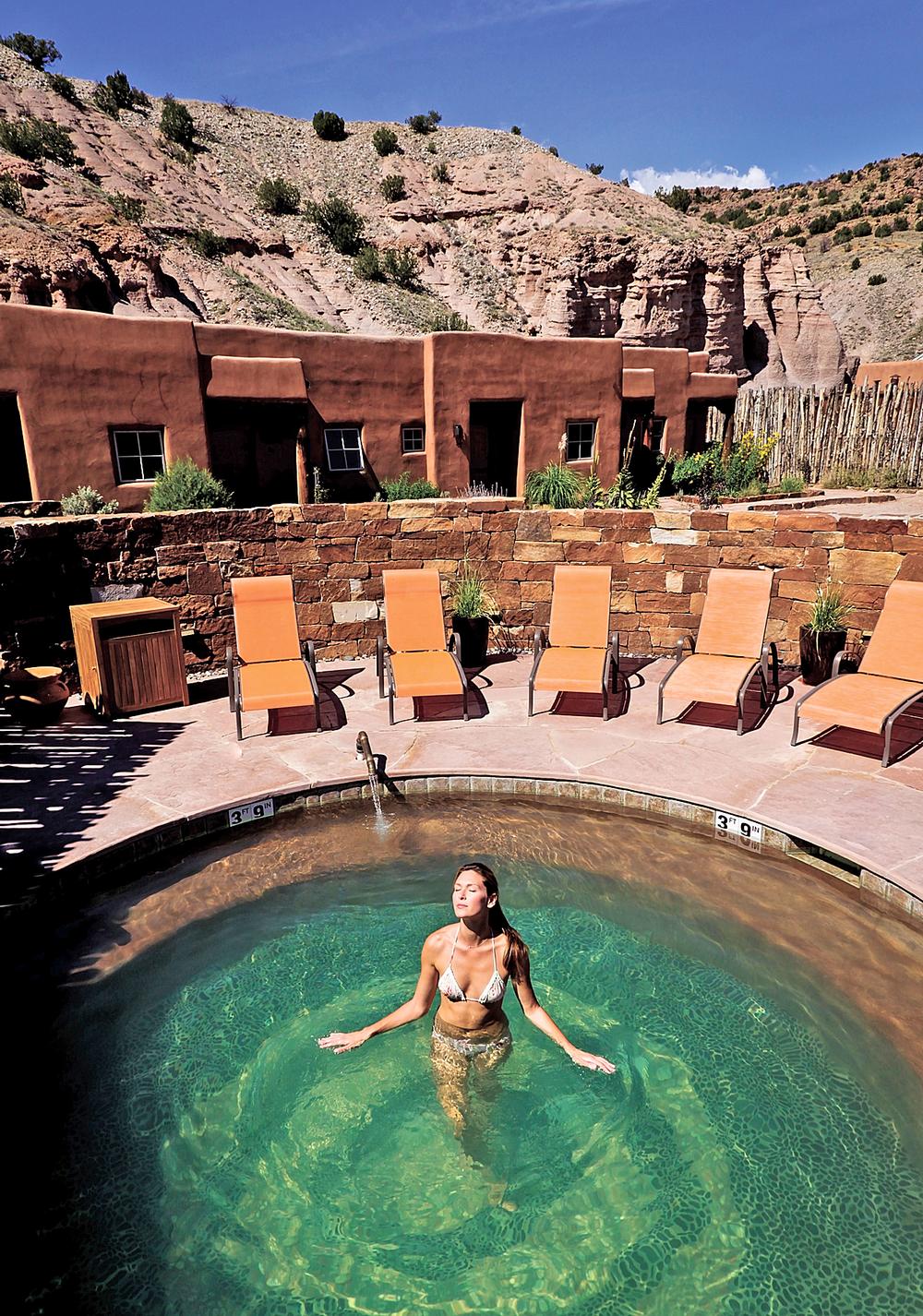
Ojo Caliente in New Mexico, US, is one of 27,507 estimated thermal and mineral springs facilities worldwide.
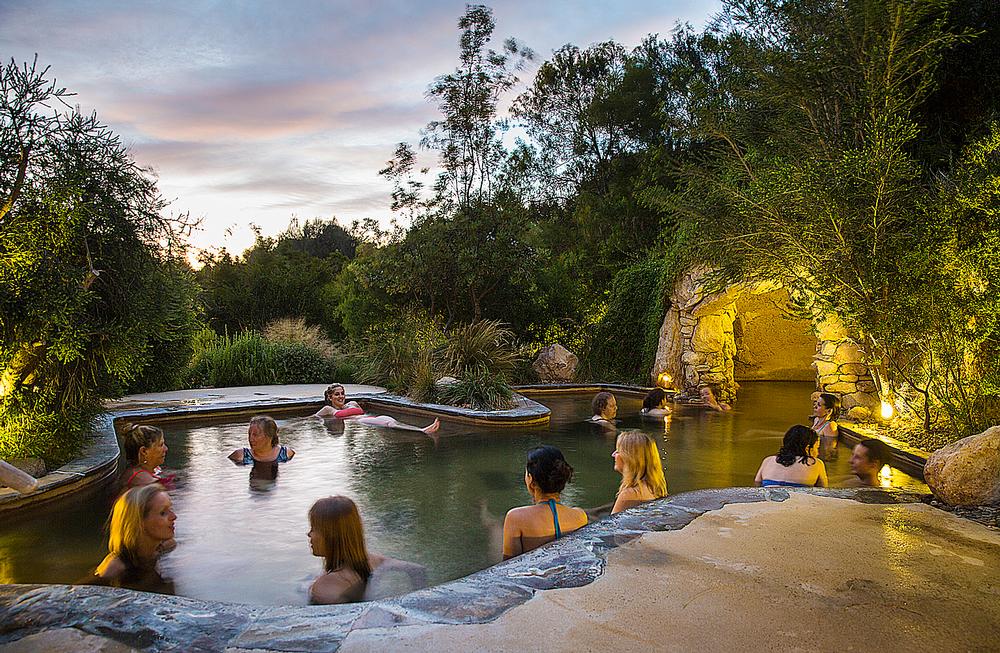
The thermal/mineral springs industry is positioned for rising investment and growth, as consumers seek out the healing properties of water
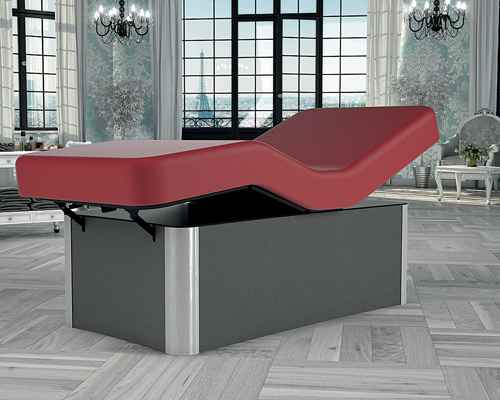
Le Atelier by C.O.D.E. doesn't offer a standard bespoke service, it provides a highly
customised approach to designing massage beds and loungers in high-end wellness
environments. [more...]
The global wellness economy has grown by 10.6 per cent, according to data from the latest Global Wellness Economy Monitor. Ophelia Yeung highlights the key findings from recent studies
By Ophelia Yeung | Published in Spa Business 2017 issue 1
Rising disposable income and an emerging global middle class are helping to fuel the growth in spa and wellness / shutterstock
The latest figures unveiled in the 2016 Global Wellness Economy Monitor show that the global spa and thermal/mineral springs industries continue to grow and evolve with consumer preferences in a dynamic wellness economy. The current and future state of the wellness economy is strong, propelled by consumer and demographic trends that are fuelling increased spending on both health and wellbeing.
Research study 1
The spa economy The Global Wellness Institute estimates that there were 121,595 spas operating around the world in 2015, earning US$77.6bn (€70.1bn, £50.8bn) in revenue and employing more than 2.1 million workers. When measured in US dollars, industry revenue has expanded by only 2.3 per cent annually since 2013 (adding US$3.5bn over the period 2013-2015).
However, revenue growth was a phenomenal 11.9 per cent annually from 2013-2015 when the figure is reported in Euros (growing from €56.0bn to €70.1bn). The difference in these growth rates is due to the significant appreciation of the US dollar against the Euro during this time. So to grasp the scale of the industry’s growth, it might be easier to note the addition of 16,005 spas to the global market and the 237,424 new workers who joined the industry since 2013.
The largest growth in the number of spas and revenues occurred in the hotel/resort spas category. This is because most 4-star properties and many 3-star properties have been adding spa services as they have quickly become an amenity expected by guests, even at the mid-tier level. In many of the mature spa markets, the growth in the number of spas reflects the addition of spas to existing hotel/resort properties as much or more than openings of entirely new properties. This trend is also decreasing the average size of a spa, as those targeting the mid-tier market tend to be smaller than the flagship spas in higher-end properties.
While Europe continues to lead in overall spa revenues, Asia-Pacific boasts the greatest number of spa establishments and also added the most new spas from 2013-2015. Not surprisingly, China led the charge, while other emerging markets such as India, Indonesia, Vietnam, and Thailand continued to expand. In the mature markets in North America and Europe, spas have continued to grow in number and revenues (when expressed in local currencies). Meanwhile, Africa, the Middle East, and Latin America also showed robust growth, fuelled by a rising middle class with more disposable income. However, security concerns have put a damper on growth in several Middle Eastern and North African countries.
The solid spa market growth rates should not mask the challenges faced by many spas today. Even with an expanding customer base, existing spas are faced with rising operating costs, shortages of skilled labour, and competition from both new spas and non-spa entities.
At the same time, spas need to navigate a complex landscape in which consumers demand value, quality, specialisation, one-stop convenience, authenticity, differentiation, evidence, and results.
We project spa facility revenues will rise at a 6 per cent annual rate over the next few years, reaching an estimated US$104bn (€99.4bn, £84.7bn) by 2020. The industry is likely to employ 2.8 million workers by then, and will need an additional 400,000 trained spa therapists and 70,000 experienced spa managers and directors by that time in order to accommodate this growth.
Spa growth also drives a broader spa economy, which encompasses not just spas themselves, but also other sectors that support and enable spa businesses, such as spa education, consulting, capital investment, associations, media, and events. These related sectors added US$21.0bn (€20bn, £17bn) on top of the US$77.6bn (€74.2bn, £63.2bn) spa revenues, to create a US$98.6bn (94.2bn, £80.3bn) global spa economy.
Research study 2
Thermal/mineral springs In 2015, we estimate there were 27,507 establishments built around thermal/mineral springs for wellness, recreational, and therapeutic purposes. These facilities are located in 109 countries and earned US$51.0bn (€46.1bn, £33.4bn) in revenues in 2015. Our research indicates that there is rapidly rising consumer, investor, and government interest in springs-based activities, with most establishments experiencing solid growth in both attendance and revenues. Measured in US dollars, the industry added $1bn in revenues from 2013-2015 (growing from US$50.0bn in 2013 to US$51.0bn in 2015); however, this modest growth trend is deceptive because it is dampened by the recent currency fluctuations. The areas with the largest thermal/mineral springs industries – especially Europe and Japan – saw major currency depreciation against the US dollar from 2013-2015, and so the revenue growth rates in these countries were much higher in local currency than in US dollars. Converting industry revenues to Euros, the thermal/mineral springs industry grew by a robust 10.4 per cent annually between 2013-2015 – from €37.9bn in 2013 to €46.1bn in 2015.
Most of the world’s thermal/mineral springs industry is concentrated in Asia-Pacific and Europe (94 per cent of establishments and 96 per cent of industry revenues). Japan alone, with its estimated 17,328 onsen, is home to nearly two-thirds of all establishments. But because of their typically small size, they earn less revenues than China’s hot springs resorts (numbering 2,200). Other top markets include many European countries with long-standing traditions of using thermal/mineral waters for therapeutic purposes. The decline in government subsidies for bathing as cure is driving many businesses to invest in better facilities to attract a younger, self-paying clientele.
The world’s thermal/mineral springs establishments include a mix of rustic, traditional bathing facilities; hot springs resorts; hotels with thermal water bathing; thermal waterparks; and thermal/mineral water-based sanatoria/health resorts. Not surprisingly, establishments that offer value-added spa services (eg, massage, facials, hydrotherapy, other treatments) earn much higher revenues than those that offer bathing only. Springs that offer such services (about a quarter of them) tend to be more developed and higher-end, and they account for nearly two-thirds of the industry’s revenues.
Overall, the thermal/mineral springs industry is positioned for rising investment and growth, as consumers increasingly seek out the healing and relaxing properties of water and nature. We project industry revenues to grow at 4.8 per cent annually from 2015-2020, driven by rising consumer interest. We estimate that there are at least three dozen new international-scale thermal/mineral springs projects and major refurbishments/renovations slated to open over the next few years in multiple markets – Japan, New Zealand, Italy, Latvia, Morocco, Brazil, the United States, and many others. Many countries are also including thermal/mineral springs as a major pillar in their wellness tourism marketing and development strategies, such as Greece, Turkey, China, Japan, Chile, and Uruguay, among others.
The wellness economy The wellness economy encompasses industries that enable consumers to incorporate wellness activities and lifestyles into their daily lives. In addition to spas and thermal/mineral springs, the GWI provides original data for the size of the global wellness tourism industry, workplace wellness, and wellness real estate. These five industries, combined with five other wellness sectors we measure using secondary sources, comprise the global wellness economy, a US$3.7tr (€3.5tr, £3.0tr) market in 2015.
The wellness economy now represents more than 5 per cent of global economic output, and it is almost half the size of global health expenditures, which reached US$7.6tr (€7.3tr, £6.2tr) in 2014. From 2013-2015, the wellness economy grew by 10.6 per cent (from US$3.4tr to US$3.7tr), while during the same period, the global economy shrank by -3.6 per cent.
Wellness economy growth is robust and resilient because it is positioned at the intersection of several major global trends: rising disposable incomes; the emerging global middle class; the mounting global health crisis; growing interest in travel, authenticity, and new experiences; and an emerging collective consciousness about the wellbeing of people and the planet.
Opportunities are particularly strong for businesses and sectors that aim to help people integrate wellness into their daily lives, instead of thinking of it as a luxury activity. As more people around the world turn to wellness-focused activities and lifestyles to mitigate their mounting stress and deteriorating health, we project that spas, thermal/mineral springs, and other wellness sectors will continue expanding at a healthy pace – faster than global GDP growth – in the coming years.
Read more from this issue of Spa Business magazine
Interview: Jeremy McCarthy
Mandarin Oriental’s group director
of spa and wellness discusses mental
wellness, spas and technology
Promotional feature: Beautyworld Middle East
Set to take place May 14-16, 2017 in Dubai, Beautyworld Middle East is billed as “three days to rediscover wellness and shake up the industry.”
Promotional feature: ESPA
ESPA has been a leader in the field of therapeutic skincare and luxury spa design and management for 25 years. Founder Susan Harmsworth explains how the company’s recent brand evolution will make ESPA even more relevant to the future of wellness
Promotional feature: Riceforce
Rice Force is set to make further inroads into the spa market in 2017 with the
launch of its new aromatic oils and treatment protocol
Promotional feature: Oakworks
Oakworks’ new Masters’ Collection range, which will consist of over 15 models by the end of 2017, has been designed to offer spa operators the ultimate in modern styling, with solutions and functionality that address each spa’s practical needs
Spa Facilities by Region, 2013 and 2015 * Note that the decline in US$ revenues for Europe from 2013-2015 is due to the significant appreciation of the US dollar against the Euro and other major European currencies, and not an actual decline in the market. When converted to Euros, Europe’s spa revenues grew from €22.7b in 2013 to €24.9b in 2015.
Presenting the data At the Global Wellness Summit, different sized balls are used to visually represent the 10 sectors that make up the US$3.7tr global wellness economy
Top Twenty Spa Markets, 2015
Thermal/Mineral Springs
Thermal/Mineral Springs Facilities by Region, 2013 and 2015 * Note that the decline in US$ revenues for Europe from 2013-2015 is due to the significant appreciation of the US dollar against the Euro and other major European currencies, and not an actual decline in the market. When converted to Euros, Europe’s thermal/mineral springs revenues grew from €16.5 billion in 2013 to €17.9 billion in 2015.
Ophelia Yeung
Ophelia Yeung is a senior research fellow at the Global Wellness Institute Twitter: @Global_GWI
Ojo Caliente in New Mexico, US, is one of 27,507 estimated thermal and mineral springs facilities worldwide.
The thermal/mineral springs industry is positioned for rising investment and growth, as consumers seek out the healing properties of water
Global Wellness Day (GWD) marked its 15th anniversary on Saturday 13 June 2026, with the
theme: #JoyMagenta – a celebration of the healing qualities of simple gestures and activities
that spark joy.
Global luxury hospitality brand, Six Senses, has partnered with longevity healthcare provider,
HUM2N, to launch a clinic at Six Senses London, at The Whiteley.
As part of its first hotel partnership, Mayrlife – the medical health resort company known for its
site in Altaussee, Austria – has launched a day clinic at the Rosewood Vienna.
Premium London health club, KX Chelsea, will imminently unveil its most significant
redevelopment since its launch in 2002 to create an integrated wellness model combining
training, recovery and relaxation.
Rosewood Le Guanahani St Barth, on the northeast coast of Saint Barthélemy in the French
West Indies, is offering a programme of ocean-inspired yoga classes between 8-14 June to
celebrate Global Wellness Day (GWD).
Hotel de France, located on the British Isle of Jersey, has created a wellness retreat package
that includes a hot yoga session that will take place in Jersey Zoo’s butterfly sanctuary.
The Ritz-Carlton, Langkawi, in Malaysia, has revealed a schedule for Global Wellness Day
(GWD) that includes guided rainforest walks, mindful movement and guided coastal meditation
experiences.
Longevitix, a clinical platform for preventive and longevity medicine, has launched its AI-
powered intelligence system to help physicians deliver continuous, personalised longevity-
focused care at scale.
Atmantan Wellness Centre, an integrative wellness destination in Mulshi, near Pune in India, is
expanding its portfolio by adding a new centre in Hyderabad that will launch between 2028 and
2029.
Le Atelier by C.O.D.E. doesn't offer a standard bespoke service, it provides a highly
customised approach to designing massage beds and loungers in high-end wellness
environments. [more...]