The renown spa at the Dolder
Grand in Zurich is one of the best
in the industry and is serving
as a destination spa for hotel
guests and an urban spa
for local city visitors
By Katie Barnes | Published in Spa Business 2012 issue 2
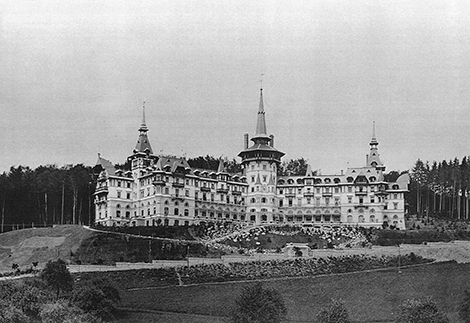
The resort dates back to 1899 and was a ‘curhaus’ focusing on health and relaxation
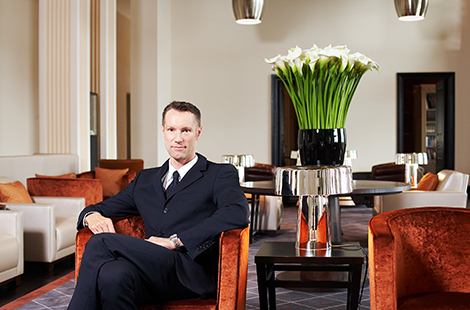
There aren’t many hotel general mangers who ‘get’ spas. It’s a common challenge convincing the head of the hotel about the value a spa brings. Not so at the Dolder Grand in Zurich, Switzerland. Managing director Thomas Schmid says: “The spa’s an important revenue stream, but, it’s more than that, it’s a PR tool and people are drawn to us because of the it.” He’s also a fan of treatments, albeit the less fussy ones, he says: “It’s the touch that’s important but I’m not so keen when it gets complicated.”
It’s fitting then that Schmid should head up a resort which has one of the most renowned spas in the industry – one that’s had spa professionals and spa-goers flocking to it since its opening in April 2008 following a chf440m (us$481m, €366m, £297m) transformation of the entire property (see p60).
Curhaus roots Schmid has had a career in spa resorts, having previously worked as assistant general manager at the Bad Ragaz mineral and healing spa in Switzerland. He started at the old Grand Hotel Dolder in 2003 and was keenly involved in its four-year overhaul, he says: “it was a once in a lifetime job to be involved in the closing of a hotel and the planning and reopening of a new one.”
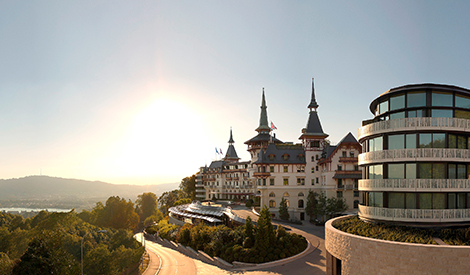
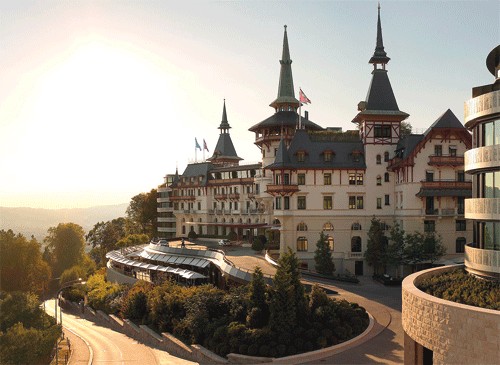
Originally opened in 1899 on a hill overlooking the city, Grand Hotel Dolder was a ‘curhaus’ where locals escaped for rest, active leisure and the feeling of being close to nature. “This history of health and wellness was the reason for adding a spa,” says Schmid. “With fresh air and trees, the destination was made for this and people expect it.”
With the idea that a spa would be a major feature – not just an afterthought or squashed into a basement – Schmid began extensive travels to research spas from Japan, Brazil and New York to those in major European cities. Careful thought was also put into choosing US-based spa specialist Sylvia Sepielli, who owns the SPAd consultancy and has created leading spas worldwide including the Pangkor Laut Spa Village in Malaysia (see sb05/2 p108). “It was important to have someone who would be prepared to compromise, but who could also bring something unique and new,” says Schmid.
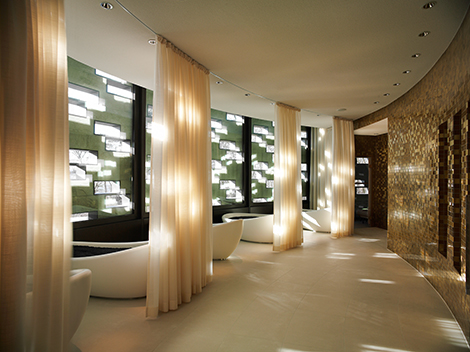
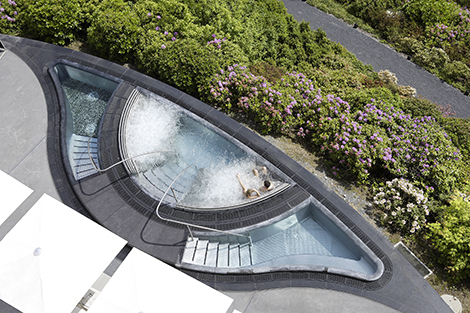
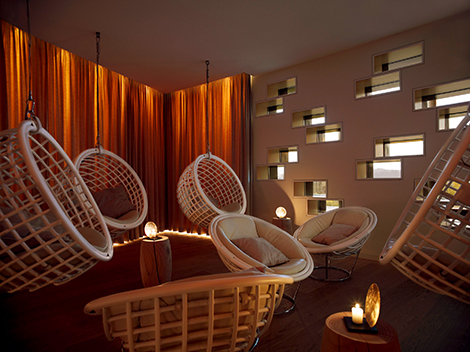
European and Asian influences Situated in one of two new wings, the beautiful 4,000sq m (43,055sq ft) Dolder Grand Spa offers an impressive, well thought out range of facilities. These include 18 treatment rooms and two suites with beds by Gharieni, a relaxation room, and male and female wet areas with a variety of thermal experiences by Klafs. There’s a generous-sized swimming pool, plus indoor and outdoor whirlpools – the latter featuring stunning views over Zurich – and a chillout room, an aqua zone flanked by a steamroom, a snow room and samarium. In addition, there’s a fitness suite as well as two exercise studios, a hair salon, a library, a meditation room, and a café and shop.
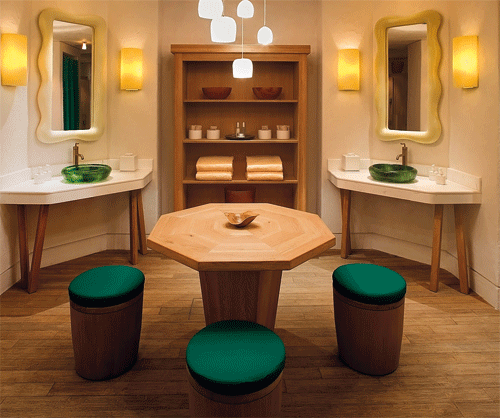
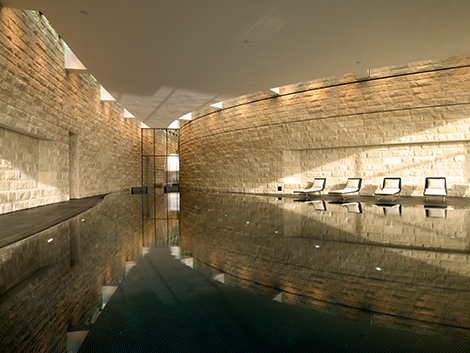
The spa’s sensuous design has been influenced by European and Japanese cultures. Eastern touches include kotatsu footbaths with simulated currents and pebble surfaces. There are also five sunaburos – tubs filled with fine, heated pebbles, which you just melt into – custom-designed for the spa by Klafs. Yet step into the swimming pool that’s surrounded by huge, curved stone walls and you feel as if you’ve been transported deep into the heart of a Swiss gorge.
The east meets west theme continues with the treatment menu which has European, Swiss and Japanese therapies such as bamboo shiatsu. Product houses include European brands such as La Prairie, Kerstin Florian and Horst Kirchberger make-up. The Japanese range Kenzola didn’t sell well, however, and has recently been replaced with the German organic and natural skincare line Amala (see p62).
Spa director, Jann Hess says: “The design sets our spa apart. It’s really special.” He also says the spa is on-trend with its medical wellness offering. Down the corridor from the spa, the medical clinic is run in conjunction with local doctors and specialises in aesthetic dermatology and laser services, anti-ageing and preventative medicine and plastic surgery consultation. Aimed at hotel guests, the services, Hess admits, could be more popular and this is something he’ll be focusing on in the future.
Destination and urban Another vision for the Dolder Grand Spa was “to create an urban spa and destination spa,” says Schmid. “I really wanted to have a place where someone could come for a quick treatment like a nail polish, but at the same time offer enough interest to cater for someone staying for one or two weeks – I think this makes us stand out from competitors”. And figures – collected using the Reservation Assistant software system by TAC – show there’s an even split between local customers and hotel guests using the spa.
One group of local users are 220 spa and fitness membership holders, with the rest coming on day spa packages costing chf250 (us$273, €208, £169) Monday through Friday and chf380 (us$416, €316, £257) Saturday to Sunday. Only day guests on packages, rather than those booking a one-off treatment, have access to the spa facilities to avoid over-crowding.
At 30-35 per cent, the capture rate is high: although that number includes guest just using the facilities as well as having treatments. Hess says: “The key to attracting guests is having a large variety of treatments and rituals. Also the hotel’s main reservation department is good at upselling.”
A graduate from the Lucerne Hotel School, Hess joined the Dolder Grand two months after its reopening in 2008 and says one of the biggest learning curves for him was understanding how his team of 25 therapists approach the guests. “My background is in food and beverage and that’s a lot faster paced – the waiters and kitchen staff spend only a minimal time with customers. It’s different in a spa, the approach has to be softer. But what makes it the most challenging is knowing if the therapists execute the treatments to our [high] standards or just do them their own way. We’re constantly asking for guest feedback to check.”
There’s also a strong in-house therapist training programme – with quarterly evaluations carried out by the treatment manager and assistant treatment manager.
Key performance indicators The spa is viewed as an independent profit centre at Dolder Grand and the goal is for it to contribute 20 per cent of total revenues.
For Hess, one of the most important benchmarks is the average revenue per treatment which sits at chf190 (us$208, €158, £128) as well as the retail/treatment revenue split which at 25-30 per cent for retail is at the top end of industry performance. “We treat retail as another part of the service we offer guests, therapists hand-write recommendations after the treatment and provide extra consultation if necessary. They get between 5-15 per cent commission, but we also have standard training in sales, plus tuition from the product houses four times a year.”
After four years, Schmid is happy with the with how the spa’s performing. “At the beginning we thought 18 treatment rooms might have been too much, but now there are some weekends when we’re fully booked. Also, it’s taken us this time to train enough therapists in our high quality treatments to reach this capacity – and over four years we’ve also built up a pool of therapists who we can call on an ad-hoc basis to cope with those big days.”
The simple things With the resort and spa still relatively new, Schmid says there are no developments in the pipeline. The biggest challenge he sees, however, is maintaining quality of service. He says: “It’s easy to change design and keep the physical offer fresh, so the focus has to be on quality and it’s my role to guide people to make sure they notice the simple things that matter.” An independent hotel, Dolder Grand has a team of four people solely focused on standards and training – “this is quite amazing as we’re not a large chain,” Schmid adds. “And it really is about noticing every detail – being specific about the attitude of staff, teaching them how they could do something better or in a different way.”
It’s perhaps not surprising then that Schmid is driven by people – both guests and staff – and understanding their different needs. For Hess, the motivation is “seeing the spa grow – it’s fantastic to see what’s happened over the last four years and I’m excited about the future.”
SWISS operates 35 daily flights from the UK to Switzerland and worldwide. Fares start at £89 return, including taxes. Details: +44 (0)845 601 0956, www.swiss.com/uk.
Read more from this issue of Spa Business magazine
View contents of Spa Business 2012 issue 2
Ask an expert...: overbuilding
Are large, extravagant spas and treatment rooms really sustainable? Or is it time to wise up about spa design? Katie Barnes reports
Interview: Darrell Metzger
Destination Resorts is creating world-class tourist developments in Malaysia on behalf of the government. Jennifer Harbottle speaks to the man heading it all up
Spa management training: The learning curve – part one
On the eve of a new GSWS study into the state of spa management training globally, we launch a three-part series to delve into our industry’s educational offering and operational needs. Rhianon Howells gets studying
US Hotel spa research: Closer look
Leonor Stanton analyses the findings from PKF’s latest Trends® in the Hotel Spa Industry study and gets the reaction of top spa professionals
Profile: Susie Ellis
SpaFinder Inc president and the face of the Global Spa & Wellness Summit talks to Rhianon Howells about the art of uncovering up-and-coming industry trends, ethics and the importance of innovation
Resort Spa: Dual purpose
Switzerland’s renown Dolder Grand Spa has an offering to satisfy its onsite, longer-staying guests as well as local day spa customers. Katie Barnes pays a visit to this standout facility
Design: Jean-Michel Gathy
The owner of Asia-based design company Denniston has worked on some of the world’s leading spas and resorts. Jennifer Harbottle finds out about his passion for creativity
Samui spotlight:
The second most popular Thai island has been transformed from a backpackers haven to a luxury lifestyle destination with a number of new five-star spa resorts. Neena Dhillon reports
Middle East benchmarks: Peaks & Troughs
Leonor Stanton reviews hotel spa performance in Lebanon, Jordan and Doha following the 2011 benchmark surveys recently released by PwC in the Middle East
Online wellness gaming: Game Changer
Scoreboards, socialisation, challenges, rewards and feedback – the compelling components of online gaming could be key to getting people to become healthy says Susie Ellis
Kuwait focus: Cue Kuwait
The first in a two-part series on the Kuwaiti spa market by Kate Cracknell focuses on the spa-goers in the capital and the new Six Senses Spa at the Hotel Missoni
Research: Happiness
Older adults who are the most content and have a more positive outlook are likely to live longer according to a new study based on 3,800 participants
Dolder Grand history The Dolder Grand Hotel & Curhaus opened in 1899. Heinrich Hürlimann, already the owner of the nearby Dolder Waldhaus hotel, commissioned Basel architect Jacques Gros to design a hotel in the Swiss rustic style popular at the time. Significant alterations took place in the 1920s and 1960s when a 60-bedroom extension was added to the 220-bedroom property.
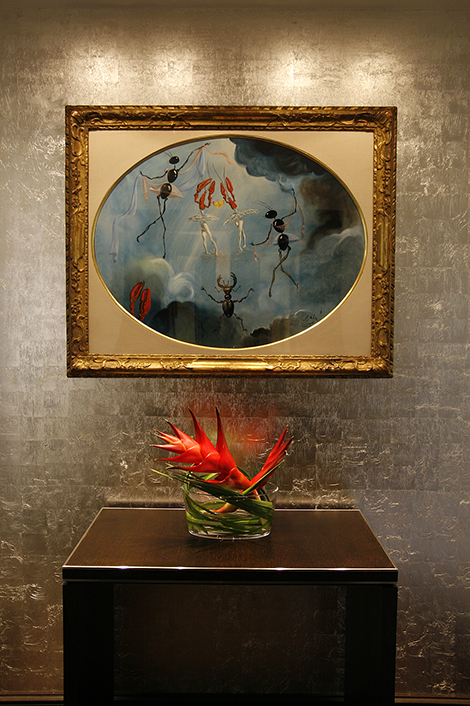
Towards the end of the 1990s, it became clear that a major investment was needed to compete with new international luxury hotels. In 2001, entrepreneur Urs E Schwarzenbach acquired the majority shareholding to assure the necessary financing. The chf440m transformation began in 2004, with Foster + Partners of London, UK stripping back and restoring the building’s original structure and façade, yet adding modern architecture in the form of two new glass wings curving round the historic main building. Meanwhile, Interior architects United Designers, also from London, shaped the inside spaces which range from those epitomising contemporary style to historic areas with eclectic twists – such as a wide selection of original works of art by icons like Andy Warhol and Salvador Dali.
Reopened in 2008, the Dolder Grand boasts 173 bedrooms and suites; two restaurants, one with two Michelin Stars; a ballroom, banqueting and conferencing facilities; and – of course – the 4,000sq m (43,055sq ft) spa. Also in the grounds is a public ice rink (used in the winter), swimming pool (for summer) and nine-hole golf course.
Dolder Grand history
Dolder Grand by numbers
- A bedroom for one night at the Dolder Grand in peak season ranges from chf540-690 (us$590-755, €445-574, £365-466) for a superior single to chf2,540-3,890 (us$2,800-4,250, €2,100-3,250, £1,700-2,650) for a grand suite
- Annual occupancy is 50 per cent
- Average length of stay is 2.2 nights
- Around 70 per cent of guests are free independent travellers (FITs)
- Switzerland is the biggest source market, accounting for 17 per cent of guests, followed by the Middle East (13 per cent), Germany (12 per cent), the US (10 per cent) and Russia/CIS (9 per cent)
- The spa employs 60 staff including 25 therapists
- Massages cost between chf190-230 (us$208-252, €158-191, £128-155) for 60 or 90 minutes
- Amala products cost between €18-186 (us$24-244, £15-151)
- A 12-month spa membership costs chf7,000 (us$7,650, €5,850, £4,750) in the first year but is reduced by chf1,000 in years two and three
Amala Skincare
The Amala skincare line was introduced to the Dolder Grand Spa in November 2011. Its products are certified 100 per cent natural and 70-95 per cent organic by Natrue – which requires at least 75 per cent of products in a range to be organic and natural before granting its seal of approval.
The spa offers three Amala treatments, including a signature Nature’s Organic Seasonal Facial which is adapted every three months to incorporate ingredients from Dolder Grand’s garden.
Used by top spas such as Rancho La Puerta, Mandarin Oriental and Six Senses spas, Amala is the premium product line of Germany’s Primavera – a masstige skincare company. Founder Ute Leube has been working with natural ingredients for over 25 years, during which time she’s established relationships with 19 fair trade, sustainable, organic farms worldwide. Her philosophy is that the very best natural ingredients can be just as effective as high-grade synthetics.
Outside of German speaking countries, the range is overseen by advisory board member Mark Wuttke – a champion of sustainable luxury who’s worked with natural medicines for more than 15 years for companies such as Jurlique.
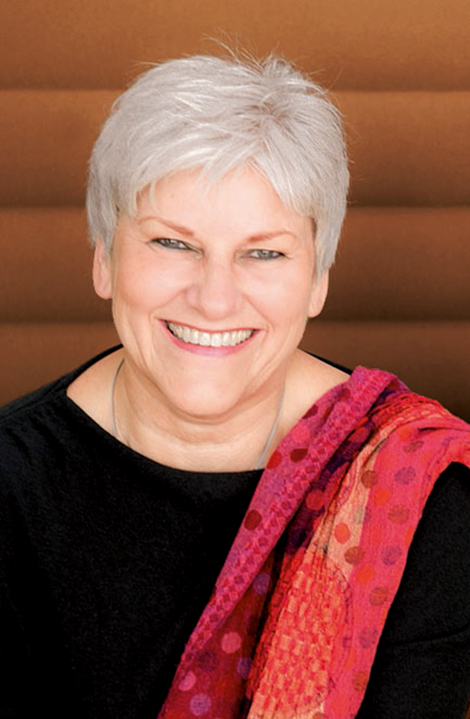
Founder Ute Leube
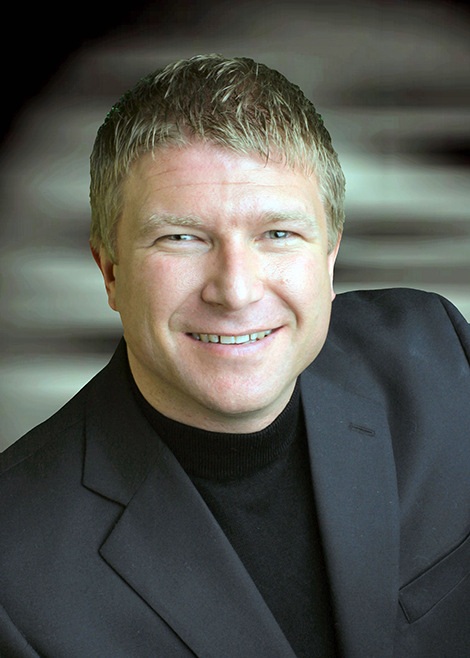
Advisory board member Mark Wuttke
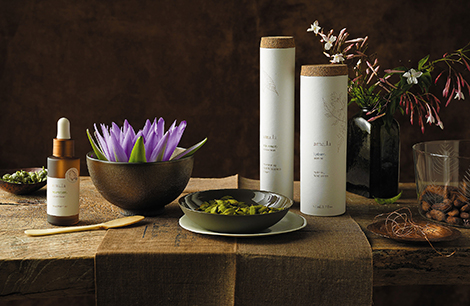
Amala is certified natural and organic
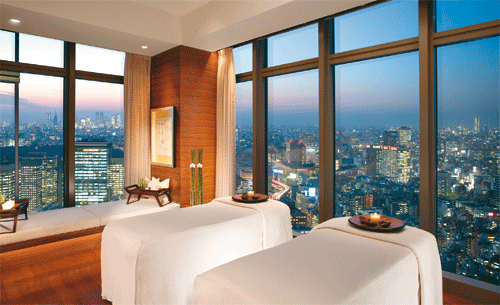
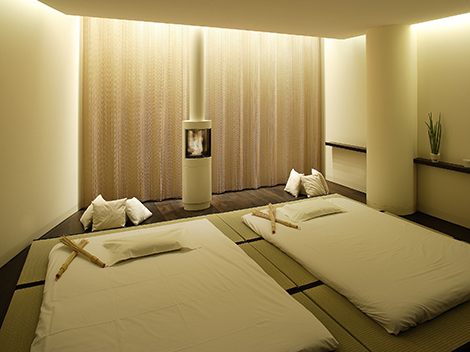
Added in 2008, the spa was inspired by Japanese (above) and European cultures
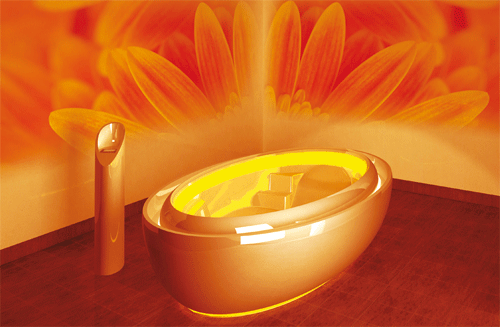
The spa’s design, by Sylvia Sepielli, is a unique selling point along with bespoke items such as the heated pebble-filled sunaburos
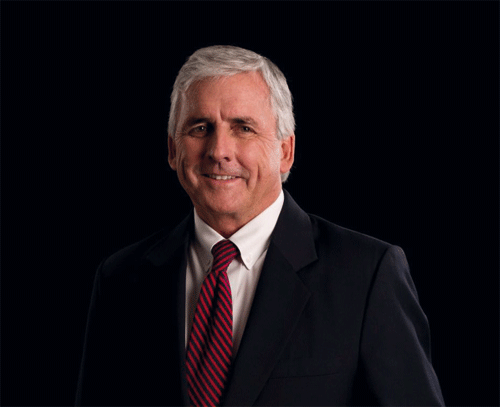
MD Thomas Schmid is a spa advocate
The outdoor whirlpool has been purposefully positioned so users overlook the city of Zurich while taking to the waters
The striking resort interiors feature original art by icons such as Salvador Dali
The curved stone walls by the pool make you feel as if you’re in the heart of a Swiss gorge
Comfort and candles in the chillout room
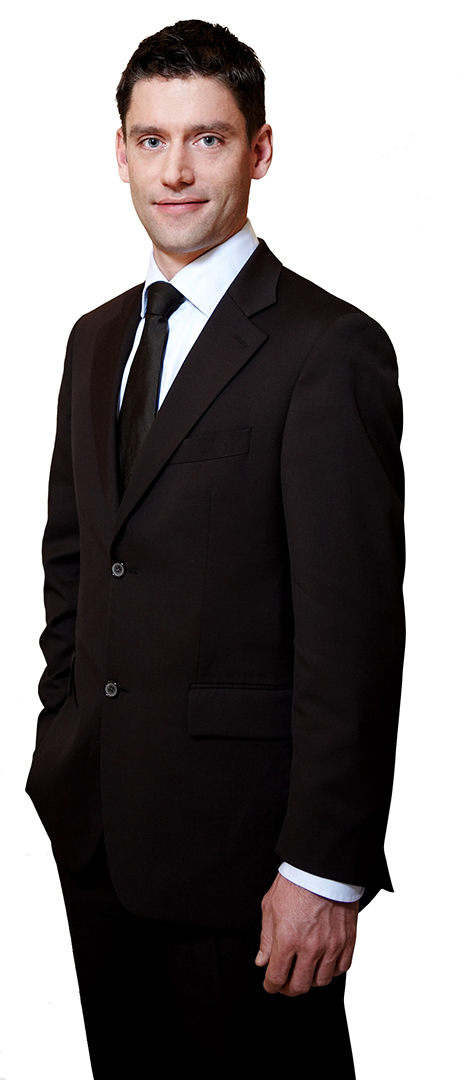
Spa director Jann Hess oversees 60
staff including
25 therapists
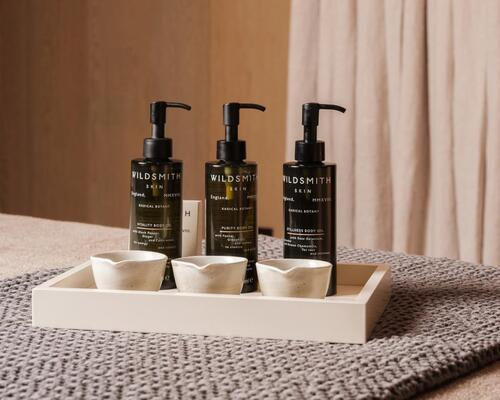
In a world where imbalance often accumulates quietly, Wildsmith unveils its newest
wellbeing innovation: Silent Loads, an approach designed to meet the needs of modern spa
guests with precision and depth. [more...]
The Spa Life UK Convention returns from 21–23 June 2026 at Whittlebury Park Hotel, Spa &
Golf Resort, bringing together spa managers, directors and owners for two days of focused
education, meaningful connection and commercial insight. [more...]
The renown spa at the Dolder
Grand in Zurich is one of the best
in the industry and is serving
as a destination spa for hotel
guests and an urban spa
for local city visitors
By Katie Barnes | Published in Spa Business 2012 issue 2
The resort dates back to 1899 and was a ‘curhaus’ focusing on health and relaxation
There aren’t many hotel general mangers who ‘get’ spas. It’s a common challenge convincing the head of the hotel about the value a spa brings. Not so at the Dolder Grand in Zurich, Switzerland. Managing director Thomas Schmid says: “The spa’s an important revenue stream, but, it’s more than that, it’s a PR tool and people are drawn to us because of the it.” He’s also a fan of treatments, albeit the less fussy ones, he says: “It’s the touch that’s important but I’m not so keen when it gets complicated.”
It’s fitting then that Schmid should head up a resort which has one of the most renowned spas in the industry – one that’s had spa professionals and spa-goers flocking to it since its opening in April 2008 following a chf440m (us$481m, €366m, £297m) transformation of the entire property (see p60).
Curhaus roots Schmid has had a career in spa resorts, having previously worked as assistant general manager at the Bad Ragaz mineral and healing spa in Switzerland. He started at the old Grand Hotel Dolder in 2003 and was keenly involved in its four-year overhaul, he says: “it was a once in a lifetime job to be involved in the closing of a hotel and the planning and reopening of a new one.”
Originally opened in 1899 on a hill overlooking the city, Grand Hotel Dolder was a ‘curhaus’ where locals escaped for rest, active leisure and the feeling of being close to nature. “This history of health and wellness was the reason for adding a spa,” says Schmid. “With fresh air and trees, the destination was made for this and people expect it.”
With the idea that a spa would be a major feature – not just an afterthought or squashed into a basement – Schmid began extensive travels to research spas from Japan, Brazil and New York to those in major European cities. Careful thought was also put into choosing US-based spa specialist Sylvia Sepielli, who owns the SPAd consultancy and has created leading spas worldwide including the Pangkor Laut Spa Village in Malaysia (see sb05/2 p108). “It was important to have someone who would be prepared to compromise, but who could also bring something unique and new,” says Schmid.
European and Asian influences Situated in one of two new wings, the beautiful 4,000sq m (43,055sq ft) Dolder Grand Spa offers an impressive, well thought out range of facilities. These include 18 treatment rooms and two suites with beds by Gharieni, a relaxation room, and male and female wet areas with a variety of thermal experiences by Klafs. There’s a generous-sized swimming pool, plus indoor and outdoor whirlpools – the latter featuring stunning views over Zurich – and a chillout room, an aqua zone flanked by a steamroom, a snow room and samarium. In addition, there’s a fitness suite as well as two exercise studios, a hair salon, a library, a meditation room, and a café and shop.
The spa’s sensuous design has been influenced by European and Japanese cultures. Eastern touches include kotatsu footbaths with simulated currents and pebble surfaces. There are also five sunaburos – tubs filled with fine, heated pebbles, which you just melt into – custom-designed for the spa by Klafs. Yet step into the swimming pool that’s surrounded by huge, curved stone walls and you feel as if you’ve been transported deep into the heart of a Swiss gorge.
The east meets west theme continues with the treatment menu which has European, Swiss and Japanese therapies such as bamboo shiatsu. Product houses include European brands such as La Prairie, Kerstin Florian and Horst Kirchberger make-up. The Japanese range Kenzola didn’t sell well, however, and has recently been replaced with the German organic and natural skincare line Amala (see p62).
Spa director, Jann Hess says: “The design sets our spa apart. It’s really special.” He also says the spa is on-trend with its medical wellness offering. Down the corridor from the spa, the medical clinic is run in conjunction with local doctors and specialises in aesthetic dermatology and laser services, anti-ageing and preventative medicine and plastic surgery consultation. Aimed at hotel guests, the services, Hess admits, could be more popular and this is something he’ll be focusing on in the future.
Destination and urban Another vision for the Dolder Grand Spa was “to create an urban spa and destination spa,” says Schmid. “I really wanted to have a place where someone could come for a quick treatment like a nail polish, but at the same time offer enough interest to cater for someone staying for one or two weeks – I think this makes us stand out from competitors”. And figures – collected using the Reservation Assistant software system by TAC – show there’s an even split between local customers and hotel guests using the spa.
One group of local users are 220 spa and fitness membership holders, with the rest coming on day spa packages costing chf250 (us$273, €208, £169) Monday through Friday and chf380 (us$416, €316, £257) Saturday to Sunday. Only day guests on packages, rather than those booking a one-off treatment, have access to the spa facilities to avoid over-crowding.
At 30-35 per cent, the capture rate is high: although that number includes guest just using the facilities as well as having treatments. Hess says: “The key to attracting guests is having a large variety of treatments and rituals. Also the hotel’s main reservation department is good at upselling.”
A graduate from the Lucerne Hotel School, Hess joined the Dolder Grand two months after its reopening in 2008 and says one of the biggest learning curves for him was understanding how his team of 25 therapists approach the guests. “My background is in food and beverage and that’s a lot faster paced – the waiters and kitchen staff spend only a minimal time with customers. It’s different in a spa, the approach has to be softer. But what makes it the most challenging is knowing if the therapists execute the treatments to our [high] standards or just do them their own way. We’re constantly asking for guest feedback to check.”
There’s also a strong in-house therapist training programme – with quarterly evaluations carried out by the treatment manager and assistant treatment manager.
Key performance indicators The spa is viewed as an independent profit centre at Dolder Grand and the goal is for it to contribute 20 per cent of total revenues.
For Hess, one of the most important benchmarks is the average revenue per treatment which sits at chf190 (us$208, €158, £128) as well as the retail/treatment revenue split which at 25-30 per cent for retail is at the top end of industry performance. “We treat retail as another part of the service we offer guests, therapists hand-write recommendations after the treatment and provide extra consultation if necessary. They get between 5-15 per cent commission, but we also have standard training in sales, plus tuition from the product houses four times a year.”
After four years, Schmid is happy with the with how the spa’s performing. “At the beginning we thought 18 treatment rooms might have been too much, but now there are some weekends when we’re fully booked. Also, it’s taken us this time to train enough therapists in our high quality treatments to reach this capacity – and over four years we’ve also built up a pool of therapists who we can call on an ad-hoc basis to cope with those big days.”
The simple things With the resort and spa still relatively new, Schmid says there are no developments in the pipeline. The biggest challenge he sees, however, is maintaining quality of service. He says: “It’s easy to change design and keep the physical offer fresh, so the focus has to be on quality and it’s my role to guide people to make sure they notice the simple things that matter.” An independent hotel, Dolder Grand has a team of four people solely focused on standards and training – “this is quite amazing as we’re not a large chain,” Schmid adds. “And it really is about noticing every detail – being specific about the attitude of staff, teaching them how they could do something better or in a different way.”
It’s perhaps not surprising then that Schmid is driven by people – both guests and staff – and understanding their different needs. For Hess, the motivation is “seeing the spa grow – it’s fantastic to see what’s happened over the last four years and I’m excited about the future.”
SWISS operates 35 daily flights from the UK to Switzerland and worldwide. Fares start at £89 return, including taxes. Details: +44 (0)845 601 0956, www.swiss.com/uk.
Read more from this issue of Spa Business magazine
View contents of Spa Business 2012 issue 2
Ask an expert...: overbuilding
Are large, extravagant spas and treatment rooms really sustainable? Or is it time to wise up about spa design? Katie Barnes reports
Interview: Darrell Metzger
Destination Resorts is creating world-class tourist developments in Malaysia on behalf of the government. Jennifer Harbottle speaks to the man heading it all up
Spa management training: The learning curve – part one
On the eve of a new GSWS study into the state of spa management training globally, we launch a three-part series to delve into our industry’s educational offering and operational needs. Rhianon Howells gets studying
US Hotel spa research: Closer look
Leonor Stanton analyses the findings from PKF’s latest Trends® in the Hotel Spa Industry study and gets the reaction of top spa professionals
Profile: Susie Ellis
SpaFinder Inc president and the face of the Global Spa & Wellness Summit talks to Rhianon Howells about the art of uncovering up-and-coming industry trends, ethics and the importance of innovation
Resort Spa: Dual purpose
Switzerland’s renown Dolder Grand Spa has an offering to satisfy its onsite, longer-staying guests as well as local day spa customers. Katie Barnes pays a visit to this standout facility
Design: Jean-Michel Gathy
The owner of Asia-based design company Denniston has worked on some of the world’s leading spas and resorts. Jennifer Harbottle finds out about his passion for creativity
Samui spotlight:
The second most popular Thai island has been transformed from a backpackers haven to a luxury lifestyle destination with a number of new five-star spa resorts. Neena Dhillon reports
Middle East benchmarks: Peaks & Troughs
Leonor Stanton reviews hotel spa performance in Lebanon, Jordan and Doha following the 2011 benchmark surveys recently released by PwC in the Middle East
Online wellness gaming: Game Changer
Scoreboards, socialisation, challenges, rewards and feedback – the compelling components of online gaming could be key to getting people to become healthy says Susie Ellis
Kuwait focus: Cue Kuwait
The first in a two-part series on the Kuwaiti spa market by Kate Cracknell focuses on the spa-goers in the capital and the new Six Senses Spa at the Hotel Missoni
Research: Happiness
Older adults who are the most content and have a more positive outlook are likely to live longer according to a new study based on 3,800 participants
Dolder Grand history The Dolder Grand Hotel & Curhaus opened in 1899. Heinrich Hürlimann, already the owner of the nearby Dolder Waldhaus hotel, commissioned Basel architect Jacques Gros to design a hotel in the Swiss rustic style popular at the time. Significant alterations took place in the 1920s and 1960s when a 60-bedroom extension was added to the 220-bedroom property.
Towards the end of the 1990s, it became clear that a major investment was needed to compete with new international luxury hotels. In 2001, entrepreneur Urs E Schwarzenbach acquired the majority shareholding to assure the necessary financing. The chf440m transformation began in 2004, with Foster + Partners of London, UK stripping back and restoring the building’s original structure and façade, yet adding modern architecture in the form of two new glass wings curving round the historic main building. Meanwhile, Interior architects United Designers, also from London, shaped the inside spaces which range from those epitomising contemporary style to historic areas with eclectic twists – such as a wide selection of original works of art by icons like Andy Warhol and Salvador Dali.
Reopened in 2008, the Dolder Grand boasts 173 bedrooms and suites; two restaurants, one with two Michelin Stars; a ballroom, banqueting and conferencing facilities; and – of course – the 4,000sq m (43,055sq ft) spa. Also in the grounds is a public ice rink (used in the winter), swimming pool (for summer) and nine-hole golf course.
Dolder Grand history
Dolder Grand by numbers
- A bedroom for one night at the Dolder Grand in peak season ranges from chf540-690 (us$590-755, €445-574, £365-466) for a superior single to chf2,540-3,890 (us$2,800-4,250, €2,100-3,250, £1,700-2,650) for a grand suite
- Annual occupancy is 50 per cent
- Average length of stay is 2.2 nights
- Around 70 per cent of guests are free independent travellers (FITs)
- Switzerland is the biggest source market, accounting for 17 per cent of guests, followed by the Middle East (13 per cent), Germany (12 per cent), the US (10 per cent) and Russia/CIS (9 per cent)
- The spa employs 60 staff including 25 therapists
- Massages cost between chf190-230 (us$208-252, €158-191, £128-155) for 60 or 90 minutes
- Amala products cost between €18-186 (us$24-244, £15-151)
- A 12-month spa membership costs chf7,000 (us$7,650, €5,850, £4,750) in the first year but is reduced by chf1,000 in years two and three
Amala Skincare
The Amala skincare line was introduced to the Dolder Grand Spa in November 2011. Its products are certified 100 per cent natural and 70-95 per cent organic by Natrue – which requires at least 75 per cent of products in a range to be organic and natural before granting its seal of approval.
The spa offers three Amala treatments, including a signature Nature’s Organic Seasonal Facial which is adapted every three months to incorporate ingredients from Dolder Grand’s garden.
Used by top spas such as Rancho La Puerta, Mandarin Oriental and Six Senses spas, Amala is the premium product line of Germany’s Primavera – a masstige skincare company. Founder Ute Leube has been working with natural ingredients for over 25 years, during which time she’s established relationships with 19 fair trade, sustainable, organic farms worldwide. Her philosophy is that the very best natural ingredients can be just as effective as high-grade synthetics.
Outside of German speaking countries, the range is overseen by advisory board member Mark Wuttke – a champion of sustainable luxury who’s worked with natural medicines for more than 15 years for companies such as Jurlique.
Founder Ute Leube
Advisory board member Mark Wuttke
Amala is certified natural and organic
Added in 2008, the spa was inspired by Japanese (above) and European cultures
The spa’s design, by Sylvia Sepielli, is a unique selling point along with bespoke items such as the heated pebble-filled sunaburos
MD Thomas Schmid is a spa advocate
The outdoor whirlpool has been purposefully positioned so users overlook the city of Zurich while taking to the waters
The striking resort interiors feature original art by icons such as Salvador Dali
The curved stone walls by the pool make you feel as if you’re in the heart of a Swiss gorge
Comfort and candles in the chillout room
Spa director Jann Hess oversees 60
staff including
25 therapists
Four Seasons Resort The Nam Hai in Hoi An, Vietnam, has put together a Global Wellness Day
(GWD) agenda with activations rooted in nature and shaped by four pillars of Joy – in
alignment with the day’s theme #JoyMagenta.
The Global Wellness Summit (GWS) will celebrate its 20th anniversary at the 2026 event in
Phuket, Thailand, later this year with the theme: The Science, Art and Soul of Wellness.
Auko, an all-inclusive development, is opening in Phong Nha in Vietnam in Q3 2026, with a
series of 30 tented eco-lodges and wellness hospitality operations by Lumina Wellbeing.
Therme Manchester’s 28-acre development, which will include interconnected glass pavilions
that measure 65,000sq m, will be the largest bathing and wellbeing attraction in the world once
complete, according to prof David Russell, CEO of Therme UK.
Naples Beach Club, a Four Seasons Resort, has opened a 2,800sq m spa called The Sanctuary,
with the design and concept inspired by the Native American people that populated Florida’s
Southwest coast – the Calusa.
Swire Hotels’ luxury hospitality brand Upper House has revealed it will roll out its two-day
House of Healing retreats at its three hotels in Hong Kong, Chengdu and Shanghai.
LVMH-owned beauty house Guerlain will launch up to five spas with partners a year as part of
its plan to expand globally, according to the brand’s international spa and wellness director,
Diane Davody.
A new global study by Kevin Kelly and Peter Yesawich, called WELLSurvey 2.0, has revealed
more than half of consumers in the UK, US and Germany would not choose numerous high-
profile wellness resort brands for a future trip.
Luxury hospitality and wellness pioneer Jeremy McCarthy has launched Leisure Alchemy, a
digital platform that will provide professionals with strategic guidance on how to build
transformational leisure experiences that drive profit.
In a world where imbalance often accumulates quietly, Wildsmith unveils its newest
wellbeing innovation: Silent Loads, an approach designed to meet the needs of modern spa
guests with precision and depth. [more...]
The Spa Life UK Convention returns from 21–23 June 2026 at Whittlebury Park Hotel, Spa &
Golf Resort, bringing together spa managers, directors and owners for two days of focused
education, meaningful connection and commercial insight. [more...]