In the first of a new eight-part series by David Camp of D&J International Consulting, we give an overview of the global visitor attractions industry and the measures used to assess performance
By David Camp | Published in Attractions Management 2016 issue 1
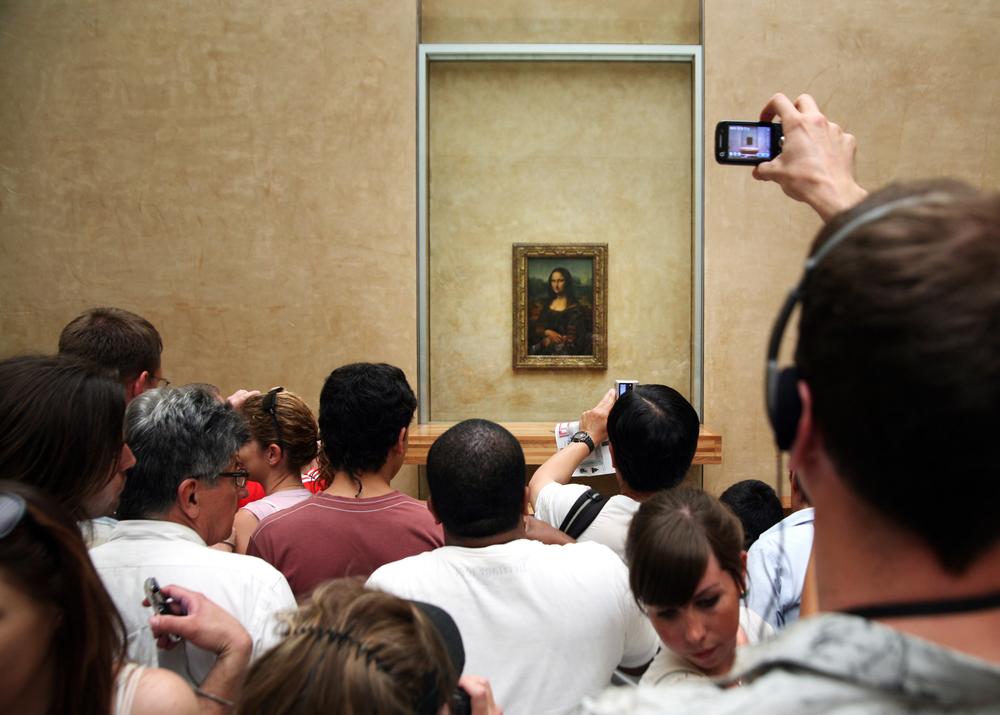
The Louvre in Paris attracts more visitors than any other museum in the world / PHOTO: shutterstock_T. Scarbrough
Visitor attractions are an important factor in many people’s travel plans. Some choose a destination in order to visit a specific attraction while others decide what to see once they arrive, but it’s rare for people not to visit an attraction while they’re on holiday.
This means that attractions around the world are well placed to benefit from the rapid growth of the tourism sector.
The World Travel & Tourism Council estimates that direct expenditure on global travel and tourism was worth a huge $2.5 trillion (£1.7tn, €2.2tn) in 2015 and the total economic impact of this sector was $7.9 trillion (£5.5tn, €7th).
Over the coming months, this series will provide an overview of the attractions sector and how it works from a business perspective. The series will review market size, diversity, dynamics and performance, as well as the all-important financial performance of a range of attractions.
The shape of the market D&J estimates that there are about 250,000 visitor attractions globally, attracting in the region of 10 billion visits a year. However, it’s a very fragmented business. The world’s biggest attraction operator is Disney, whose 13 theme parks and waterparks attract 134 million guests annually, generating over $14bn (£9.7bn, €12.4bn) revenue for the company.
Although these are huge numbers, Disney actually draws less than 1.5 per cent of the world’s attractions visitors.
Furthermore, combined attendance at the top 10 global operating groups only accounts for 4 per cent of visits.
Most attractions are operated by national, regional or local governments, by small regional groups or by individuals or families. This fragmentation means there’s relatively little data available on the industry when compared with the hotel or transportation sectors where there are greater proportions of large operators.
Differences in scale The museum sector varies widely in size from country to country. For example, there are around 1,500 museums in Spain, 1,800 in the UK, 3,600 in China, 6,400 in Germany and a massive 16,000 in the US. Between them, they attract almost 1.3 billion visits each year – that’s an average of almost 45,000 visits per museum.
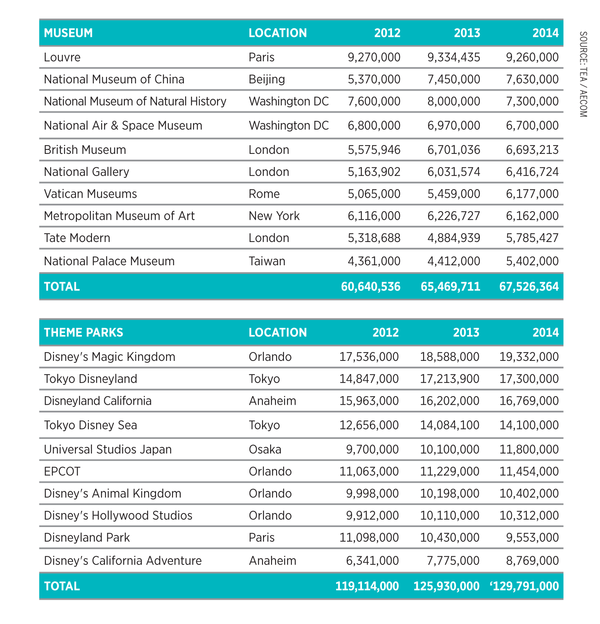
Data from the TEA/AECOM Theme Index and Museum Index (see Table 1 on page 56) reveals that admission to the world’s top museums and theme parks has grown strongly in recent years.
At the top of the list, the Louvre in Paris is the world’s most visited museum, with 9.3 million visits annually. Among zoos, the honour goes to Chapultepec Zoo in Mexico, with 5 million visitors a year – and Disney’s Magic Kingdom in Orlando, with 19.3 million guests in 2014, is the most visited park.
Free attractions Moving outdoors, there are many free-to-enter natural attractions, historic sites and national parks. Visitor numbers to these locations are estimated based on surveys and the volumes are impressive: 9 million to the Great Wall of China; 15 million to the Golden Gate Park in California; 15 million to the Forbidden City in Beijing; 22 million to Niagara Falls and 37 million to New York’s Central Park.
These attractions are internationally famous destinations run by large operating teams who have substantial resources at their fingertips. However, the majority of visitor attractions are modest in size and run by small groups, families, volunteers, charities or regional or local governments – without the luxury of deep pockets.
The 80:20 rule While every attraction is unique, there are similarities and patterns in visitor behaviour, guest spending, operating cost ratios, market penetration rates and profitability across different attraction types. It’s these patterns and ratios this series will be examining.
There are also similarities and patterns across attractions in different countries and regions. The 80:20 rule applies in leisure; 80 per cent of what people do is comparable around the world, but it’s understanding the 20 per cent local context that makes or breaks an operation. For example, the basics of running a restaurant are always the same. You need good food and service, an enjoyable ambience and value for money. These are the 80 per cent factors. The 20 per cent is understanding local tastes, patterns and demands. In the Midwestern US, restaurants typically close by 10pm, while in Spain time people are just sitting down to eat at that time. Local context is critical.
The Attractions Business series will discuss the challenges that are facing visitor attractions, highlighting the world’s strongest performers and helping to build a deeper understanding of the dynamics of this vital industry.
Read more from this issue of Spa Business magazine
Interview: Tony Butler
Tony Butler, executive director of Derby
Museums Trust, on how museums can
be a force for good in their communities
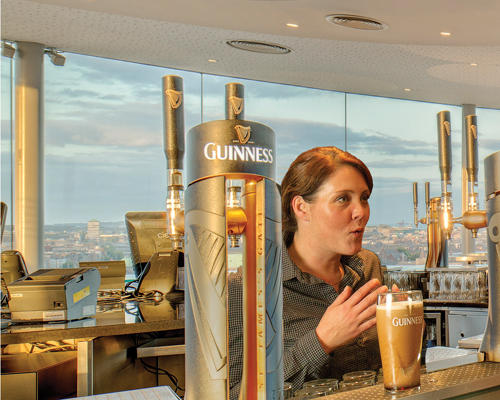
Attractions: Perfect Brew
At 15 years old, the Guinness Storehouse
has been voted Europe’s best-loved
attraction. Manager Paul Carty reveals
the secrets of the Dublin brandland
Profile: John McReynolds
IAAPA’s new chairman reveals his aims
for the year ahead, his vision for a
global association and how his role at
Universal Orlando informs his goals
Analysis: The Attractions Business
Business planning consultant
David Camp starts an exclusive eight-part
series, delving into the fine art of attractions
operation from a business perspective
Science Centres: How to Future-Proof a Science Centre
Peter Slavenburg of design agency
NorthernLight describes how invisible
technology, serious play, co-creation
and the digital experience will inform
the science centre of tomorrow
Promotional feature: Simworx Ventures
Simworx Ventures is bringing its expertise in cutting-edge media-based attractions
to a new audience of museums, heritage sites, zoos and aquariums
Technology: Beacons on the Horizon
Beacons have countless applications in
the world of attractions. A case study
from the Cleveland Museum of Art
illustrates the technology’s potential
Museums & Galleries: Art Attack
Some of the most exciting attractions
design is happening in new and
upcoming galleries around the world,
from firms like Kengo Kuma and BIG
Promotional feature: IDEA
2016 is shaping up to be an interesting year for the attractions industry.
IDEA looks at what it takes to win audiences and command attention
Mystery Shopper: Spring in Your Step
We disappear down the rabbit hole as we
pay a mystery shopper visit to Bounce
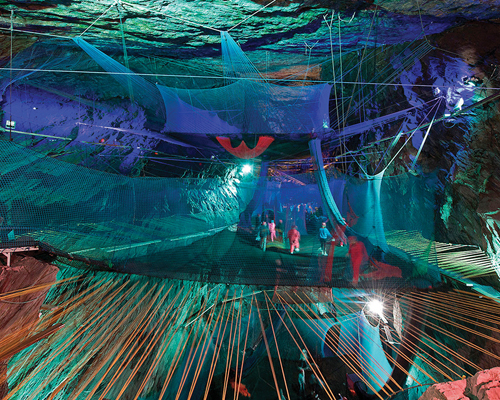
Below, a unique underground trampolining
attraction in Snowdonia, north Wales
Rides: The Ride Makers
Our ride makers series continues with
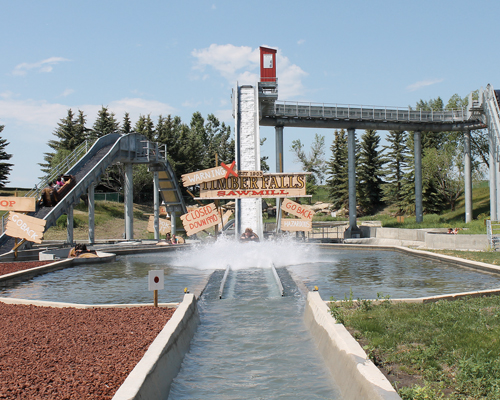
water rides, a firm favourite with park
guests. Three leading companies reveal
the latest trends in flumes and chutes
Technology: Tech Check
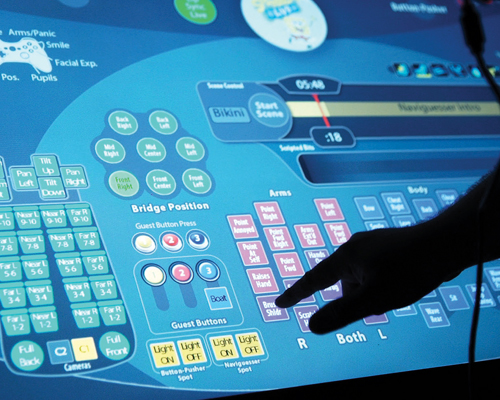
The industry technology unveiled at
IAAPA 2015: from VR to interactives, and
digital puppets to 20-storey LED giants
Series Roadmap This eight-part series outlines the patterns and dynamics that define every attraction – from visitor behaviour and guest spending to operating costs and profitability CONTENTS 1. An overview 2. How are you perceived? 3. Benchmarking 4. Planning a new attraction 5. Driving revenues 6. Controlling costs 7. Is it worth it? 8. Benefits and impacts
Table 1 : Attendance at the World’s Most Visited Museums and Theme Parks
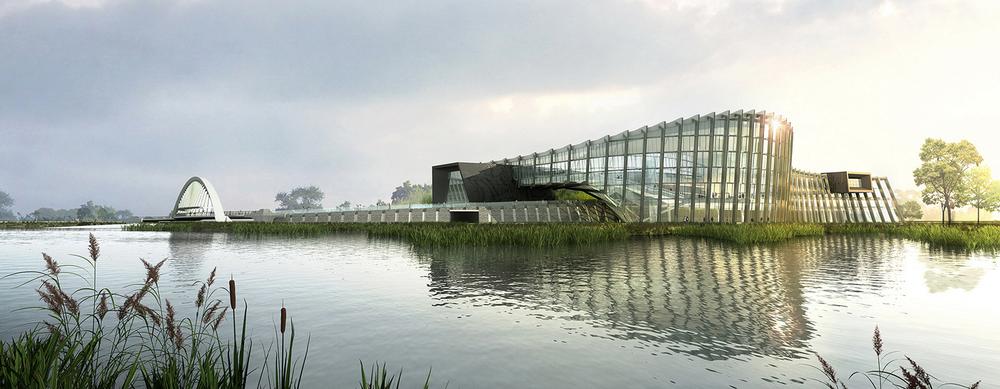
The National Palace Museum in Taiwan attracts so many visitors it’s opened a sister site
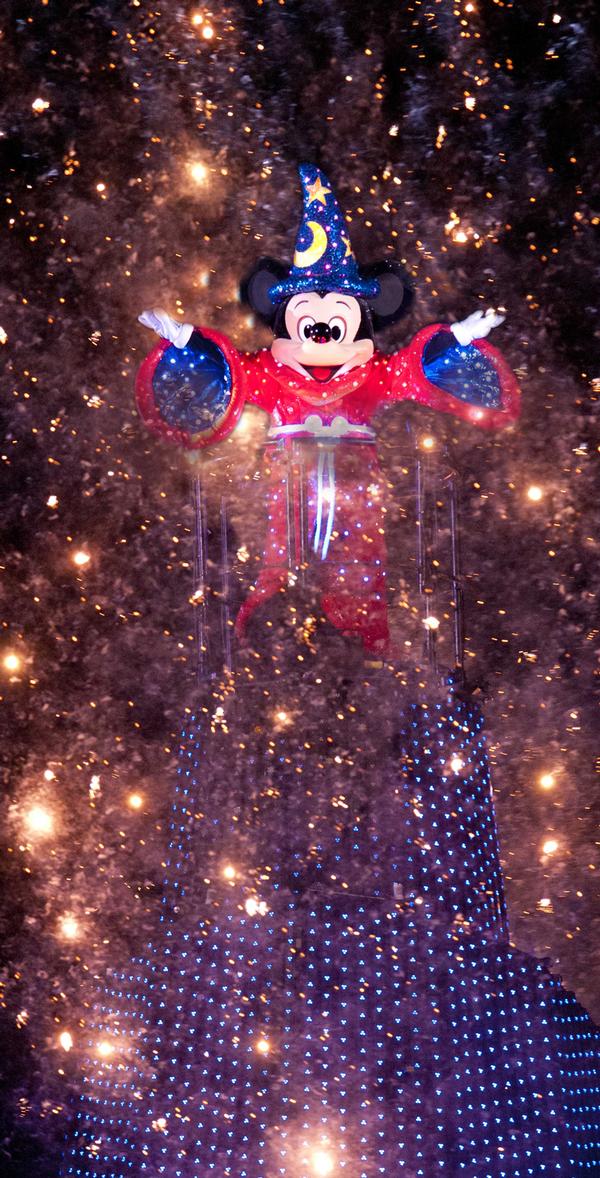
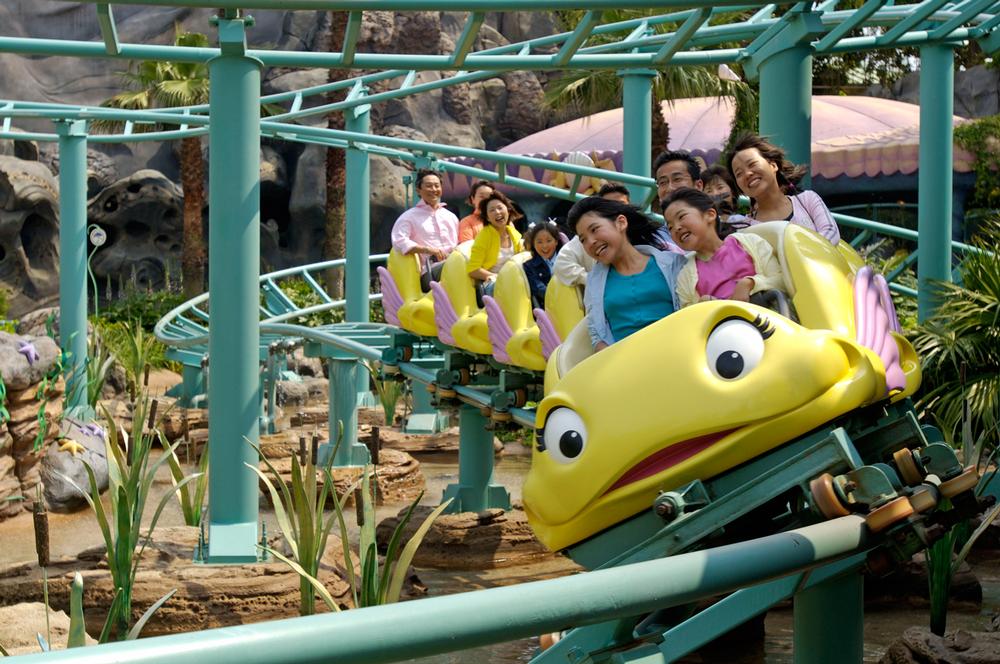
Disney parks such as Tokyo Disney Sea make up nine of the 10 most visited theme parks in the world, with more than 100 million guests a year / PHOTOS: TOKYO DISNEY SEA
Disney parks such as Tokyo Disney Sea make up nine of the 10 most visited theme parks in the world, with more than 100 million guests a year / PHOTOS: TOKYO DISNEY SEA
In the first of a new eight-part series by David Camp of D&J International Consulting, we give an overview of the global visitor attractions industry and the measures used to assess performance
By David Camp | Published in Attractions Management 2016 issue 1
The Louvre in Paris attracts more visitors than any other museum in the world / PHOTO: shutterstock_T. Scarbrough
Visitor attractions are an important factor in many people’s travel plans. Some choose a destination in order to visit a specific attraction while others decide what to see once they arrive, but it’s rare for people not to visit an attraction while they’re on holiday.
This means that attractions around the world are well placed to benefit from the rapid growth of the tourism sector.
The World Travel & Tourism Council estimates that direct expenditure on global travel and tourism was worth a huge $2.5 trillion (£1.7tn, €2.2tn) in 2015 and the total economic impact of this sector was $7.9 trillion (£5.5tn, €7th).
Over the coming months, this series will provide an overview of the attractions sector and how it works from a business perspective. The series will review market size, diversity, dynamics and performance, as well as the all-important financial performance of a range of attractions.
The shape of the market D&J estimates that there are about 250,000 visitor attractions globally, attracting in the region of 10 billion visits a year. However, it’s a very fragmented business. The world’s biggest attraction operator is Disney, whose 13 theme parks and waterparks attract 134 million guests annually, generating over $14bn (£9.7bn, €12.4bn) revenue for the company.
Although these are huge numbers, Disney actually draws less than 1.5 per cent of the world’s attractions visitors.
Furthermore, combined attendance at the top 10 global operating groups only accounts for 4 per cent of visits.
Most attractions are operated by national, regional or local governments, by small regional groups or by individuals or families. This fragmentation means there’s relatively little data available on the industry when compared with the hotel or transportation sectors where there are greater proportions of large operators.
Differences in scale The museum sector varies widely in size from country to country. For example, there are around 1,500 museums in Spain, 1,800 in the UK, 3,600 in China, 6,400 in Germany and a massive 16,000 in the US. Between them, they attract almost 1.3 billion visits each year – that’s an average of almost 45,000 visits per museum.
Data from the TEA/AECOM Theme Index and Museum Index (see Table 1 on page 56) reveals that admission to the world’s top museums and theme parks has grown strongly in recent years.
At the top of the list, the Louvre in Paris is the world’s most visited museum, with 9.3 million visits annually. Among zoos, the honour goes to Chapultepec Zoo in Mexico, with 5 million visitors a year – and Disney’s Magic Kingdom in Orlando, with 19.3 million guests in 2014, is the most visited park.
Free attractions Moving outdoors, there are many free-to-enter natural attractions, historic sites and national parks. Visitor numbers to these locations are estimated based on surveys and the volumes are impressive: 9 million to the Great Wall of China; 15 million to the Golden Gate Park in California; 15 million to the Forbidden City in Beijing; 22 million to Niagara Falls and 37 million to New York’s Central Park.
These attractions are internationally famous destinations run by large operating teams who have substantial resources at their fingertips. However, the majority of visitor attractions are modest in size and run by small groups, families, volunteers, charities or regional or local governments – without the luxury of deep pockets.
The 80:20 rule While every attraction is unique, there are similarities and patterns in visitor behaviour, guest spending, operating cost ratios, market penetration rates and profitability across different attraction types. It’s these patterns and ratios this series will be examining.
There are also similarities and patterns across attractions in different countries and regions. The 80:20 rule applies in leisure; 80 per cent of what people do is comparable around the world, but it’s understanding the 20 per cent local context that makes or breaks an operation. For example, the basics of running a restaurant are always the same. You need good food and service, an enjoyable ambience and value for money. These are the 80 per cent factors. The 20 per cent is understanding local tastes, patterns and demands. In the Midwestern US, restaurants typically close by 10pm, while in Spain time people are just sitting down to eat at that time. Local context is critical.
The Attractions Business series will discuss the challenges that are facing visitor attractions, highlighting the world’s strongest performers and helping to build a deeper understanding of the dynamics of this vital industry.
Read more from this issue of Spa Business magazine
Interview: Tony Butler
Tony Butler, executive director of Derby
Museums Trust, on how museums can
be a force for good in their communities
Attractions: Perfect Brew
At 15 years old, the Guinness Storehouse
has been voted Europe’s best-loved
attraction. Manager Paul Carty reveals
the secrets of the Dublin brandland
Profile: John McReynolds
IAAPA’s new chairman reveals his aims
for the year ahead, his vision for a
global association and how his role at
Universal Orlando informs his goals
Analysis: The Attractions Business
Business planning consultant
David Camp starts an exclusive eight-part
series, delving into the fine art of attractions
operation from a business perspective
Science Centres: How to Future-Proof a Science Centre
Peter Slavenburg of design agency
NorthernLight describes how invisible
technology, serious play, co-creation
and the digital experience will inform
the science centre of tomorrow
Promotional feature: Simworx Ventures
Simworx Ventures is bringing its expertise in cutting-edge media-based attractions
to a new audience of museums, heritage sites, zoos and aquariums
Technology: Beacons on the Horizon
Beacons have countless applications in
the world of attractions. A case study
from the Cleveland Museum of Art
illustrates the technology’s potential
Museums & Galleries: Art Attack
Some of the most exciting attractions
design is happening in new and
upcoming galleries around the world,
from firms like Kengo Kuma and BIG
Promotional feature: IDEA
2016 is shaping up to be an interesting year for the attractions industry.
IDEA looks at what it takes to win audiences and command attention
Mystery Shopper: Spring in Your Step
We disappear down the rabbit hole as we
pay a mystery shopper visit to Bounce
Below, a unique underground trampolining
attraction in Snowdonia, north Wales
Rides: The Ride Makers
Our ride makers series continues with
water rides, a firm favourite with park
guests. Three leading companies reveal
the latest trends in flumes and chutes
Technology: Tech Check
The industry technology unveiled at
IAAPA 2015: from VR to interactives, and
digital puppets to 20-storey LED giants
Series Roadmap This eight-part series outlines the patterns and dynamics that define every attraction – from visitor behaviour and guest spending to operating costs and profitability CONTENTS 1. An overview 2. How are you perceived? 3. Benchmarking 4. Planning a new attraction 5. Driving revenues 6. Controlling costs 7. Is it worth it? 8. Benefits and impacts
Table 1 : Attendance at the World’s Most Visited Museums and Theme Parks
The National Palace Museum in Taiwan attracts so many visitors it’s opened a sister site
Disney parks such as Tokyo Disney Sea make up nine of the 10 most visited theme parks in the world, with more than 100 million guests a year / PHOTOS: TOKYO DISNEY SEA
Disney parks such as Tokyo Disney Sea make up nine of the 10 most visited theme parks in the world, with more than 100 million guests a year / PHOTOS: TOKYO DISNEY SEA
Global Wellness Day (GWD) marked its 15th anniversary on Saturday 13 June 2026, with the
theme: #JoyMagenta – a celebration of the healing qualities of simple gestures and activities
that spark joy.
Global luxury hospitality brand, Six Senses, has partnered with longevity healthcare provider,
HUM2N, to launch a clinic at Six Senses London, at The Whiteley.
As part of its first hotel partnership, Mayrlife – the medical health resort company known for its
site in Altaussee, Austria – has launched a day clinic at the Rosewood Vienna.
Premium London health club, KX Chelsea, will imminently unveil its most significant
redevelopment since its launch in 2002 to create an integrated wellness model combining
training, recovery and relaxation.
Rosewood Le Guanahani St Barth, on the northeast coast of Saint Barthélemy in the French
West Indies, is offering a programme of ocean-inspired yoga classes between 8-14 June to
celebrate Global Wellness Day (GWD).
Hotel de France, located on the British Isle of Jersey, has created a wellness retreat package
that includes a hot yoga session that will take place in Jersey Zoo’s butterfly sanctuary.
The Ritz-Carlton, Langkawi, in Malaysia, has revealed a schedule for Global Wellness Day
(GWD) that includes guided rainforest walks, mindful movement and guided coastal meditation
experiences.
Longevitix, a clinical platform for preventive and longevity medicine, has launched its AI-
powered intelligence system to help physicians deliver continuous, personalised longevity-
focused care at scale.
Atmantan Wellness Centre, an integrative wellness destination in Mulshi, near Pune in India, is
expanding its portfolio by adding a new centre in Hyderabad that will launch between 2028 and
2029.