Yes! Send me the FREE digital editions of Spa Business and Spa Business insider magazines and the FREE weekly Spa Business and Spa Business insider ezines and breaking news alerts!
With so many people struggling with their mental health, new research reveals the full potential for spas to harness their expertise to support customers, staff and the wider community
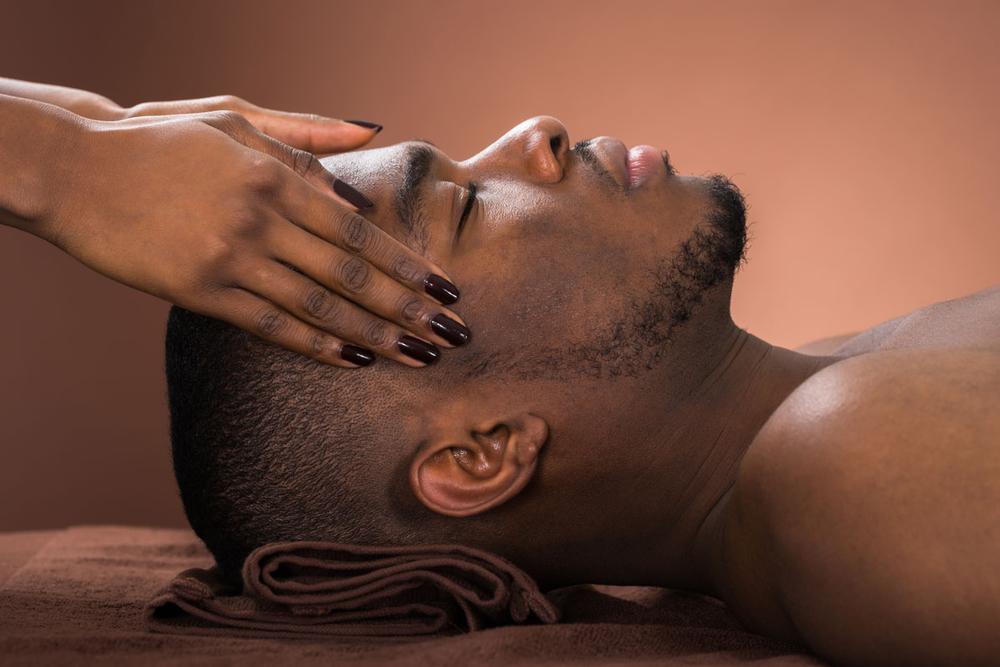
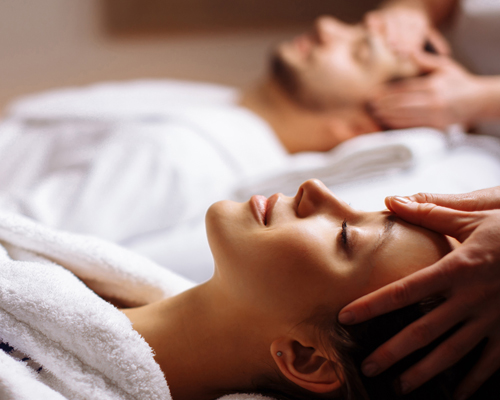
Spas can help meet the growing demand for mental health support / Andrey_Popov/shutterstock
Anew study by the Global Wellness Institute (GWI), Defining the Mental Wellness Economy, is the first to identify mental wellness as a fully-fledged market sector (see p90).
The study, which has identified a global expenditure of US$121bn in four key mental health markets, describes mental wellness as being more than simply an absence of mental illness, saying, “It’s an internal resource that helps us think, feel, connect and function; it’s an active process that helps us to build resilience, grow and flourish.”
The economic and social burden of mental ill health is predicted to reach US$1.6tn globally by 2030 according to the World Economic Forum, with this escalating mental health crisis being exacerbated by COVID-19.
The report puts numbers to what many in the spa industry have been emphasising for some time – that consumers are prioritising wellness and are desperate for strategies and products to improve their mental health.
We know we can help, as so many of the modalities we offer, from massage to multi-sensory experiences and exercise to sleep health, have been scientifically proven to benefit the mind. An in-depth 122-page white paper – Mental Wellness: Pathways, Evidence and Horizons – from the GWI’s Mental Wellness Initiative documents the most significant of these.
However, if we are to support governments and societies in tackling these issues, we need to re-evaluate our approach to mental wellness provision as an industry.
Careful consideration must be given to how spas position themselves. They can’t do the work of mental health professionals, but can partner with them to combine their expertise with what the industry does so well – create safe, healing spaces and deliver customer engagement, accessibility, calming environments and professional services.
Mental health first aider training is now widely available and a cost-effective starting point. Spa therapists can be trained to spot common symptoms and act to support both customers and co-workers.
If spas are to make a difference, they must also extend support as widely as possible – not just to those who can afford it. Forming relationships with charities and creating outreach programmes, in-person and online, are two ways in which we can widen our influence and be more useful.
Katie Barnes is the editor of Spa Business magazine
| [email protected]
Read more from this issue of Spa Business magazine
View contents of Spa Business 2020 issue 4
Editor's letter: Nurturing mental health
It’s time for spas re-evaluate their mental wellness approach to help governments and society to tackle the escalating mental health crisis says Katie Barnes
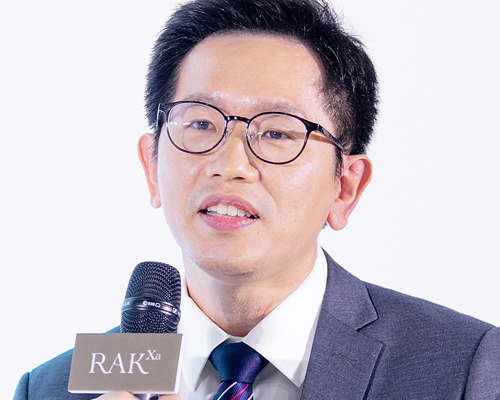
Spa people: Dr Narinthorn Surasinthon
RAKxa Jai, a cutting-edge medi-wellness spa, has opened in partnership with Bumrungrad International Hospital and Minor Hotels in Bangkok. Spa Business talks to its COO
Spa people: Isabelle Duchesneau
The executive director of Québec's Le Monastère Augustines explains why its priority of serving caretakers is more relevant today than ever
Spa people: Michael Banissy
The world's largest study on touch uncovers the role it plays in our health and wellbeing. Spa Business talks to the lead researcher
Interview: Krip Rojanastien
Chiva-Som’s CEO talks to Spa Business magazine about guiding the destination spa through COVID-19 and its first contract management project in Qatar
Ask an expert: Corridors of power
What will it take to make politicians realise the value of spas? Spa Business magazine asks those in government and others who’ve made inroads
Promotion: Artofcryo: Cold Calling
Artofcryo.com aims to offer the best whole-body cryotherapy chambers as well as a complete, reliable and effective solution for operators and results for guests
Promotion: ISPA: Lead, inform, inspire
Lead, Inform, Inspire. It’s been quite a year for ISPA, with its firm commitment to supporting members through the pandemic, as president, Lynne McNees explains
Interview: Mark Hennebry
Ensana’s chair tells Spa Business magazine about its landmark development, Buxton Crescent, one of the only genuine spa hotels in the UK
Promotion: Lemi: Creating the dream team
This year leading Italian supplier Lemi launched three new spa solutions, and ventured into the creation of signature treatments for the first time. General manager Matteo Brusaferri explains why he sees this as the way forward to help spas maximise their investment
Interview: Luisa Anderson
A Longevity Garden and inner healing room are just two of the extra special features at the new Healing Village Spa at Four Seasons Jimbaran Bay, Bali, says its regional spa director
Promotion: Biologique Recherche
Skincare specialist, Biologique Recherche, is using its knowledge of chronobiology to create new approaches to skincare which yield powerful results
Event review: Global Wellness Summit 2020
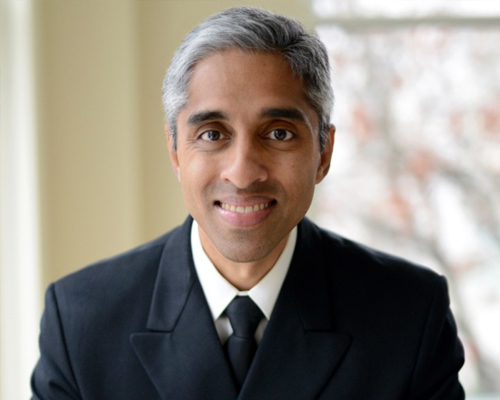
This year’s Global Wellness Summit saw two US surgeon generals, leading spa stakeholders and wellness professionals look towards the role they have to play following the global pandemic. Spa Business magazine gives its highlights
Research: Matter of minds
A new study is the first to define and put a value on the global mental wellness industry – estimating it to be worth US$121bn. But what does this mean for spas?
Sponsored briefing: Starpool: Cargo-tecture
During lockdown, Riccardo Turri, CEO of Starpool, was inspired to create a whole new category of product, based on recycled containers. The result is the new i.con spa brand, which fuses luxury, wellness, recycling and design
Software: All booked up
Spa software suppliers take a look at 'big data' to reveal the booking trends they’ve seen since spas have reopened
Promotion: Voya: supporting spa partners
Jessica Anhold, Voya’s head of global sales and marketing, talks community in a time of crisis and how the company is supporting its spa partners
The MSpa Oslo series is a perennial bestseller in global markets. With innovative
engineering and premium performance, this completely portable spa line-up is expertly
designed to meet the needs of customers worldwide. [more...]
With so many people struggling with their mental health, new research reveals the full potential for spas to harness their expertise to support customers, staff and the wider community
Spas can help meet the growing demand for mental health support / Andrey_Popov/shutterstock
Anew study by the Global Wellness Institute (GWI), Defining the Mental Wellness Economy, is the first to identify mental wellness as a fully-fledged market sector (see p90).
The study, which has identified a global expenditure of US$121bn in four key mental health markets, describes mental wellness as being more than simply an absence of mental illness, saying, “It’s an internal resource that helps us think, feel, connect and function; it’s an active process that helps us to build resilience, grow and flourish.”
The economic and social burden of mental ill health is predicted to reach US$1.6tn globally by 2030 according to the World Economic Forum, with this escalating mental health crisis being exacerbated by COVID-19.
The report puts numbers to what many in the spa industry have been emphasising for some time – that consumers are prioritising wellness and are desperate for strategies and products to improve their mental health.
We know we can help, as so many of the modalities we offer, from massage to multi-sensory experiences and exercise to sleep health, have been scientifically proven to benefit the mind. An in-depth 122-page white paper – Mental Wellness: Pathways, Evidence and Horizons – from the GWI’s Mental Wellness Initiative documents the most significant of these.
However, if we are to support governments and societies in tackling these issues, we need to re-evaluate our approach to mental wellness provision as an industry.
Careful consideration must be given to how spas position themselves. They can’t do the work of mental health professionals, but can partner with them to combine their expertise with what the industry does so well – create safe, healing spaces and deliver customer engagement, accessibility, calming environments and professional services.
Mental health first aider training is now widely available and a cost-effective starting point. Spa therapists can be trained to spot common symptoms and act to support both customers and co-workers.
If spas are to make a difference, they must also extend support as widely as possible – not just to those who can afford it. Forming relationships with charities and creating outreach programmes, in-person and online, are two ways in which we can widen our influence and be more useful.
Katie Barnes is the editor of Spa Business magazine
| [email protected]
Read more from this issue of Spa Business magazine
View contents of Spa Business 2020 issue 4
Editor's letter: Nurturing mental health
It’s time for spas re-evaluate their mental wellness approach to help governments and society to tackle the escalating mental health crisis says Katie Barnes
Spa people: Dr Narinthorn Surasinthon
RAKxa Jai, a cutting-edge medi-wellness spa, has opened in partnership with Bumrungrad International Hospital and Minor Hotels in Bangkok. Spa Business talks to its COO
Spa people: Isabelle Duchesneau
The executive director of Québec's Le Monastère Augustines explains why its priority of serving caretakers is more relevant today than ever
Spa people: Michael Banissy
The world's largest study on touch uncovers the role it plays in our health and wellbeing. Spa Business talks to the lead researcher
Interview: Krip Rojanastien
Chiva-Som’s CEO talks to Spa Business magazine about guiding the destination spa through COVID-19 and its first contract management project in Qatar
Ask an expert: Corridors of power
What will it take to make politicians realise the value of spas? Spa Business magazine asks those in government and others who’ve made inroads
Promotion: Artofcryo: Cold Calling
Artofcryo.com aims to offer the best whole-body cryotherapy chambers as well as a complete, reliable and effective solution for operators and results for guests
Promotion: ISPA: Lead, inform, inspire
Lead, Inform, Inspire. It’s been quite a year for ISPA, with its firm commitment to supporting members through the pandemic, as president, Lynne McNees explains
Interview: Mark Hennebry
Ensana’s chair tells Spa Business magazine about its landmark development, Buxton Crescent, one of the only genuine spa hotels in the UK
Promotion: Lemi: Creating the dream team
This year leading Italian supplier Lemi launched three new spa solutions, and ventured into the creation of signature treatments for the first time. General manager Matteo Brusaferri explains why he sees this as the way forward to help spas maximise their investment
Interview: Luisa Anderson
A Longevity Garden and inner healing room are just two of the extra special features at the new Healing Village Spa at Four Seasons Jimbaran Bay, Bali, says its regional spa director
Promotion: Biologique Recherche
Skincare specialist, Biologique Recherche, is using its knowledge of chronobiology to create new approaches to skincare which yield powerful results
Event review: Global Wellness Summit 2020
This year’s Global Wellness Summit saw two US surgeon generals, leading spa stakeholders and wellness professionals look towards the role they have to play following the global pandemic. Spa Business magazine gives its highlights
Research: Matter of minds
A new study is the first to define and put a value on the global mental wellness industry – estimating it to be worth US$121bn. But what does this mean for spas?
Sponsored briefing: Starpool: Cargo-tecture
During lockdown, Riccardo Turri, CEO of Starpool, was inspired to create a whole new category of product, based on recycled containers. The result is the new i.con spa brand, which fuses luxury, wellness, recycling and design
Software: All booked up
Spa software suppliers take a look at 'big data' to reveal the booking trends they’ve seen since spas have reopened
Promotion: Voya: supporting spa partners
Jessica Anhold, Voya’s head of global sales and marketing, talks community in a time of crisis and how the company is supporting its spa partners
Synergy – The Retreat Show, the global trade show for retreats, has launched a global research
initiative that will provide insights into the retreat sector from both consumer and industry
perspectives.
The Wellness Tourism Association (WTA) has published a non-regulatory global industry
framework designed to ensure the retreat market offers responsible experiences.
A new survey of UK and international spa practitioners shows that stress, burnout and
wellbeing concerns have caused one in three respondents to consider leaving the industry.
The UK's four Chief Medical Officers have published a refreshed edition of Physical activity
guidelines: UK Chief Medical Officers' report, updating the evidence that underpins the nation's
physical activity recommendations and placing greater emphasis on strength, balance, reducing
sedentary behaviour and, for the first time, supporting people taking weight loss medications.
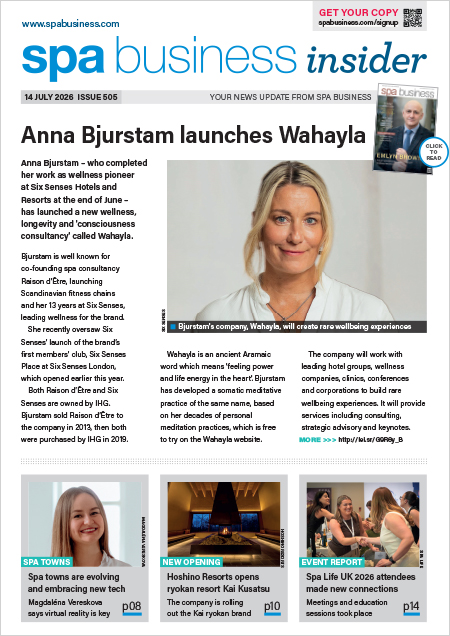
Anna Bjurstam has left her role as Wellness Pioneer at Six Senses Hotels and Resorts and
launched a new wellness, longevity and “consciousness consultancy” called Wahayla.
Fairmont Cheshire, The Mere, has opened today (10 July) in the Northwest of England
with a
1,715sq m Fairmont Spa that has been designed using a ‘Wellness without Walls’
concept.
Wellness hotels generating less than US$1 million (€932,700, £785,200) – or 10 per cent of
total revenue from wellness and leisure – recorded the strongest RevPAR and TRevPAR growth
in 2025 across categories when compared with 2024, according to the latest Wellness Real
Estate Report by RLA Global, produced in partnership with P and L benchmarking firm HotStats.
Lefay Resorts, the portfolio of two luxury wellness properties in Italy, has added emotional
dance classes and group cold plunge sessions in response to market demand for social
connection.
The MSpa Oslo series is a perennial bestseller in global markets. With innovative
engineering and premium performance, this completely portable spa line-up is expertly
designed to meet the needs of customers worldwide. [more...]