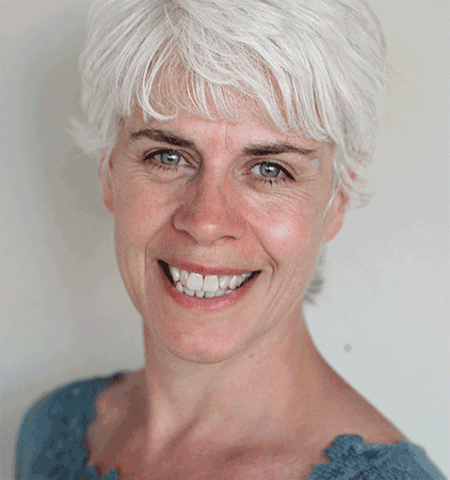
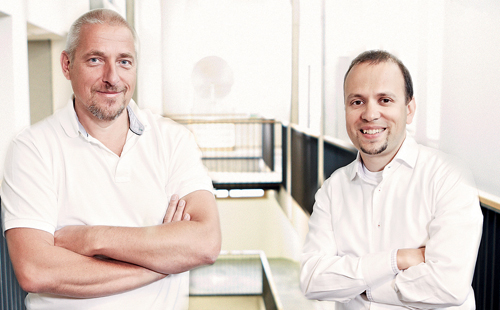
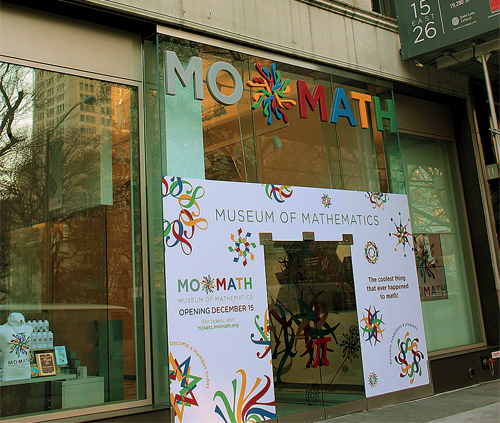
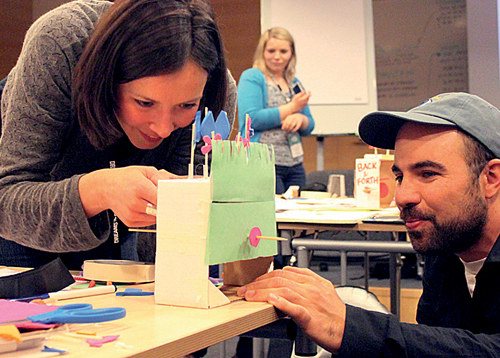
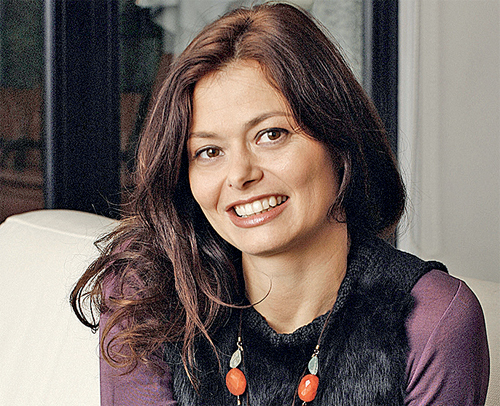
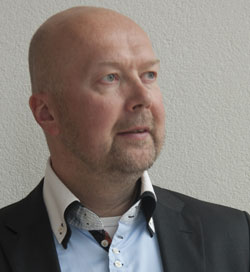
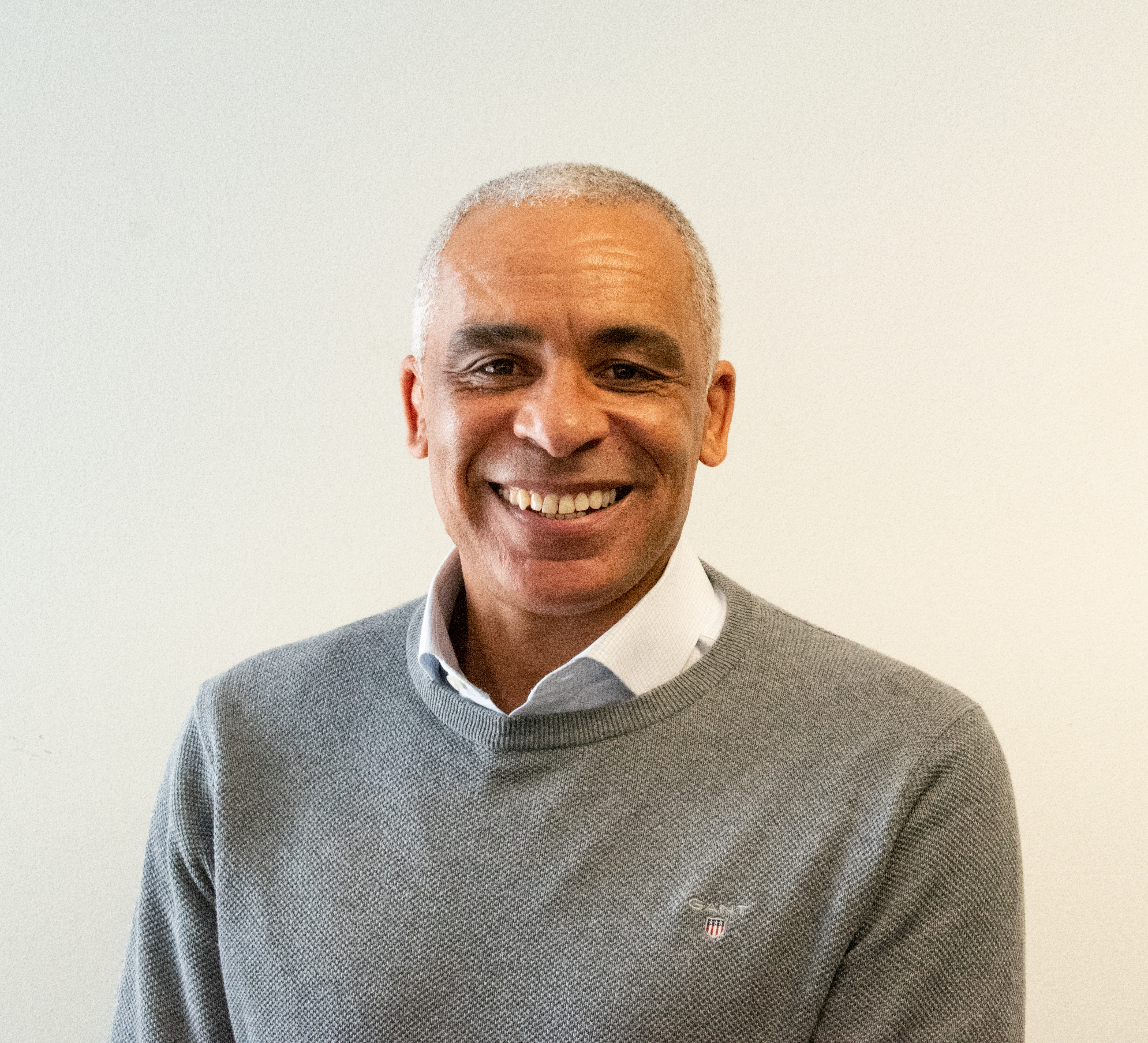
Glen Whitney (left) and Cindy Lawrence (right) teamed up to create the Museum of Mathematics
On the subject of maths, Glen Whitney and Cindy Lawrence, co-founders and executive directors of the Museum of Mathematics (MoMath) in New York City, are surprisingly lyrical – they talk less about formulae, theorems and proofs than they do about beauty and wonder, excitement and falling in love. Yet despite this undisguised passion, they’re the first to admit that maths has an image problem.
“Math is too often presented as a cookbook of recipes to memorise, and it’s really a cultural problem,” says Lawrence, a certified public accountant (CPA) who spent 16 years as national editor for CPA education provider Becker, and runs a programme for gifted maths students in her spare time. “If I go to a party and get into a conversation about what I do, people aren’t ashamed to say, ‘I’m terrible at math.’ If I said I was an author, no one would say, ‘I’m a terrible writer,’ whereas to say ‘I’m not a math person’ is almost a badge of honour.”
Through MoMath, which celebrated its first anniversary in December, Whitney and Lawrence have made it their mission to turn this common perception of maths as difficult and dull on its head. “We’re not trying to shame anyone,” says Whitney, a Harvard- and UCLA-educated mathematics professor and former quantitative analyst for hedge fund Renaissance Technologies. “We’re just trying to show the face of math that people naturally want to engage with.”
With MoMath’s visitors for year one topping 173,000 (massively exceeding the projected 68,000), Whitney and Lawrence are clearly doing something right. Here, they talk about changing public perceptions, the dangers of ‘maths illiteracy’ and what’s next for North America’s only math’s museum.
How was the idea for MoMath born? Glen Whitney (GW): For about 20 years, there was a tiny math museum on Long Island. I went along, and it was sort of run down, but I had a great time. I thought nothing of it until I started coaching the math club at my daughter’s elementary school. I was talking to some teachers when the topic of the museum came up and I found out it had closed down. I thought perhaps this was an opportunity to create an institution with a similar flavour and feel, but a little bit more of an ambitious mission.
Cindy Lawrence (CL): I’d also visited that museum with my family before I met Glen. Then our daughters became friends. One day, Glen was picking his daughter up from my house when he asked if I’d ever heard of this museum. I said, “Sure, I love that museum.” And he said, “Well, it is no more.” In the next breath he said, “But I’m going to open another math museum.” And I said, “Wow, if you need any help with that let me know.” I thought, “What fun!” In my career I didn’t do anything focused on math, then suddenly here was this project that sounded like all play and no work.
What’s the aim of the museum? GW: Our mission is to change public perceptions of mathematics and share its evolving, creative, dynamic, beautiful nature. These are not words people associate with mathematics, but they give a much better description of what it really is than the ones most people would use.
Before MoMath, you launched a touring exhibition called the Math Midway. Tell us about that CL: We got together a group of sympathetic people and held monthly meetings. Then Glen met someone involved with the World Science Festival in New York City, who said we could have a booth, and I volunteered to spearhead that initiative. I thought I’d be sitting at a table handing out brochures, but Glen’s vision was to build an exhibit that would have a life beyond the festival, that would travel to other science centres around the country and be a sort of proof of concept for us. Out of that came the Math Midway, which has been travelling the country without a break since June 2009, and was in fact an excellent proof of concept. We had 3,000 to 4,000 people show up on the first day. So it really showed us, and showed people considering investing in the project, that it had legs.
The museum cost $23m. How easy was it to raise the money? GW: I don’t know that raising money is ever easy. You have to get people to share your passion and vision, get them excited, and try to meet as many people as possible. We were fortunate that our vision, and the fact that we’re the only institution of our kind in North America, resonated with some people.
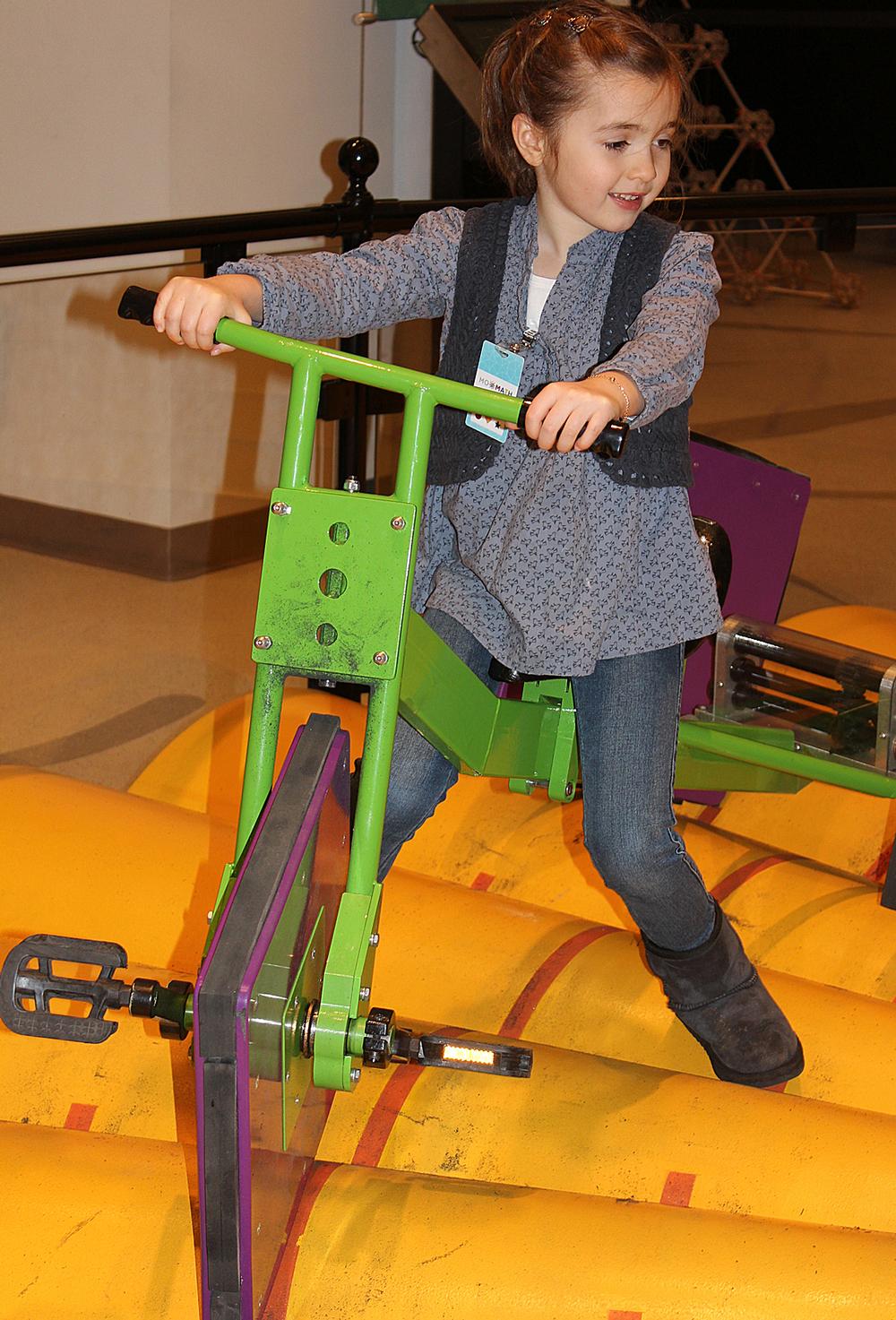
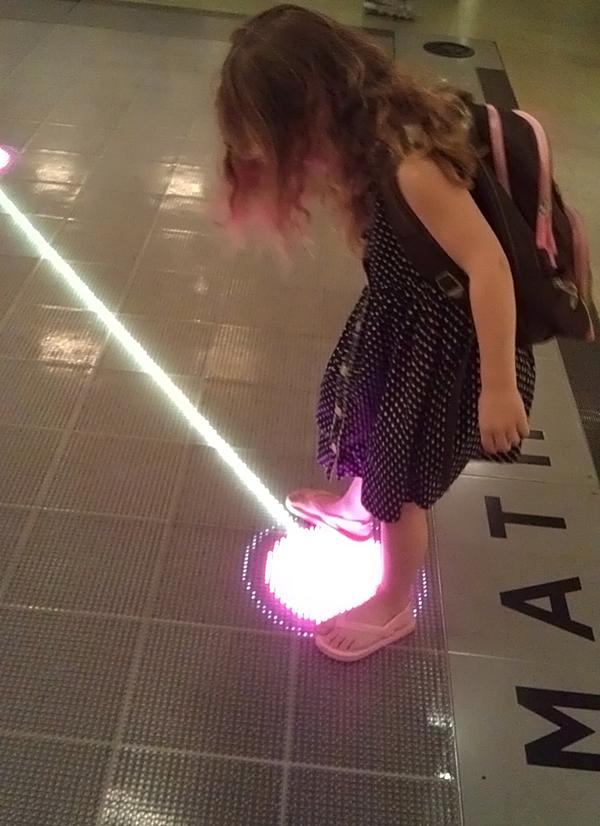
What are the most popular exhibits in the museum? CL: The one that’s got the lion’s share of attention is the Square-Wheeled Trike. It’s just such a surprising thing. We all know square wheels don’t roll. So the fact that mathematics can teach you to create a track on which a square wheel will roll just as smoothly as a round wheel does on a flat surface is shocking to people, and they will line up for the opportunity to try it out for themselves.
Another is the Enigma Café, a puzzle area that’s designed to feel like a café. It’s amazing how many people gather in there and how long they spend.
GW: One of the reasons we wanted the Enigma Café is that for folks to get into math, puzzles are one of the biggest hooks. You get your teeth sunk into a knotty problem and you want to know the solution. And when you get it, the pieces fit together conceptually in your brain – or physically in the case of a puzzle – and you have a new perspective: you look at the world in a slightly different way than you did before that moment.
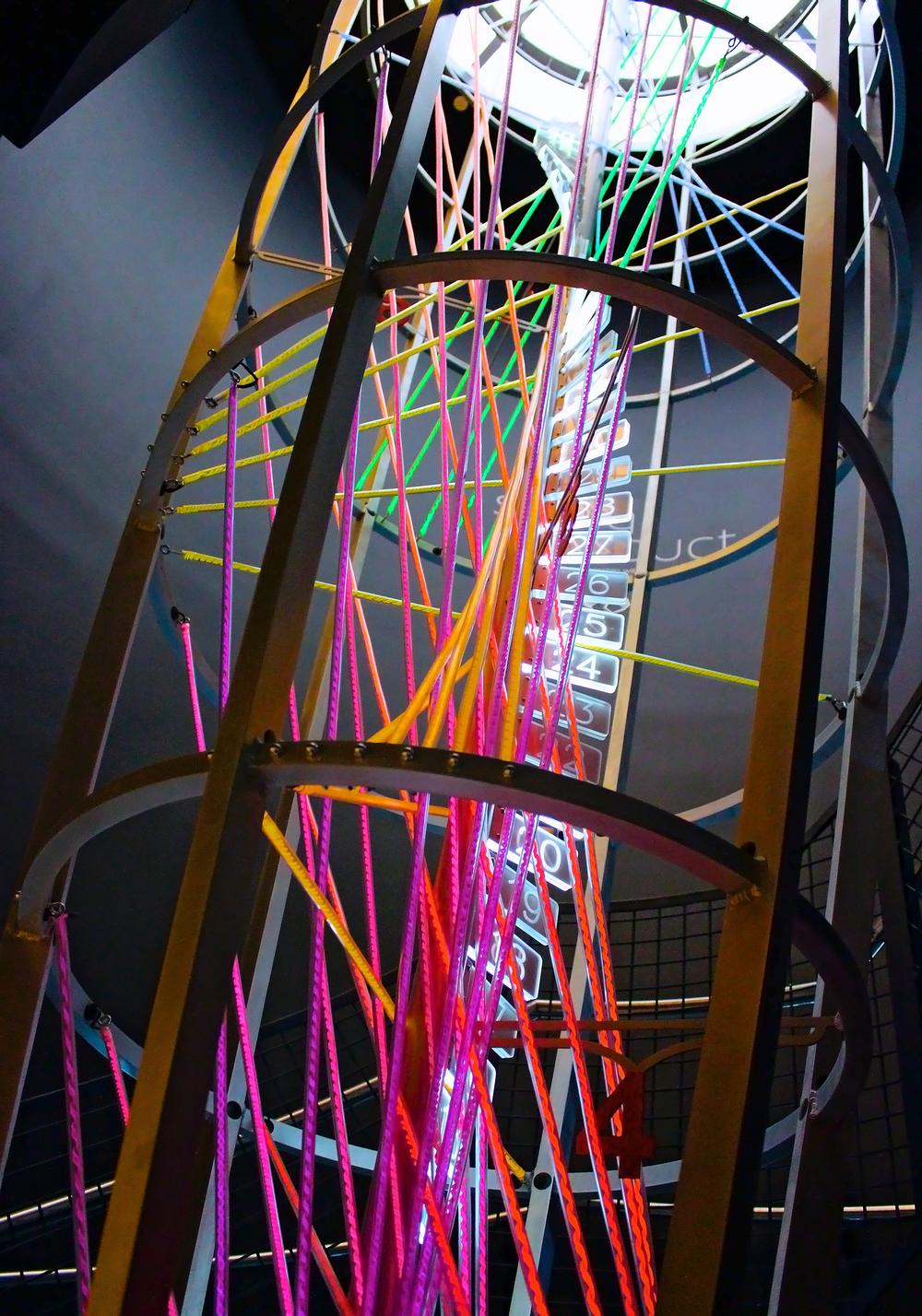
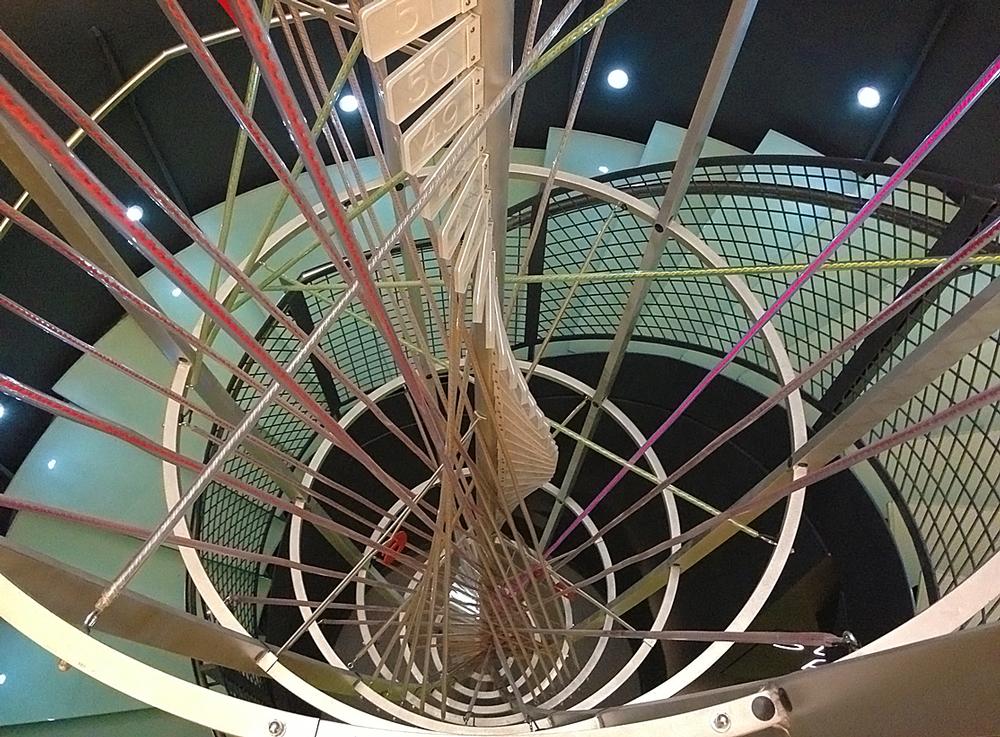
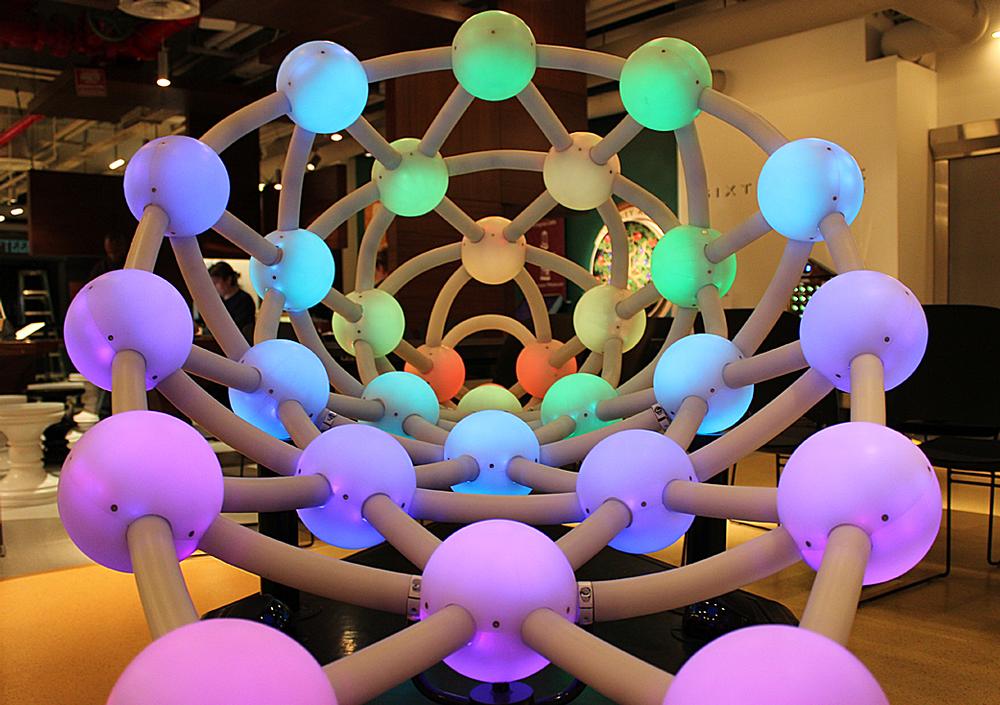
Which exhibit or exhibits best sum up what you’re trying to achieve? CL: What people miss about mathematics is that it has a lot of depth: you might not like long division, but that doesn’t mean there isn’t some part of math that can speak to you. And there are concepts in math that can speak to people at different levels. For me, the exhibit that best exemplifies that is String Product. It’s a giant paraboloid – a paraboloid is the curve you get when you throw a ball in the air – rotated to make a long bowl; it has lots of strings running through it and when you press numbered buttons they light up.
A toddler will press the buttons and get the sense that numbers are fun. Slightly older children will notice that when they press five and six, the string connecting them happens to cross the centre point at 30 – so they realise they’re looking at something beautiful that somehow conveys the multiplication table. Kids who have finished algebra and know a little bit about geometry can sit down with the equation of a paraboloid and the equation of a line and work out why that has to happen. And even mathematicians who see the exhibit and didn’t know about that property are delighted by it.
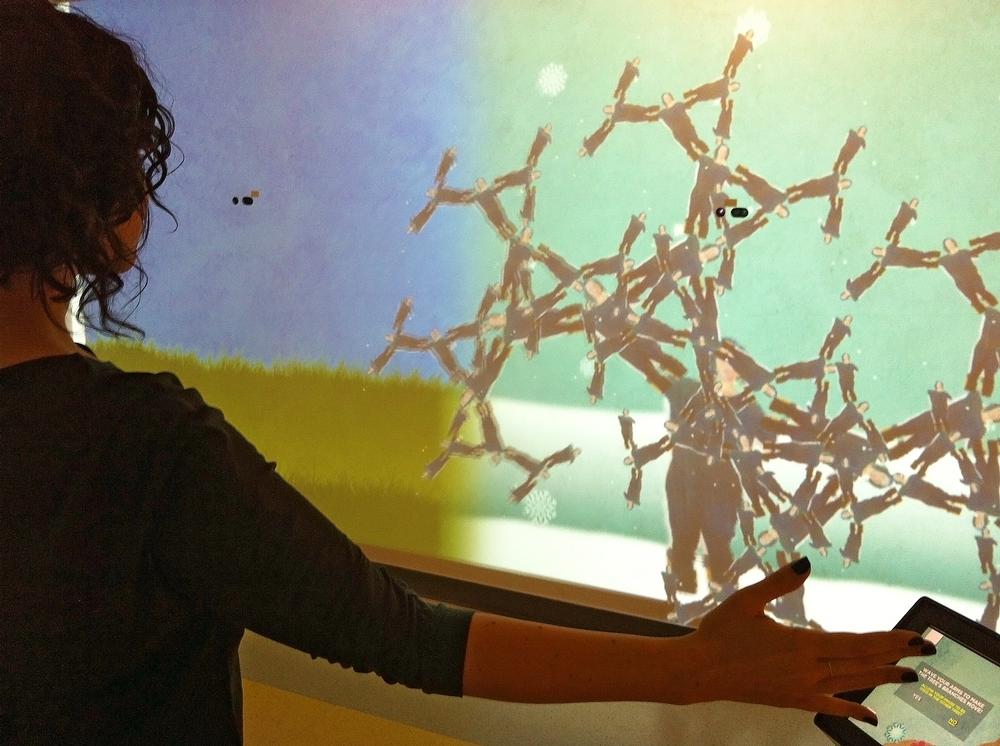
GW: For me, it’s the Human Tree. A camera picks up your image and projects it onto a screen, but replaces your arms with a smaller picture of you, and the arms of that smaller picture with yet another picture of you, and so on, producing a pattern known as a fractal – a pattern which is similar to itself on a smaller scale. There’s a rich landscape of fractals you can make just by varying the angles and length of your arms.
Some of the key elements we use to draw people in and show them the beauty and creativity of mathematics are right there: it’s visually beautiful, you see surprising patterns and you’re engaged with your entire body.
What was the biggest challenge of opening the museum? CL: We’re one of the only science centres I know of that has opened with all its exhibits designed completely from scratch. That was both a joy and a challenge. We had ideas contributed from mathematicians around the world, so our first challenge was whittling those down. Then we’d create drawings and a little storyline for each exhibit and go out to companies that might be able to build it. Some got thrown out because they were too expensive, others because the fabricator had no idea how to do it – but what one company would say was impossible, another would say, “Oh, that? Yes, we can do that.”
GW: We ended up with eight different contractors, when the advice was to have two or three. Managing all those different providers was a challenge.
Who or what made you love maths? GW: When I was in grade school, I didn’t like math. I found it came fairly easily to me and I got good grades, but I had no enthusiasm for it. Then one summer my parents sent me to a math camp. The very first weekend I broke my collarbone playing soccer, and from that point on I couldn’t do much apart from work on the problems set in our daily math classes.
Somehow this answer would line up with that answer and I started to see patterns emerging. Then I’d get glimpses of the reasons for these structures and that would open up new vistas. I discovered that it was all really quite beautiful. Plus, I was in a community of peers who were just as excited by it as I was. So I fell in love with math, and have been in love with it ever since.
CL: I enjoyed math as soon as I realised it was something you could understand rather than just memorise, but it was a wonderful calculus teacher in high school who really made me feel that it could be beautiful.
Can you give some examples of how we use maths in everyday life? CL: Just trying to work out the most efficient order of all the errands you need to do is very mathematical.
I need to go to the grocery store, post office and bank and stop off at the school to pick up a child – what order should I do that in? You’re using math when you make those calculations in your mind.
GW: Yes! Companies like FedEx pay mathematicians good money to figure out exactly that: what is the most efficient route from A to B.
CL: Glen does math tours that underscore the fact that math is all around us: in the timing of a traffic light, the way the subway runs. We have a place that sells ice cream shakes near the museum that has very long lines and Glen has taken people there to talk about queuing theory, or he’ll talk about the math in the way certain plants grow.
GW: The gingko tree is a good example. It’s a tree you see fairly often in New York City and one that everyone is able to recognise at a glance, though they don’t really know why. It’s because, unlike most other trees, all of the junctions of its branches are right angles. It’s not something most people realise, but when you have it pointed out to you, you say, aha, there it is! It’s the geometry of the tree that gives you the ability to recognise it.
What common mathematical mistakes do people make? GW: There are certain aspects of math that people are naturally quite adept at, but there are other areas where our intuition leads us astray.
One of the most notorious is assessing risks and probabilities. An important example is in medicine, when you have a routine screening for a rare condition and you get a positive result. You ask, “How reliable is this test?” and the doctor says: “Well, it’s 99 per cent accurate: 99 per cent of the time, if it says you have the disease, you have the disease.” So you immediately think, “Oh no, there’s a 99 per cent chance I have this disease!”
But that’s not at all the case. If the disease has a frequency of only one in 10,000 in the population at large, it’s actually extremely likely that you’ve got a false positive, just because the original disease is so unlikely. Even though only one per cent of positives are false positives, it’s much more likely that you’re that one in 100 than the one in 10,000 that actually has the disease.
So people do have difficulty understanding probabilities and it can lead to errors of judgement. It’s called the base rate fallacy.
What’s next for MoMath? CL: We’re working on a number of programme ideas right now, so we’re back in fundraising mode. For example, there’s a lot of interest in having a math and music concert series here.
GW: We’re also commissioning our first new exhibits since we opened. One is entitled Motion Scape and will help visitors better understand the relationship between position, velocity and acceleration. The other is a dramatic lobby piece.
What drives you? GW: The opportunity to share the beauty and wonder of mathematics. CL: The excitement of coming up with ideas, then the pleasure of watching people enjoy the things we’ve created.
Read more from this issue of Spa Business magazine
View contents of Spa Business 2014 issue 2
Editor's letter: The New Philanthropists
Tech is hot and as the growing number of tech millionaires
turn their thoughts to philanthropy, tech-related
attactions will prosper
Profile: Mario Mamon
The current chair of IAAPA talks about
his role with the organisation, doubling
the size of family theme park Enchanted
Kingdom in the Philippines and the
devastation of Super Typhoon Haiyan
Museums: MOHAI
MOHAI's executive director,
Leonard Garfield, talks about
the Seattle museum's new Bezos
Center for Innovation, named after
Amazon founder Jeff Bezos
Science centres: Appliance of science
Andreas Waschk and Mike Boris
explain how they made Blueprint
Entertainment into Europe's largest
private science centre operator
Museums: Olympic Movement
Director Francis Gabet describes how
The Olympic Museum's extensive
refurbishment reflects the excitement
and diveristy of the modern Games
Planetariums: Starry skies
The newly upgraded Fiske Planetarium in
Boulder, Colorado now boasts the highest
specification full dome theatre in the US.
Director Douglas Duncan tells us more
Museums: Beautiful minds
The founders of MoMath, the New York
Museum of Mathematics, tell us how
they're on a mission to get ordinary
people to fall in love with maths
World expos: Brave new world
Christian Lachel considers how world
expos can raise global awareness
about what matters for the planet
3D/4D/5D: IMERSA
A review of the fifth annual IMERSA
conference held in Denver, Colorado
Advertisement feature: EAS 2014
The exhibitors reveal what they’ll be showcasing at EAS in
September and what the hot topics of conversation will be
Waterparks: Wet'n'Wild
Wet'n'Wild Sydney has welcomed
a million visitors through its gates
since opening in December. Managing
director Chris Warhurst tells us why
Ticketing: Convenience store
Gateway's Liesel Tarquini explains
how mobile web stores can help
generate additional revenue
for attractions operators
Among MoMath’s major sponsors was Google, which donated $2m (E1.4m, £1.2m) in 2011. In total, the internet giant awarded $12m (E8.7m, £7.2m) to seven science centres across the US and the UK in the same period.
Each year, through its charitable arm, Google Giving, the company donates $100m (E72.4m, £59.6m) in grants, 50,000 hours and $1bn (E724m, £596m) in products to good causes. These range from Global Impact Awards – focused on education and computer science; the environment; development; and empowering women and girls – to Community Impact Awards, covering not only disaster relief but also deserving non-profit organisations in the countries where Google is based.
Community initiatives include the Roberta Initiative, Germany; the restoration of Bletchley Park, UK; and The High Line, New York City.
Rhianon Howells is a freelance writer for numerous publications including The Guardian [email protected]
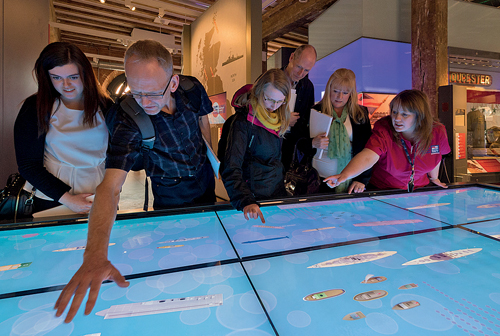
String Product is the museum’s centrepiece. The 23ft (7m)-tall paraboloid fills the central staircase and teaches visitors about multiplication
All of the exhibits were designed for MoMath.
All of the exhibits were designed for MoMath. These include the Square-Wheeled Trike
All of the exhibits were designed for MoMath.
All of the exhibits were designed for MoMath.
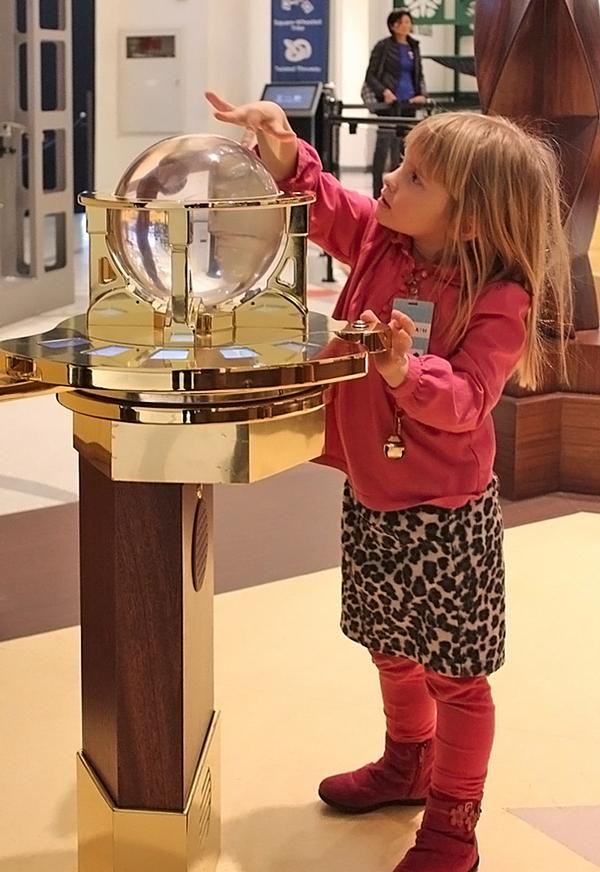
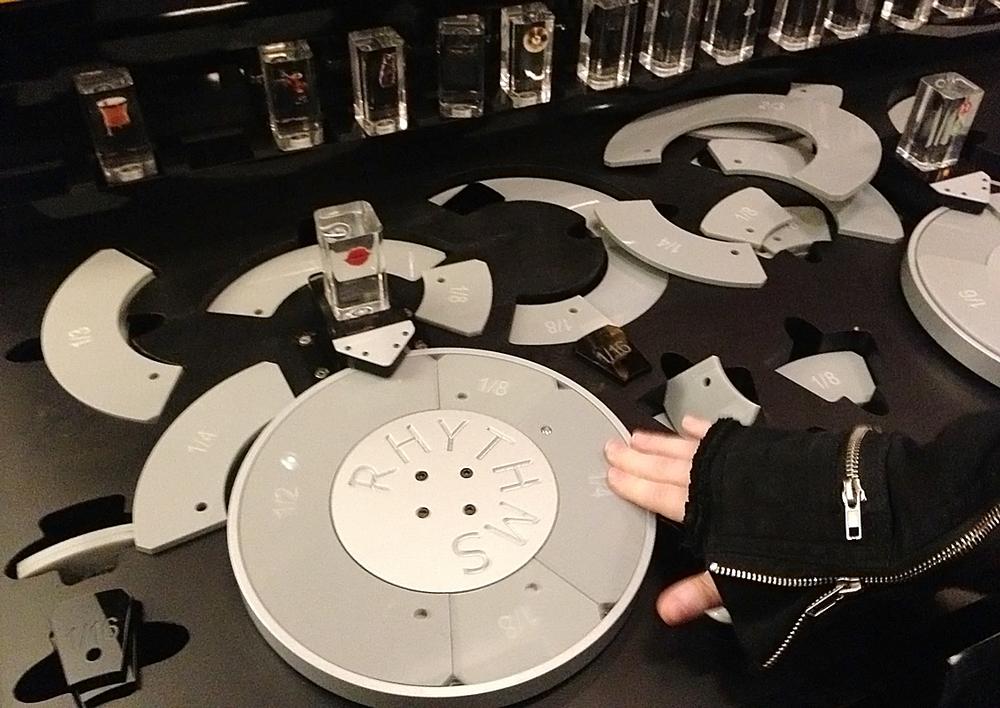
All of the exhibits were designed for MoMath. These include the Rhythms of Life
The Human Tree exhibit allows visitors to become a work of fractal art
Le Atelier by C.O.D.E. doesn't offer a standard bespoke service, it provides a highly
customised approach to designing massage beds and loungers in high-end wellness
environments. [more...]
Glen Whitney (left) and Cindy Lawrence (right) teamed up to create the Museum of Mathematics
On the subject of maths, Glen Whitney and Cindy Lawrence, co-founders and executive directors of the Museum of Mathematics (MoMath) in New York City, are surprisingly lyrical – they talk less about formulae, theorems and proofs than they do about beauty and wonder, excitement and falling in love. Yet despite this undisguised passion, they’re the first to admit that maths has an image problem.
“Math is too often presented as a cookbook of recipes to memorise, and it’s really a cultural problem,” says Lawrence, a certified public accountant (CPA) who spent 16 years as national editor for CPA education provider Becker, and runs a programme for gifted maths students in her spare time. “If I go to a party and get into a conversation about what I do, people aren’t ashamed to say, ‘I’m terrible at math.’ If I said I was an author, no one would say, ‘I’m a terrible writer,’ whereas to say ‘I’m not a math person’ is almost a badge of honour.”
Through MoMath, which celebrated its first anniversary in December, Whitney and Lawrence have made it their mission to turn this common perception of maths as difficult and dull on its head. “We’re not trying to shame anyone,” says Whitney, a Harvard- and UCLA-educated mathematics professor and former quantitative analyst for hedge fund Renaissance Technologies. “We’re just trying to show the face of math that people naturally want to engage with.”
With MoMath’s visitors for year one topping 173,000 (massively exceeding the projected 68,000), Whitney and Lawrence are clearly doing something right. Here, they talk about changing public perceptions, the dangers of ‘maths illiteracy’ and what’s next for North America’s only math’s museum.
How was the idea for MoMath born? Glen Whitney (GW): For about 20 years, there was a tiny math museum on Long Island. I went along, and it was sort of run down, but I had a great time. I thought nothing of it until I started coaching the math club at my daughter’s elementary school. I was talking to some teachers when the topic of the museum came up and I found out it had closed down. I thought perhaps this was an opportunity to create an institution with a similar flavour and feel, but a little bit more of an ambitious mission.
Cindy Lawrence (CL): I’d also visited that museum with my family before I met Glen. Then our daughters became friends. One day, Glen was picking his daughter up from my house when he asked if I’d ever heard of this museum. I said, “Sure, I love that museum.” And he said, “Well, it is no more.” In the next breath he said, “But I’m going to open another math museum.” And I said, “Wow, if you need any help with that let me know.” I thought, “What fun!” In my career I didn’t do anything focused on math, then suddenly here was this project that sounded like all play and no work.
What’s the aim of the museum? GW: Our mission is to change public perceptions of mathematics and share its evolving, creative, dynamic, beautiful nature. These are not words people associate with mathematics, but they give a much better description of what it really is than the ones most people would use.
Before MoMath, you launched a touring exhibition called the Math Midway. Tell us about that CL: We got together a group of sympathetic people and held monthly meetings. Then Glen met someone involved with the World Science Festival in New York City, who said we could have a booth, and I volunteered to spearhead that initiative. I thought I’d be sitting at a table handing out brochures, but Glen’s vision was to build an exhibit that would have a life beyond the festival, that would travel to other science centres around the country and be a sort of proof of concept for us. Out of that came the Math Midway, which has been travelling the country without a break since June 2009, and was in fact an excellent proof of concept. We had 3,000 to 4,000 people show up on the first day. So it really showed us, and showed people considering investing in the project, that it had legs.
The museum cost $23m. How easy was it to raise the money? GW: I don’t know that raising money is ever easy. You have to get people to share your passion and vision, get them excited, and try to meet as many people as possible. We were fortunate that our vision, and the fact that we’re the only institution of our kind in North America, resonated with some people.
What are the most popular exhibits in the museum? CL: The one that’s got the lion’s share of attention is the Square-Wheeled Trike. It’s just such a surprising thing. We all know square wheels don’t roll. So the fact that mathematics can teach you to create a track on which a square wheel will roll just as smoothly as a round wheel does on a flat surface is shocking to people, and they will line up for the opportunity to try it out for themselves.
Another is the Enigma Café, a puzzle area that’s designed to feel like a café. It’s amazing how many people gather in there and how long they spend.
GW: One of the reasons we wanted the Enigma Café is that for folks to get into math, puzzles are one of the biggest hooks. You get your teeth sunk into a knotty problem and you want to know the solution. And when you get it, the pieces fit together conceptually in your brain – or physically in the case of a puzzle – and you have a new perspective: you look at the world in a slightly different way than you did before that moment.
Which exhibit or exhibits best sum up what you’re trying to achieve? CL: What people miss about mathematics is that it has a lot of depth: you might not like long division, but that doesn’t mean there isn’t some part of math that can speak to you. And there are concepts in math that can speak to people at different levels. For me, the exhibit that best exemplifies that is String Product. It’s a giant paraboloid – a paraboloid is the curve you get when you throw a ball in the air – rotated to make a long bowl; it has lots of strings running through it and when you press numbered buttons they light up.
A toddler will press the buttons and get the sense that numbers are fun. Slightly older children will notice that when they press five and six, the string connecting them happens to cross the centre point at 30 – so they realise they’re looking at something beautiful that somehow conveys the multiplication table. Kids who have finished algebra and know a little bit about geometry can sit down with the equation of a paraboloid and the equation of a line and work out why that has to happen. And even mathematicians who see the exhibit and didn’t know about that property are delighted by it.
GW: For me, it’s the Human Tree. A camera picks up your image and projects it onto a screen, but replaces your arms with a smaller picture of you, and the arms of that smaller picture with yet another picture of you, and so on, producing a pattern known as a fractal – a pattern which is similar to itself on a smaller scale. There’s a rich landscape of fractals you can make just by varying the angles and length of your arms.
Some of the key elements we use to draw people in and show them the beauty and creativity of mathematics are right there: it’s visually beautiful, you see surprising patterns and you’re engaged with your entire body.
What was the biggest challenge of opening the museum? CL: We’re one of the only science centres I know of that has opened with all its exhibits designed completely from scratch. That was both a joy and a challenge. We had ideas contributed from mathematicians around the world, so our first challenge was whittling those down. Then we’d create drawings and a little storyline for each exhibit and go out to companies that might be able to build it. Some got thrown out because they were too expensive, others because the fabricator had no idea how to do it – but what one company would say was impossible, another would say, “Oh, that? Yes, we can do that.”
GW: We ended up with eight different contractors, when the advice was to have two or three. Managing all those different providers was a challenge.
Who or what made you love maths? GW: When I was in grade school, I didn’t like math. I found it came fairly easily to me and I got good grades, but I had no enthusiasm for it. Then one summer my parents sent me to a math camp. The very first weekend I broke my collarbone playing soccer, and from that point on I couldn’t do much apart from work on the problems set in our daily math classes.
Somehow this answer would line up with that answer and I started to see patterns emerging. Then I’d get glimpses of the reasons for these structures and that would open up new vistas. I discovered that it was all really quite beautiful. Plus, I was in a community of peers who were just as excited by it as I was. So I fell in love with math, and have been in love with it ever since.
CL: I enjoyed math as soon as I realised it was something you could understand rather than just memorise, but it was a wonderful calculus teacher in high school who really made me feel that it could be beautiful.
Can you give some examples of how we use maths in everyday life? CL: Just trying to work out the most efficient order of all the errands you need to do is very mathematical.
I need to go to the grocery store, post office and bank and stop off at the school to pick up a child – what order should I do that in? You’re using math when you make those calculations in your mind.
GW: Yes! Companies like FedEx pay mathematicians good money to figure out exactly that: what is the most efficient route from A to B.
CL: Glen does math tours that underscore the fact that math is all around us: in the timing of a traffic light, the way the subway runs. We have a place that sells ice cream shakes near the museum that has very long lines and Glen has taken people there to talk about queuing theory, or he’ll talk about the math in the way certain plants grow.
GW: The gingko tree is a good example. It’s a tree you see fairly often in New York City and one that everyone is able to recognise at a glance, though they don’t really know why. It’s because, unlike most other trees, all of the junctions of its branches are right angles. It’s not something most people realise, but when you have it pointed out to you, you say, aha, there it is! It’s the geometry of the tree that gives you the ability to recognise it.
What common mathematical mistakes do people make? GW: There are certain aspects of math that people are naturally quite adept at, but there are other areas where our intuition leads us astray.
One of the most notorious is assessing risks and probabilities. An important example is in medicine, when you have a routine screening for a rare condition and you get a positive result. You ask, “How reliable is this test?” and the doctor says: “Well, it’s 99 per cent accurate: 99 per cent of the time, if it says you have the disease, you have the disease.” So you immediately think, “Oh no, there’s a 99 per cent chance I have this disease!”
But that’s not at all the case. If the disease has a frequency of only one in 10,000 in the population at large, it’s actually extremely likely that you’ve got a false positive, just because the original disease is so unlikely. Even though only one per cent of positives are false positives, it’s much more likely that you’re that one in 100 than the one in 10,000 that actually has the disease.
So people do have difficulty understanding probabilities and it can lead to errors of judgement. It’s called the base rate fallacy.
What’s next for MoMath? CL: We’re working on a number of programme ideas right now, so we’re back in fundraising mode. For example, there’s a lot of interest in having a math and music concert series here.
GW: We’re also commissioning our first new exhibits since we opened. One is entitled Motion Scape and will help visitors better understand the relationship between position, velocity and acceleration. The other is a dramatic lobby piece.
What drives you? GW: The opportunity to share the beauty and wonder of mathematics. CL: The excitement of coming up with ideas, then the pleasure of watching people enjoy the things we’ve created.
Read more from this issue of Spa Business magazine
View contents of Spa Business 2014 issue 2
Editor's letter: The New Philanthropists
Tech is hot and as the growing number of tech millionaires
turn their thoughts to philanthropy, tech-related
attactions will prosper
Profile: Mario Mamon
The current chair of IAAPA talks about
his role with the organisation, doubling
the size of family theme park Enchanted
Kingdom in the Philippines and the
devastation of Super Typhoon Haiyan
Museums: MOHAI
MOHAI's executive director,
Leonard Garfield, talks about
the Seattle museum's new Bezos
Center for Innovation, named after
Amazon founder Jeff Bezos
Science centres: Appliance of science
Andreas Waschk and Mike Boris
explain how they made Blueprint
Entertainment into Europe's largest
private science centre operator
Museums: Olympic Movement
Director Francis Gabet describes how
The Olympic Museum's extensive
refurbishment reflects the excitement
and diveristy of the modern Games
Planetariums: Starry skies
The newly upgraded Fiske Planetarium in
Boulder, Colorado now boasts the highest
specification full dome theatre in the US.
Director Douglas Duncan tells us more
Museums: Beautiful minds
The founders of MoMath, the New York
Museum of Mathematics, tell us how
they're on a mission to get ordinary
people to fall in love with maths
World expos: Brave new world
Christian Lachel considers how world
expos can raise global awareness
about what matters for the planet
3D/4D/5D: IMERSA
A review of the fifth annual IMERSA
conference held in Denver, Colorado
Advertisement feature: EAS 2014
The exhibitors reveal what they’ll be showcasing at EAS in
September and what the hot topics of conversation will be
Waterparks: Wet'n'Wild
Wet'n'Wild Sydney has welcomed
a million visitors through its gates
since opening in December. Managing
director Chris Warhurst tells us why
Ticketing: Convenience store
Gateway's Liesel Tarquini explains
how mobile web stores can help
generate additional revenue
for attractions operators
Among MoMath’s major sponsors was Google, which donated $2m (E1.4m, £1.2m) in 2011. In total, the internet giant awarded $12m (E8.7m, £7.2m) to seven science centres across the US and the UK in the same period.
Each year, through its charitable arm, Google Giving, the company donates $100m (E72.4m, £59.6m) in grants, 50,000 hours and $1bn (E724m, £596m) in products to good causes. These range from Global Impact Awards – focused on education and computer science; the environment; development; and empowering women and girls – to Community Impact Awards, covering not only disaster relief but also deserving non-profit organisations in the countries where Google is based.
Community initiatives include the Roberta Initiative, Germany; the restoration of Bletchley Park, UK; and The High Line, New York City.
Rhianon Howells is a freelance writer for numerous publications including The Guardian [email protected]
String Product is the museum’s centrepiece. The 23ft (7m)-tall paraboloid fills the central staircase and teaches visitors about multiplication
All of the exhibits were designed for MoMath.
All of the exhibits were designed for MoMath. These include the Square-Wheeled Trike
All of the exhibits were designed for MoMath.
All of the exhibits were designed for MoMath.
All of the exhibits were designed for MoMath. These include the Rhythms of Life
The Human Tree exhibit allows visitors to become a work of fractal art
A recent survey by the UK Spa Association (UKSA) into the industry’s approach to cancer care
has revealed that almost half of participating respondents (46 per cent) are unaware that
cancer is a disability and guests with a cancer diagnosis must be given
Mexican operator, Solmar Hotels and Resorts, is hosting a series of events in celebration of
Global Wellness Day, including a Temazcal ceremony at its Playa Grande Resort and Spa in Los
Cabos.
Mandarin Oriental has announced a standalone residence brand, Mansions, which will debut at
Emirates Palace, Mandarin Oriental Mansions, Abu Dhabi, in 2029.
Four Seasons Resort The Nam Hai in Hoi An, Vietnam, has put together a Global Wellness Day
(GWD) agenda with activations rooted in nature and shaped by four pillars of Joy – in
alignment with the day’s theme #JoyMagenta.
The Global Wellness Summit (GWS) will celebrate its 20th anniversary at the 2026 event in
Phuket, Thailand, later this year with the theme: The Science, Art and Soul of Wellness.
Auko, an all-inclusive development, is opening in Phong Nha in Vietnam in Q3 2026, with a
series of 30 tented eco-lodges and wellness hospitality operations by Lumina Wellbeing.
Therme Manchester’s 28-acre development, which will include interconnected glass pavilions
that measure 65,000sq m, will be the largest bathing and wellbeing attraction in the world once
complete, according to prof David Russell, CEO of Therme UK.
Naples Beach Club, a Four Seasons Resort, has opened a 2,800sq m spa called The Sanctuary,
with the design and concept inspired by the Native American people that populated Florida’s
Southwest coast – the Calusa.
Swire Hotels’ luxury hospitality brand Upper House has revealed it will roll out its two-day
House of Healing retreats at its three hotels in Hong Kong, Chengdu and Shanghai.
Le Atelier by C.O.D.E. doesn't offer a standard bespoke service, it provides a highly
customised approach to designing massage beds and loungers in high-end wellness
environments. [more...]