A groundbreaking new study shows that massage can help muscle re-growth after an injury – even when applied to the opposite, uninjured limb. Jane Kitchen takes a closer look
By Jane Kitchen | Published in Spa Business 2017 issue 4
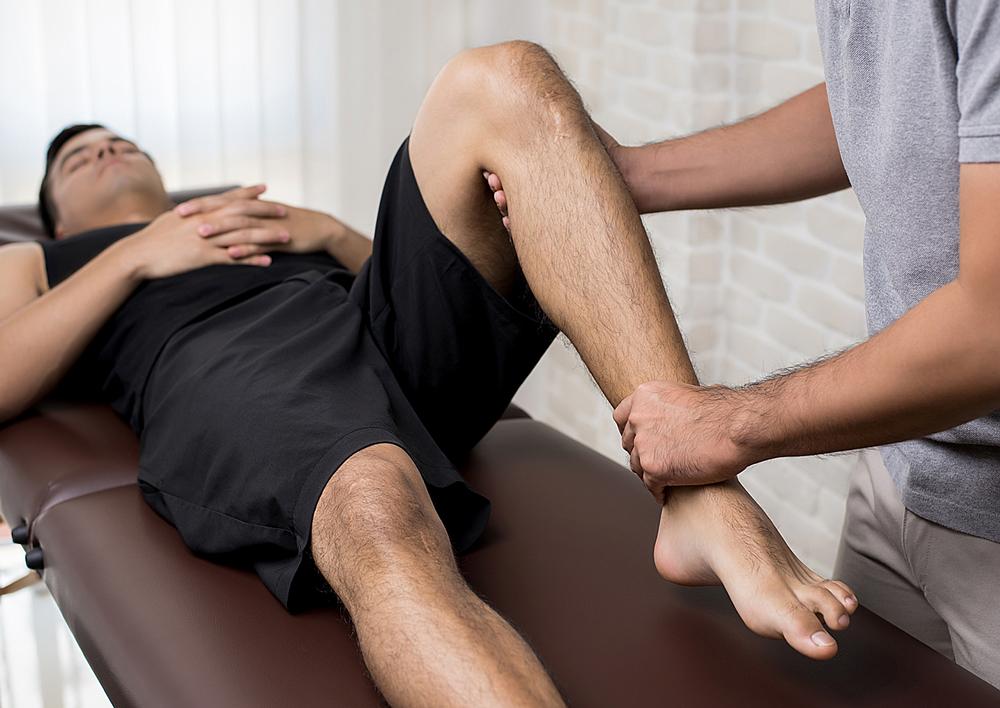
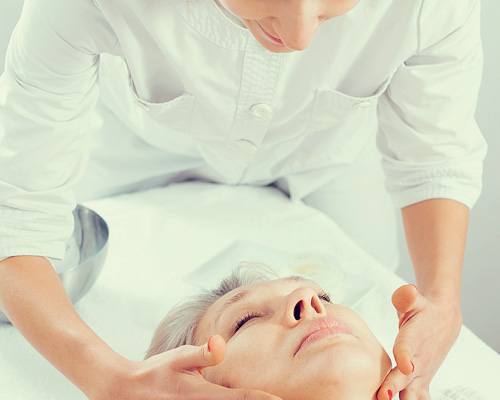
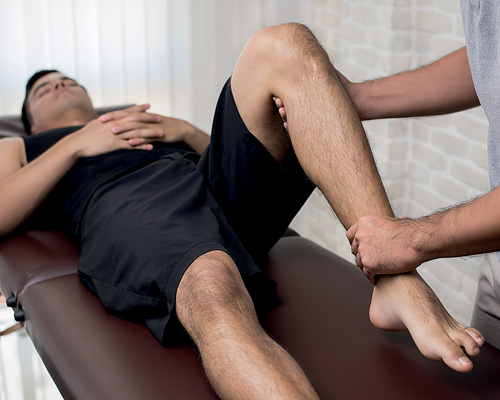
Massage could be used for patients after orthopaedic surgeries / shutterstock
Massage has long been known in the physiology world as an easy-to-use treatment with very few side effects, which can also lessen pain, decrease anxiety and stress, increase flexibility, improve immunity and increase blood flow. But its value for muscle regeneration has also now been demonstrated, and researchers from Colorado State University (CSU) and the University of Kentucky have found some surprising new benefits with important implications for healing.
The researchers have shown that massage can increase the re-growth of muscle tissue after an injury – even when applied to the opposite, uninjured limb. Their paper, published in November in The Journal of Physiology, showed that muscle grew faster after a massage because the making of protein in cells was improved. They also showed that when one leg was massaged, the muscle in the other, non-massaged leg also grew faster.
This has implications for people on bed rest, the elderly or those having a prolonged hospital stay, as muscle is lost quickly during periods of disuse and is difficult to grow back – especially in the elderly. Karyn Hamilton and Ben Miller, faculty members of CSU’s Department of Health and Exercise Science and authors on the paper, say the concept that massaging one limb might also lead to benefits in another non-massaged limb is groundbreaking.
“For instance, if you injured one leg and couldn’t massage it because of that injury, we now have evidence suggesting that massaging the other non-injured leg could lead to benefits in the injured leg,” says Hamilton. “That’s a novel finding with potentially very important implications.”
The researchers used rats that underwent a period of inactivity to decrease muscle mass, then were allowed to recover. During the recovery period, the rats were massaged every other day, and the researchers analysed the muscle for the size of muscle fibres, making of proteins, presence of other cells and communication in the cells that programmes them to grow.
The research team is beginning studies with human participants, and hopes to find similar implications.
“We foresee that massage could be used in situations where other treatments, such as exercise, can’t be applied: in the intensive care unit and in patients who are under non-weight-bearing orders after orthopaedic surgeries,” says Esther Dupont-Versteegden, one of the investigators at the University of Kentucky’s College of Health Sciences.
Read more from this issue of Spa Business magazine
Promotional feature: Anne Semonin
Katherine Connolly, newly appointed global
director of retail and spa operations at Anne
Semonin, discusses her plans for the brand
Promotional feature: Thalion
Thalion is the first company to develop highly
specialised mineral therapies for clients, says
training manager Sophie Alemany
Research: Finishing touch
A new study shows that massage can
help muscle re-growth after an injury –
even when applied to the opposite limb
Contrast therapy, based on the alternation of hot and cold rituals, has become one of the
most valued practices in the fields of wellness and recovery. [more...]
+ More featured suppliers
COMPANY PROFILES
TechnoAlpin Indoor
TechnoAlpin is the world leader for snowmaking systems. With the Indoor snow division, TechnoAlpin c [more...]
TLEE Spas + Wellness
Founded in 2010 by industry visionary Tracy Lee, TLEE Spas + Wellness is a globally acclaimed spa an [more...]
A groundbreaking new study shows that massage can help muscle re-growth after an injury – even when applied to the opposite, uninjured limb. Jane Kitchen takes a closer look
By Jane Kitchen | Published in Spa Business 2017 issue 4
Massage could be used for patients after orthopaedic surgeries / shutterstock
Massage has long been known in the physiology world as an easy-to-use treatment with very few side effects, which can also lessen pain, decrease anxiety and stress, increase flexibility, improve immunity and increase blood flow. But its value for muscle regeneration has also now been demonstrated, and researchers from Colorado State University (CSU) and the University of Kentucky have found some surprising new benefits with important implications for healing.
The researchers have shown that massage can increase the re-growth of muscle tissue after an injury – even when applied to the opposite, uninjured limb. Their paper, published in November in The Journal of Physiology, showed that muscle grew faster after a massage because the making of protein in cells was improved. They also showed that when one leg was massaged, the muscle in the other, non-massaged leg also grew faster.
This has implications for people on bed rest, the elderly or those having a prolonged hospital stay, as muscle is lost quickly during periods of disuse and is difficult to grow back – especially in the elderly. Karyn Hamilton and Ben Miller, faculty members of CSU’s Department of Health and Exercise Science and authors on the paper, say the concept that massaging one limb might also lead to benefits in another non-massaged limb is groundbreaking.
“For instance, if you injured one leg and couldn’t massage it because of that injury, we now have evidence suggesting that massaging the other non-injured leg could lead to benefits in the injured leg,” says Hamilton. “That’s a novel finding with potentially very important implications.”
The researchers used rats that underwent a period of inactivity to decrease muscle mass, then were allowed to recover. During the recovery period, the rats were massaged every other day, and the researchers analysed the muscle for the size of muscle fibres, making of proteins, presence of other cells and communication in the cells that programmes them to grow.
The research team is beginning studies with human participants, and hopes to find similar implications.
“We foresee that massage could be used in situations where other treatments, such as exercise, can’t be applied: in the intensive care unit and in patients who are under non-weight-bearing orders after orthopaedic surgeries,” says Esther Dupont-Versteegden, one of the investigators at the University of Kentucky’s College of Health Sciences.
Read more from this issue of Spa Business magazine
Promotional feature: Anne Semonin
Katherine Connolly, newly appointed global
director of retail and spa operations at Anne
Semonin, discusses her plans for the brand
Promotional feature: Thalion
Thalion is the first company to develop highly
specialised mineral therapies for clients, says
training manager Sophie Alemany
Research: Finishing touch
A new study shows that massage can
help muscle re-growth after an injury –
even when applied to the opposite limb
Bel Hotel Oléron Thalasso and Spa, MGallery Collection has opened on the French island Île
d'Oléron off the country’s western coast with a 27-treatment-room spa.
Manipulating the gut microbiome could become a powerful tool for preserving brain health and
resilience as people age, according to research led by Professor Paola Tognini, a neuroscientist
at the Sant'Anna School of Advanced Studies in Pisa, Italy.
Jessica Sloyan, a wellness operations and training expert, has established an independent
private training academy to provide professional qualifications for practitioners looking to offer
immersive wellness experiences.
The International Spa Association (ISPA) has published its full 2026 US Spa Industry Study,
providing further insights into the region’s total US$1 billion (€855 million, £780 million)
industry revenue increase from 2024 to 2025.
Ameyalli, the 78-acre wellbeing resort and residential community in Midway in Utah, US, has
broken ground on phase two of the hot spring development – the Ameyalli Resort and Spa –
which is due to open in 2028.
TLee Spas and Wellness has revealed the design concept for a high-tech spa with body
mapping scanners to improve public health, for AI company Midjourney.
Gran Hotel Taoro in northern Tenerife, Spain, has completed the final phase of its three-year
renovation with the debut of its Sandára Wellness Centre.
Hand and Stone Massage and Facial Spa, the spa business with more than 650 locations across
the US and Canada, has appointed franchise expert Carrie Walsh as CEO as the company plans
to expand.
Synergy – The Retreat Show, the global trade show for retreats, has launched a global research
initiative that will provide insights into the retreat sector from both consumer and industry
perspectives.
Contrast therapy, based on the alternation of hot and cold rituals, has become one of the
most valued practices in the fields of wellness and recovery. [more...]
+ More featured suppliers
COMPANY PROFILES
TechnoAlpin Indoor TechnoAlpin is the world leader for snowmaking systems. With the Indoor snow division, TechnoAlpin c [more...]