A new study is the first to define and put a value on the global mental wellness industry – estimating it to be worth US$121bn. But what does this mean for spas?
There’s been a huge shift in the way people think about mental wellness this year. Even before the coronavirus pandemic, 15 per cent of the world’s population suffered from mental illness and substance abuse disorders, dementia was on the rise and happiness was declining. In fact, the economic and social burden of mental illness and mental unwellness is predicted to reach US$16.1tn (€13.5tn, £12.2tn) globally by 2030 according to the World Economic Forum. Beyond this, it’s linked to high rates of poverty and has a much wider impact on individuals, families and society.
Being ‘healthy of mind’ could help to address some of these needs and increase people’s overall wellbeing, as well as helping to ease the cost burden of mental illness, giving governments and businesses – including spas – an incentive to support and promote it. Up until now, however, there’s been no attempt to define or quantify this burgeoning market.
First of its kind It’s with this backdrop that the Global Wellness Institute (GWI) has unveiled a new study that defines mental wellness as an industry for the first time. It pinpoints its worth as a US$121bn (€101.6bn, £91.8bn) sector based on consumer spending in four markets in 2019. Defining the Mental Wellness Economy was released at the Global Wellness Summit (GWS) in the US on 9 November (see Spa Business 2020 issue 4 p82).
Presenting the research, study co-author Ophelia Yeung said: “This grim picture is why mental wellness is so important now and why it has attracted so much interest from consumers and business.”
The study defines mental wellness as more than just an absence of mental illness. It’s “an internal resource that helps us think, feel, connect and function; it is an active process that helps us to build resilience, grow and flourish”.
The GWI study homed in on consumer-facing businesses that provide products and services specifically for mental wellness to calculate its value. Yeung added: “People are desperate for strategies to improve their mental health and businesses have been jumping in with all kinds of products and solutions.”
Four main markets which are coming together in an ‘emerging mental wellness industry’ were identified in the study. These markets, or subsectors, include self-improvement (therapy, coaching, mentoring and cognitive enhancement); meditation and mindfulness; brain-boosting nutraceuticals and botanicals; senses (sensory experiences), spaces and sleep (see Spa Business 2020 issue 4 p91).
As a caveat, the study acknowledges that these subsectors are not necessarily the most important or effective for helping with mental wellness. “They are simply the practices that are most closely and proactively identified by businesses and consumers as being related to mental wellness,” it notes.
Spa relevance The 122-page industry white paper Mental Wellness: Pathways, Evidence and Horizons has already highlighted how services offered by spas are already proven to benefit the mind (see http://lei.sr/f8n1s). This new piece of research from GWI now gives spa stakeholders an idea of how to better position themselves in the emerging mental wellness industry. Maybe there’s a niche they haven’t considered. There could be potential for them to specialise in a certain area. Or perhaps they might want to span all of the subsectors.
Joining Yeung in presenting the study findings as co-author Katherine Johnston added: “Businesses can shape and support our mental wellness at an individual and at a community level. They have a huge role to play. At the individual level, businesses are helping to bring new mental wellness modalities and practices to more and more consumers through different channels and at different price points.
“At the community level, businesses also shape our built environments and the culture of those environments.”
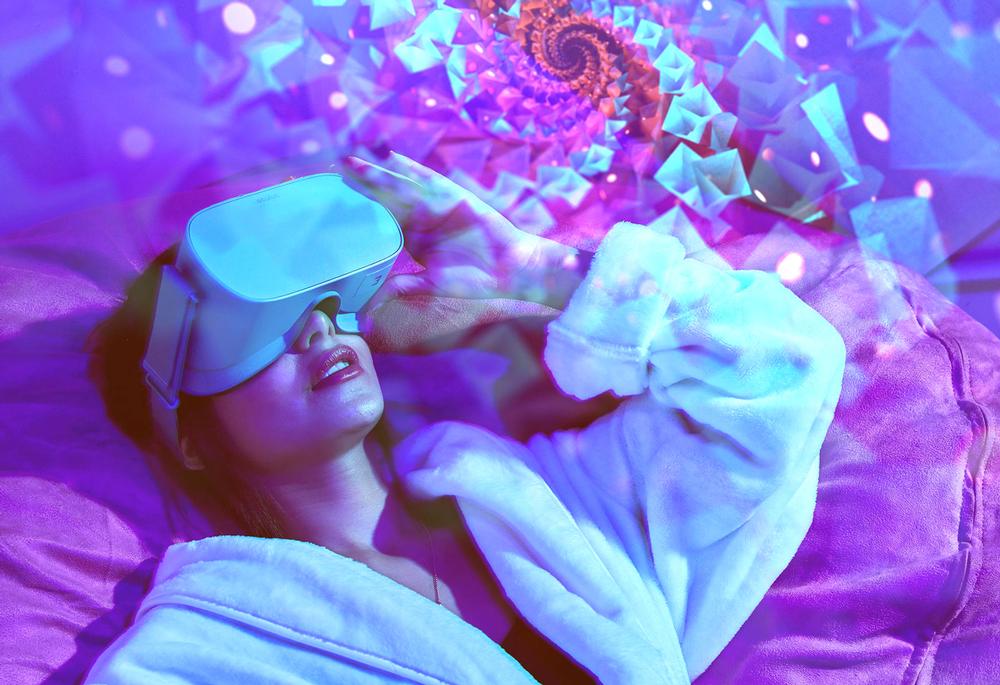
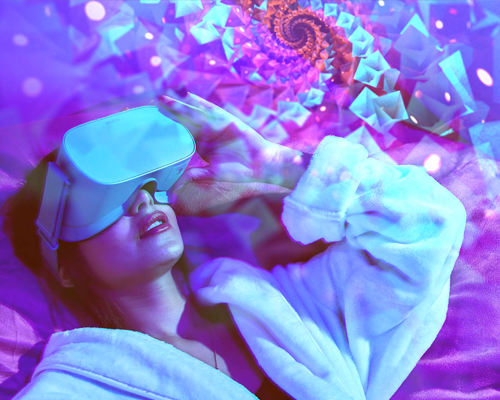
■ GWI values the senses, spaces & sleep subsector at US$49.5bn (€41.7bn, £37.3bn), which makes it the biggest in the mental wellness industry. It covers a broad range of products, services and designs that target our senses – sound, scent, light and touch. Spas fit neatly into this category with the growing number offering mood-boosting, multi-sensory experiences – from forest bathing and cuddle therapy to VR and floatation. Sensory-based design and architecture, especially in wellness real estate developments, is a growing part of the sector too. The goliath in this market, however, is sleep and consumer spending on the array of products and services, including tech gadgets, which promote a good night’s sleep is exploding.
■ The self-improvement subsector, estimated to be worth US$33.6bn (€28.2bn, £25.5bn), includes a wide range of self-help and personal development services and activities. Anything from self-help books, apps, online platforms and gurus to organisations and institutes offering classes, workshops and retreats. Destination spas which dedicate numerous sessions to teaching self-care spring to mind here, some, such as Multiversity 1440 in the US, even dedicate their whole offering to this concept.
■ Supplements, herbs and botanicals, and traditional remedies we take to improve our mental health and wellbeing all fall into the brain-boosting nutraceuticals & botanicals subcategory. Also included are functional foods and beverages that claim to have brain health benefits and the growing area of cannabis and its (legal) derivatives for mental wellness and treatment purposes. Maybe this is a subsector that spas could specialise in to differentiate themselves? Or at the very least, this could be a way to boost retail offers. GWI research puts its value at US$34.8bn (€29.2bn, £26.4bn).
■ The meditation & mindfulness subsector encompasses all forms of meditation/mindfulness practices and supporting products. Key revenue categories include classes, retreats, online platforms, apps, books and videos. The research also notes a growing market for accessories and gadgets, trackers and monitors. Estimated to be worth US$2.9bn (€2.4bn, £2.2bn) it’s by far the smallest of the subsectors, but GWI points out millions of people practice meditation and mindfulness worldwide without spending any money on it.
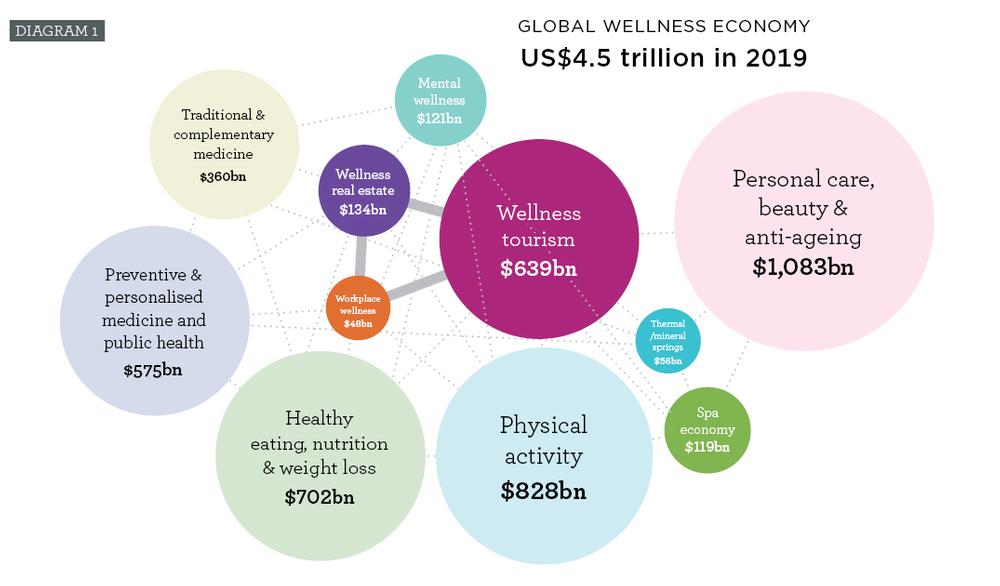
New ‘industry bubble’ The GWI first published its Global Wellness Economy Monitor, which defines and measures the wellness industry worldwide, in 2014. It spans 10 industries, including spas and hot springs, and the latest update values it at an impressive US$4.5tn (€3.8tn, £3.4tn). For the first time, it is now adding a new ‘industry bubble’ with the mental wellness industry which it’s calling “a significant addition to our framework” (see Diagram 1).
“This study is the first time anyone has measured the mental wellness industry and it’s exciting to see these big numbers,” said Johnston. “With the mental wellness crisis the world is facing due to COVID-19, there are massive needs to be met. There’s huge demand and there are huge opportunities. Business innovation is important. But businesses also need to be cautious, because they’re responsible for what they offer and do. We should not look at this US$121bn industry and this study as the next profit-making grab, but rather as an opportunity to make sure we’re offering the right kind of mental wellness solutions to the people who desperately need this help.”
Johnston revealed that next year’s GWI research will focus on updating the numbers in the Global Wellness Economy Monitor. This is set to give some indication of how coronavirus has impacted the industry, as well as potential recovery, following a vaccine rollout.
"People are desperate for
strategies to improve
their mental health
and businesses" – Ophelia Yeung
"With the mental wellness crisis
that the world is now facing
due to COVID-19, there are
massive needs to be met" – Katherine Johnston
The new mental wellness industry research was presented at the 2020 Global Wellness Summit (see Spa Business 2020 issue 4 p82)
Diagram 1 note: Figure for Mental Wellness is for 2019; figure for Physical Activity is 2018; figures for all other sectors are for 2017. Dark coloured bubbles are the sectors for which GWI conducts in-depth, country-level primary research. Light coloured bubbles are sectors for which GWI aggregates global estimates only.
Read more about how the myriad of services offered by spas have already been scientifically proven to benefit the mind in the white paper Mental Wellness: Pathways, Evidence and Horizons – see http://lei.sr/f8n1s
Read more from this issue of Spa Business magazine
View contents of Spa Business 2020 issue 4
Editor's letter: Nurturing mental health
It’s time for spas re-evaluate their mental wellness approach to help governments and society to tackle the escalating mental health crisis says Katie Barnes
Spa people: Dr Narinthorn Surasinthon
RAKxa Jai, a cutting-edge medi-wellness spa, has opened in partnership with Bumrungrad International Hospital and Minor Hotels in Bangkok. Spa Business talks to its COO
Spa people: Isabelle Duchesneau
The executive director of Québec's Le Monastère Augustines explains why its priority of serving caretakers is more relevant today than ever
Spa people: Michael Banissy
The world's largest study on touch uncovers the role it plays in our health and wellbeing. Spa Business talks to the lead researcher
Interview: Krip Rojanastien
Chiva-Som’s CEO talks to Spa Business magazine about guiding the destination spa through COVID-19 and its first contract management project in Qatar
Ask an expert: Corridors of power
What will it take to make politicians realise the value of spas? Spa Business magazine asks those in government and others who’ve made inroads
Promotion: Artofcryo: Cold Calling
Artofcryo.com aims to offer the best whole-body cryotherapy chambers as well as a complete, reliable and effective solution for operators and results for guests
Promotion: ISPA: Lead, inform, inspire
Lead, Inform, Inspire. It’s been quite a year for ISPA, with its firm commitment to supporting members through the pandemic, as president, Lynne McNees explains
Interview: Mark Hennebry
Ensana’s chair tells Spa Business magazine about its landmark development, Buxton Crescent, one of the only genuine spa hotels in the UK
Promotion: Lemi: Creating the dream team
This year leading Italian supplier Lemi launched three new spa solutions, and ventured into the creation of signature treatments for the first time. General manager Matteo Brusaferri explains why he sees this as the way forward to help spas maximise their investment
Interview: Luisa Anderson
A Longevity Garden and inner healing room are just two of the extra special features at the new Healing Village Spa at Four Seasons Jimbaran Bay, Bali, says its regional spa director
Promotion: Biologique Recherche
Skincare specialist, Biologique Recherche, is using its knowledge of chronobiology to create new approaches to skincare which yield powerful results
Event review: Global Wellness Summit 2020
This year’s Global Wellness Summit saw two US surgeon generals, leading spa stakeholders and wellness professionals look towards the role they have to play following the global pandemic. Spa Business magazine gives its highlights
Research: Matter of minds
A new study is the first to define and put a value on the global mental wellness industry – estimating it to be worth US$121bn. But what does this mean for spas?
Sponsored briefing: Starpool: Cargo-tecture
During lockdown, Riccardo Turri, CEO of Starpool, was inspired to create a whole new category of product, based on recycled containers. The result is the new i.con spa brand, which fuses luxury, wellness, recycling and design
Software: All booked up
Spa software suppliers take a look at 'big data' to reveal the booking trends they’ve seen since spas have reopened
Promotion: Voya: supporting spa partners
Jessica Anhold, Voya’s head of global sales and marketing, talks community in a time of crisis and how the company is supporting its spa partners
Le Atelier by C.O.D.E. doesn't offer a standard bespoke service, it provides a highly
customised approach to designing massage beds and loungers in high-end wellness
environments. [more...]
+ More featured suppliers
COMPANY PROFILES
Borghese Roma
Borghese is an Italian luxury skincare brand founded in 1957 by Princess Marcella Borghese. [more...]
Aromatherapy Associates
Aromatherapy Associates is a world-leading British wellness brand, harnessing the power of essential [more...]
A new study is the first to define and put a value on the global mental wellness industry – estimating it to be worth US$121bn. But what does this mean for spas?
There’s been a huge shift in the way people think about mental wellness this year. Even before the coronavirus pandemic, 15 per cent of the world’s population suffered from mental illness and substance abuse disorders, dementia was on the rise and happiness was declining. In fact, the economic and social burden of mental illness and mental unwellness is predicted to reach US$16.1tn (€13.5tn, £12.2tn) globally by 2030 according to the World Economic Forum. Beyond this, it’s linked to high rates of poverty and has a much wider impact on individuals, families and society.
Being ‘healthy of mind’ could help to address some of these needs and increase people’s overall wellbeing, as well as helping to ease the cost burden of mental illness, giving governments and businesses – including spas – an incentive to support and promote it. Up until now, however, there’s been no attempt to define or quantify this burgeoning market.
First of its kind It’s with this backdrop that the Global Wellness Institute (GWI) has unveiled a new study that defines mental wellness as an industry for the first time. It pinpoints its worth as a US$121bn (€101.6bn, £91.8bn) sector based on consumer spending in four markets in 2019. Defining the Mental Wellness Economy was released at the Global Wellness Summit (GWS) in the US on 9 November (see Spa Business 2020 issue 4 p82).
Presenting the research, study co-author Ophelia Yeung said: “This grim picture is why mental wellness is so important now and why it has attracted so much interest from consumers and business.”
The study defines mental wellness as more than just an absence of mental illness. It’s “an internal resource that helps us think, feel, connect and function; it is an active process that helps us to build resilience, grow and flourish”.
The GWI study homed in on consumer-facing businesses that provide products and services specifically for mental wellness to calculate its value. Yeung added: “People are desperate for strategies to improve their mental health and businesses have been jumping in with all kinds of products and solutions.”
Four main markets which are coming together in an ‘emerging mental wellness industry’ were identified in the study. These markets, or subsectors, include self-improvement (therapy, coaching, mentoring and cognitive enhancement); meditation and mindfulness; brain-boosting nutraceuticals and botanicals; senses (sensory experiences), spaces and sleep (see Spa Business 2020 issue 4 p91).
As a caveat, the study acknowledges that these subsectors are not necessarily the most important or effective for helping with mental wellness. “They are simply the practices that are most closely and proactively identified by businesses and consumers as being related to mental wellness,” it notes.
Spa relevance The 122-page industry white paper Mental Wellness: Pathways, Evidence and Horizons has already highlighted how services offered by spas are already proven to benefit the mind (see http://lei.sr/f8n1s). This new piece of research from GWI now gives spa stakeholders an idea of how to better position themselves in the emerging mental wellness industry. Maybe there’s a niche they haven’t considered. There could be potential for them to specialise in a certain area. Or perhaps they might want to span all of the subsectors.
Joining Yeung in presenting the study findings as co-author Katherine Johnston added: “Businesses can shape and support our mental wellness at an individual and at a community level. They have a huge role to play. At the individual level, businesses are helping to bring new mental wellness modalities and practices to more and more consumers through different channels and at different price points.
“At the community level, businesses also shape our built environments and the culture of those environments.”
■ GWI values the senses, spaces & sleep subsector at US$49.5bn (€41.7bn, £37.3bn), which makes it the biggest in the mental wellness industry. It covers a broad range of products, services and designs that target our senses – sound, scent, light and touch. Spas fit neatly into this category with the growing number offering mood-boosting, multi-sensory experiences – from forest bathing and cuddle therapy to VR and floatation. Sensory-based design and architecture, especially in wellness real estate developments, is a growing part of the sector too. The goliath in this market, however, is sleep and consumer spending on the array of products and services, including tech gadgets, which promote a good night’s sleep is exploding.
■ The self-improvement subsector, estimated to be worth US$33.6bn (€28.2bn, £25.5bn), includes a wide range of self-help and personal development services and activities. Anything from self-help books, apps, online platforms and gurus to organisations and institutes offering classes, workshops and retreats. Destination spas which dedicate numerous sessions to teaching self-care spring to mind here, some, such as Multiversity 1440 in the US, even dedicate their whole offering to this concept.
■ Supplements, herbs and botanicals, and traditional remedies we take to improve our mental health and wellbeing all fall into the brain-boosting nutraceuticals & botanicals subcategory. Also included are functional foods and beverages that claim to have brain health benefits and the growing area of cannabis and its (legal) derivatives for mental wellness and treatment purposes. Maybe this is a subsector that spas could specialise in to differentiate themselves? Or at the very least, this could be a way to boost retail offers. GWI research puts its value at US$34.8bn (€29.2bn, £26.4bn).
■ The meditation & mindfulness subsector encompasses all forms of meditation/mindfulness practices and supporting products. Key revenue categories include classes, retreats, online platforms, apps, books and videos. The research also notes a growing market for accessories and gadgets, trackers and monitors. Estimated to be worth US$2.9bn (€2.4bn, £2.2bn) it’s by far the smallest of the subsectors, but GWI points out millions of people practice meditation and mindfulness worldwide without spending any money on it.
New ‘industry bubble’ The GWI first published its Global Wellness Economy Monitor, which defines and measures the wellness industry worldwide, in 2014. It spans 10 industries, including spas and hot springs, and the latest update values it at an impressive US$4.5tn (€3.8tn, £3.4tn). For the first time, it is now adding a new ‘industry bubble’ with the mental wellness industry which it’s calling “a significant addition to our framework” (see Diagram 1).
“This study is the first time anyone has measured the mental wellness industry and it’s exciting to see these big numbers,” said Johnston. “With the mental wellness crisis the world is facing due to COVID-19, there are massive needs to be met. There’s huge demand and there are huge opportunities. Business innovation is important. But businesses also need to be cautious, because they’re responsible for what they offer and do. We should not look at this US$121bn industry and this study as the next profit-making grab, but rather as an opportunity to make sure we’re offering the right kind of mental wellness solutions to the people who desperately need this help.”
Johnston revealed that next year’s GWI research will focus on updating the numbers in the Global Wellness Economy Monitor. This is set to give some indication of how coronavirus has impacted the industry, as well as potential recovery, following a vaccine rollout.
"People are desperate for
strategies to improve
their mental health
and businesses" – Ophelia Yeung
"With the mental wellness crisis
that the world is now facing
due to COVID-19, there are
massive needs to be met" – Katherine Johnston
The new mental wellness industry research was presented at the 2020 Global Wellness Summit (see Spa Business 2020 issue 4 p82)
Diagram 1 note: Figure for Mental Wellness is for 2019; figure for Physical Activity is 2018; figures for all other sectors are for 2017. Dark coloured bubbles are the sectors for which GWI conducts in-depth, country-level primary research. Light coloured bubbles are sectors for which GWI aggregates global estimates only.
Read more about how the myriad of services offered by spas have already been scientifically proven to benefit the mind in the white paper Mental Wellness: Pathways, Evidence and Horizons – see http://lei.sr/f8n1s
Read more from this issue of Spa Business magazine
View contents of Spa Business 2020 issue 4
Editor's letter: Nurturing mental health
It’s time for spas re-evaluate their mental wellness approach to help governments and society to tackle the escalating mental health crisis says Katie Barnes
Spa people: Dr Narinthorn Surasinthon
RAKxa Jai, a cutting-edge medi-wellness spa, has opened in partnership with Bumrungrad International Hospital and Minor Hotels in Bangkok. Spa Business talks to its COO
Spa people: Isabelle Duchesneau
The executive director of Québec's Le Monastère Augustines explains why its priority of serving caretakers is more relevant today than ever
Spa people: Michael Banissy
The world's largest study on touch uncovers the role it plays in our health and wellbeing. Spa Business talks to the lead researcher
Interview: Krip Rojanastien
Chiva-Som’s CEO talks to Spa Business magazine about guiding the destination spa through COVID-19 and its first contract management project in Qatar
Ask an expert: Corridors of power
What will it take to make politicians realise the value of spas? Spa Business magazine asks those in government and others who’ve made inroads
Promotion: Artofcryo: Cold Calling
Artofcryo.com aims to offer the best whole-body cryotherapy chambers as well as a complete, reliable and effective solution for operators and results for guests
Promotion: ISPA: Lead, inform, inspire
Lead, Inform, Inspire. It’s been quite a year for ISPA, with its firm commitment to supporting members through the pandemic, as president, Lynne McNees explains
Interview: Mark Hennebry
Ensana’s chair tells Spa Business magazine about its landmark development, Buxton Crescent, one of the only genuine spa hotels in the UK
Promotion: Lemi: Creating the dream team
This year leading Italian supplier Lemi launched three new spa solutions, and ventured into the creation of signature treatments for the first time. General manager Matteo Brusaferri explains why he sees this as the way forward to help spas maximise their investment
Interview: Luisa Anderson
A Longevity Garden and inner healing room are just two of the extra special features at the new Healing Village Spa at Four Seasons Jimbaran Bay, Bali, says its regional spa director
Promotion: Biologique Recherche
Skincare specialist, Biologique Recherche, is using its knowledge of chronobiology to create new approaches to skincare which yield powerful results
Event review: Global Wellness Summit 2020
This year’s Global Wellness Summit saw two US surgeon generals, leading spa stakeholders and wellness professionals look towards the role they have to play following the global pandemic. Spa Business magazine gives its highlights
Research: Matter of minds
A new study is the first to define and put a value on the global mental wellness industry – estimating it to be worth US$121bn. But what does this mean for spas?
Sponsored briefing: Starpool: Cargo-tecture
During lockdown, Riccardo Turri, CEO of Starpool, was inspired to create a whole new category of product, based on recycled containers. The result is the new i.con spa brand, which fuses luxury, wellness, recycling and design
Software: All booked up
Spa software suppliers take a look at 'big data' to reveal the booking trends they’ve seen since spas have reopened
Promotion: Voya: supporting spa partners
Jessica Anhold, Voya’s head of global sales and marketing, talks community in a time of crisis and how the company is supporting its spa partners
Four Seasons Resort The Nam Hai in Hoi An, Vietnam, has put together a Global Wellness Day
(GWD) agenda with activations rooted in nature and shaped by four pillars of Joy – in
alignment with the day’s theme #JoyMagenta.
The Global Wellness Summit (GWS) will celebrate its 20th anniversary at the 2026 event in
Phuket, Thailand, later this year with the theme: The Science, Art and Soul of Wellness.
Auko, an all-inclusive development, is opening in Phong Nha in Vietnam in Q3 2026, with a
series of 30 tented eco-lodges and wellness hospitality operations by Lumina Wellbeing.
Therme Manchester’s 28-acre development, which will include interconnected glass pavilions
that measure 65,000sq m, will be the largest bathing and wellbeing attraction in the world once
complete, according to prof David Russell, CEO of Therme UK.
Naples Beach Club, a Four Seasons Resort, has opened a 2,800sq m spa called The Sanctuary,
with the design and concept inspired by the Native American people that populated Florida’s
Southwest coast – the Calusa.
Swire Hotels’ luxury hospitality brand Upper House has revealed it will roll out its two-day
House of Healing retreats at its three hotels in Hong Kong, Chengdu and Shanghai.
LVMH-owned beauty house Guerlain will launch up to five spas with partners a year as part of
its plan to expand globally, according to the brand’s international spa and wellness director,
Diane Davody.
A new global study by Kevin Kelly and Peter Yesawich, called WELLSurvey 2.0, has revealed
more than half of consumers in the UK, US and Germany would not choose numerous high-
profile wellness resort brands for a future trip.
Luxury hospitality and wellness pioneer Jeremy McCarthy has launched Leisure Alchemy, a
digital platform that will provide professionals with strategic guidance on how to build
transformational leisure experiences that drive profit.
Le Atelier by C.O.D.E. doesn't offer a standard bespoke service, it provides a highly
customised approach to designing massage beds and loungers in high-end wellness
environments. [more...]
+ More featured suppliers
COMPANY PROFILES
Borghese Roma Borghese is an Italian luxury skincare brand founded in 1957 by Princess Marcella Borghese. [more...]