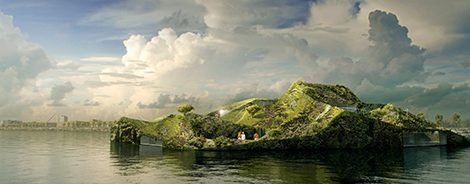
Amsterdam’s Floating Gardens spa will be built out of recycled polystyrene, covered with vegetation and offer treatments that promise to help the brain adapt and heal itself
By Magali Robathan | Published in Spa Business 2013 issue 1
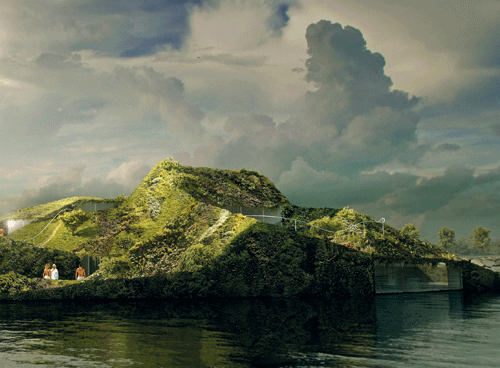
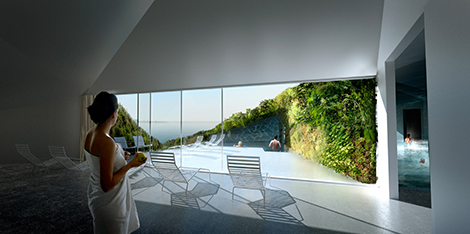
Botanist Patrick Blanc used his living wall technique to cover the outside of the building in vegetation
Developed by Michel Kreuger and ex-footballer Kizito Musampa of Studio Noach, together with architect Anne Holtrop, the €9m (US$12m, £8m) Floating Gardens spa is due to open toward mid-2014.
The two-storey building will be located on a lake just outside Amsterdam’s city centre. It will feature four pools, two restaurants/bars, five saunas and three treatment rooms and will be covered with a ‘living wall’ of plants designed by renowned botanist Patrick Blanc. Its treatments will based around concepts such as psychoneuroimmunology (PNI), which looks at how emotions and health are linked; and neuroplasticity, a science focused on the brain’s potential to react to change, heal and renew itself.
The idea has been presented at various exhibitions since 2010, and has attracted high levels of interest. Michel Kreuger explains how the concept was born.
When was Studio Noach founded? I founded it in 2008 with my business partner (ex Ajax Amsterdam player) Kizito ‘Kiki’ Musampa. It was based on our Green Floating concept, which uses recycled polystyrene to create floating buildings. The original idea was to build houseboats, but when the housing market stalled we move into wellness – a niche market that’s still in demand.
What is the Green Floating concept? It’s all based on building on a foundation of recycled polystyrene, which is as strong as steel, but can flex by 17 per cent and is also buoyant and provides excellent insulation. This structure is coated by fibreglass and a layer of vegetation covers the top of the building. We always knew that the carbon footprint of our buildings had to be neutral – we’ve actually gone one step further and made it carbon negative because the vegetation will convert CO2 to oxygen.
How did the partnership with Patrick Blanc come about? The idea of having vegetation on the walls and roof came from the floating gardens created in the 1970s and 1980s by the Dutch artist Robert Jasper Grootveld. We wanted to create a structure similar to that; when we teamed up with architect Anne Holtrop he said there’s a better way of doing this – a new technique developed by Patrick Blanc, the creator of the living wall.
Blanc’s technique is based in the idea that you don’t need soil to grow plants – all you need is sunlight, nutrients, minerals and water. He wraps a composite cloth material around buildings, which just needs to be sprinkled with water for a few minutes each day – using this technique you can have plants on the side of walls.
It wasn’t easy to contact Patrick, but when we did he got very enthusiastic about our idea because what we had created was an ecological loop – normally his vertical gardens use rainwater with added nutrients and minerals, but our building floats on freshwater so the plants can use that.
How did you choose the location for the first Floating Gardens? We’re based in Amsterdam, and we have a freshwater lake around 15 minutes outside the middle of the city. It’s a place where you can relax and look over the horizon, while being very close to the city centre and the 17th century canals.
The Amsterdam local government is trying to move away from the image of the red light district and the coffee shops and encourage more visitors interested in Van Gogh, Rembrandt and the canals. I think that sort of audience would be keen to go on a boat trip, and come and spend half a day in the spa.
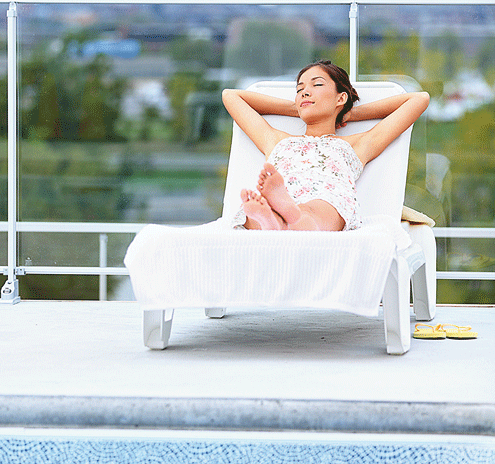
What facilities will the spa have? On the ground floor there will be four pools, including an outdoor infinity pool and a hot tub. There will also be two restaurants/bars and five saunas. The top floor will feature three treatment rooms and a large room for group therapy such as hot yoga.
What will set the Floating Gardens apart from other spas? We are competing with four- and five-star city centre hotels. In these hotels, the spa facilities tend to consist of a pool and a sauna – sometimes in the basement – where the view is of someone else’s genitals! In our case you have a beautiful view across the lake and gardens.
How did Musampa get involved? I live on the canal close to the red light district, and one day I saw a Lamborghini with a Spanish licence plate. I kept seeing it and noticed the owner paying a parking meter. Parking meters in Amsterdam are some of the most expensive in the world. A few weeks later I recognised him in a restaurant and I offered him my spare parking permit – I was quite surprised when he turned out to be the professional footballer Kiki Musampa. Months later we got closer, he got enthusiastic about my plans and he said he’d like to get involved.
Kiki is originally from the Congo. His father is a professor of botanics, so he already had an interest.
How is the project being funded? Kiki is mainly funding it. We are also in the process of negotiating a roll out of the concept to the rest of the world, but I can't say too much about that yet. We need to get the first spa out so that we have a flagship.
Who will the spa attract? It will be quite high-end – it will attract four and five-star visitors.
What kind of treatments will you offer? Spas shouldn’t just offer treatments for relaxation purposes: change is what people are really looking for.
Areas such as psychoneuroimmunology (PNI), which looks at how emotions and health are related, and the links between stress and disease, will be explored in some of our treatments.
I’ve travelled the world researching treatment ideas. I met many teachers, but it was the Tibetan Lamas in India and Nepal who really opened my eyes. I learned that it’s possible to not only change the mind, but also the structure of the brain. Today, pioneering experiments in neuroplasticity, a new science studying the brain’s potential for change, reveal that we are capable not only of altering its structure but also of generating new neurons. There’s now clear evidence that the brain can adapt, heal and renew itself. Our spa will offer this wealth of knowledge to its customers.
Read more from this issue of Spa Business magazine
View contents of Spa Business 2013 issue 1
Project update: Floating point
Michel Kreuger, the man behind Amsterdam’s €9m Floating Gardens spa, tells Magali Robathan how the innovative project is shaping up
Everyone's talking about...: Online reviews
Economists have revealed that just half a star difference in online consumer reviews can make or break a business. But are spa operators doing enough to boost their online reputation?
Marketing: Award winning advice
Spa judge Samantha Foster shares her top tips on how to write an award application entry with a winning edge
Interview: Deborah Szekely
The extraordinary Deborah Szekely has spent 73 years in the industry, creating Rancho La Puerta and the Golden Door. Her 90th birthday marked the dawn of a new era, with the launch of lobbying organisation Wellness Warrior. She talks to Liz Terry
Research: Recovery begins
Hotel spas in the US are starting to bounce back from the economic downturn. Andrea Foster from PKF Consulting analyses its 2012 Trends® in the Hotel Spa Industry report
Trends: Watch this space
The Brazilian middle class, millennials and gamification will have a significant impact on the spa industry moving forwards. Health and wellness experts at global foresights firm The Futures Company tell us why and suggest other trends to keep an eye out for
Promotion: company profile: Thalgo
Spa Business talks to Bernard Sirop, managing director of Thalgo, about the evolution of the company and where it is set to go in the future
Spa science: Entering the telo-age
Jay Williams explains the science behind telomere health – DNA structures linked to cellular ageing – and how it can be used in spas
Top team: Botanique Hotel & Spa
The hottest new spa in Brazil is backed by leading entrepreneurs including The Body Shop’s Gordon Roddick and AOL co-founder David Cole. We find out more
Promotional feature : Concept development
Special experiences are created when spa concepts are expressed through great design. Kate Corney talks to WTS president Gary Henkin and business partner Doug Chambers, principal of Blu Spas, about concept and branding
Product focus: Amenities - part two
Amenities, which are often overlooked by spa suppliers, can bring in 20 per cent of revenue for a product house. Spa Business get the low-down
Research: Fighting fat
A new type of ‘beige fat’ cell has been found to burn energy rather than store excess calories. Scientists say it could be key to tackling obesity
Amsterdam’s Floating Gardens spa will be built out of recycled polystyrene, covered with vegetation and offer treatments that promise to help the brain adapt and heal itself
By Magali Robathan | Published in Spa Business 2013 issue 1
Botanist Patrick Blanc used his living wall technique to cover the outside of the building in vegetation
Developed by Michel Kreuger and ex-footballer Kizito Musampa of Studio Noach, together with architect Anne Holtrop, the €9m (US$12m, £8m) Floating Gardens spa is due to open toward mid-2014.
The two-storey building will be located on a lake just outside Amsterdam’s city centre. It will feature four pools, two restaurants/bars, five saunas and three treatment rooms and will be covered with a ‘living wall’ of plants designed by renowned botanist Patrick Blanc. Its treatments will based around concepts such as psychoneuroimmunology (PNI), which looks at how emotions and health are linked; and neuroplasticity, a science focused on the brain’s potential to react to change, heal and renew itself.
The idea has been presented at various exhibitions since 2010, and has attracted high levels of interest. Michel Kreuger explains how the concept was born.
When was Studio Noach founded? I founded it in 2008 with my business partner (ex Ajax Amsterdam player) Kizito ‘Kiki’ Musampa. It was based on our Green Floating concept, which uses recycled polystyrene to create floating buildings. The original idea was to build houseboats, but when the housing market stalled we move into wellness – a niche market that’s still in demand.
What is the Green Floating concept? It’s all based on building on a foundation of recycled polystyrene, which is as strong as steel, but can flex by 17 per cent and is also buoyant and provides excellent insulation. This structure is coated by fibreglass and a layer of vegetation covers the top of the building. We always knew that the carbon footprint of our buildings had to be neutral – we’ve actually gone one step further and made it carbon negative because the vegetation will convert CO2 to oxygen.
How did the partnership with Patrick Blanc come about? The idea of having vegetation on the walls and roof came from the floating gardens created in the 1970s and 1980s by the Dutch artist Robert Jasper Grootveld. We wanted to create a structure similar to that; when we teamed up with architect Anne Holtrop he said there’s a better way of doing this – a new technique developed by Patrick Blanc, the creator of the living wall.
Blanc’s technique is based in the idea that you don’t need soil to grow plants – all you need is sunlight, nutrients, minerals and water. He wraps a composite cloth material around buildings, which just needs to be sprinkled with water for a few minutes each day – using this technique you can have plants on the side of walls.
It wasn’t easy to contact Patrick, but when we did he got very enthusiastic about our idea because what we had created was an ecological loop – normally his vertical gardens use rainwater with added nutrients and minerals, but our building floats on freshwater so the plants can use that.
How did you choose the location for the first Floating Gardens? We’re based in Amsterdam, and we have a freshwater lake around 15 minutes outside the middle of the city. It’s a place where you can relax and look over the horizon, while being very close to the city centre and the 17th century canals.
The Amsterdam local government is trying to move away from the image of the red light district and the coffee shops and encourage more visitors interested in Van Gogh, Rembrandt and the canals. I think that sort of audience would be keen to go on a boat trip, and come and spend half a day in the spa.
What facilities will the spa have? On the ground floor there will be four pools, including an outdoor infinity pool and a hot tub. There will also be two restaurants/bars and five saunas. The top floor will feature three treatment rooms and a large room for group therapy such as hot yoga.
What will set the Floating Gardens apart from other spas? We are competing with four- and five-star city centre hotels. In these hotels, the spa facilities tend to consist of a pool and a sauna – sometimes in the basement – where the view is of someone else’s genitals! In our case you have a beautiful view across the lake and gardens.
How did Musampa get involved? I live on the canal close to the red light district, and one day I saw a Lamborghini with a Spanish licence plate. I kept seeing it and noticed the owner paying a parking meter. Parking meters in Amsterdam are some of the most expensive in the world. A few weeks later I recognised him in a restaurant and I offered him my spare parking permit – I was quite surprised when he turned out to be the professional footballer Kiki Musampa. Months later we got closer, he got enthusiastic about my plans and he said he’d like to get involved.
Kiki is originally from the Congo. His father is a professor of botanics, so he already had an interest.
How is the project being funded? Kiki is mainly funding it. We are also in the process of negotiating a roll out of the concept to the rest of the world, but I can't say too much about that yet. We need to get the first spa out so that we have a flagship.
Who will the spa attract? It will be quite high-end – it will attract four and five-star visitors.
What kind of treatments will you offer? Spas shouldn’t just offer treatments for relaxation purposes: change is what people are really looking for.
Areas such as psychoneuroimmunology (PNI), which looks at how emotions and health are related, and the links between stress and disease, will be explored in some of our treatments.
I’ve travelled the world researching treatment ideas. I met many teachers, but it was the Tibetan Lamas in India and Nepal who really opened my eyes. I learned that it’s possible to not only change the mind, but also the structure of the brain. Today, pioneering experiments in neuroplasticity, a new science studying the brain’s potential for change, reveal that we are capable not only of altering its structure but also of generating new neurons. There’s now clear evidence that the brain can adapt, heal and renew itself. Our spa will offer this wealth of knowledge to its customers.
Read more from this issue of Spa Business magazine
View contents of Spa Business 2013 issue 1
Project update: Floating point
Michel Kreuger, the man behind Amsterdam’s €9m Floating Gardens spa, tells Magali Robathan how the innovative project is shaping up
Everyone's talking about...: Online reviews
Economists have revealed that just half a star difference in online consumer reviews can make or break a business. But are spa operators doing enough to boost their online reputation?
Marketing: Award winning advice
Spa judge Samantha Foster shares her top tips on how to write an award application entry with a winning edge
Interview: Deborah Szekely
The extraordinary Deborah Szekely has spent 73 years in the industry, creating Rancho La Puerta and the Golden Door. Her 90th birthday marked the dawn of a new era, with the launch of lobbying organisation Wellness Warrior. She talks to Liz Terry
Research: Recovery begins
Hotel spas in the US are starting to bounce back from the economic downturn. Andrea Foster from PKF Consulting analyses its 2012 Trends® in the Hotel Spa Industry report
Trends: Watch this space
The Brazilian middle class, millennials and gamification will have a significant impact on the spa industry moving forwards. Health and wellness experts at global foresights firm The Futures Company tell us why and suggest other trends to keep an eye out for
Promotion: company profile: Thalgo
Spa Business talks to Bernard Sirop, managing director of Thalgo, about the evolution of the company and where it is set to go in the future
Spa science: Entering the telo-age
Jay Williams explains the science behind telomere health – DNA structures linked to cellular ageing – and how it can be used in spas
Top team: Botanique Hotel & Spa
The hottest new spa in Brazil is backed by leading entrepreneurs including The Body Shop’s Gordon Roddick and AOL co-founder David Cole. We find out more
Promotional feature : Concept development
Special experiences are created when spa concepts are expressed through great design. Kate Corney talks to WTS president Gary Henkin and business partner Doug Chambers, principal of Blu Spas, about concept and branding
Product focus: Amenities - part two
Amenities, which are often overlooked by spa suppliers, can bring in 20 per cent of revenue for a product house. Spa Business get the low-down
Research: Fighting fat
A new type of ‘beige fat’ cell has been found to burn energy rather than store excess calories. Scientists say it could be key to tackling obesity
Jessica Sloyan, a wellness operations and training expert, has established an independent
private training academy to provide professional qualifications for practitioners looking to offer
immersive wellness experiences.
The International Spa Association (ISPA) has published its full 2026 US Spa Industry Study,
providing further insights into the region’s total US$1 billion (€855 million, £780 million)
industry revenue increase from 2024 to 2025.
Ameyalli, the 78-acre wellbeing resort and residential community in Midway in Utah, US, has
broken ground on phase two of the hot spring development – the Ameyalli Resort and Spa –
which is due to open in 2028.
TLee Spas and Wellness has revealed the design concept for a high-tech spa with body
mapping scanners to improve public health, for AI company Midjourney.
Gran Hotel Taoro in northern Tenerife, Spain, has completed the final phase of its three-year
renovation with the debut of its Sandára Wellness Centre.
Hand and Stone Massage and Facial Spa, the spa business with more than 650 locations across
the US and Canada, has appointed franchise expert Carrie Walsh as CEO as the company plans
to expand.
Synergy – The Retreat Show, the global trade show for retreats, has launched a global research
initiative that will provide insights into the retreat sector from both consumer and industry
perspectives.
The Wellness Tourism Association (WTA) has published a non-regulatory global industry
framework designed to ensure the retreat market offers responsible experiences.
A new survey of UK and international spa practitioners shows that stress, burnout and
wellbeing concerns have caused one in three respondents to consider leaving the industry.