Yes! Send me the FREE digital editions of Spa Business and Spa Business insider magazines and the FREE weekly Spa Business and Spa Business insider ezines and breaking news alerts!
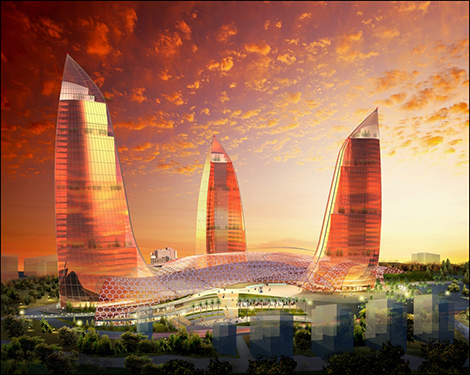
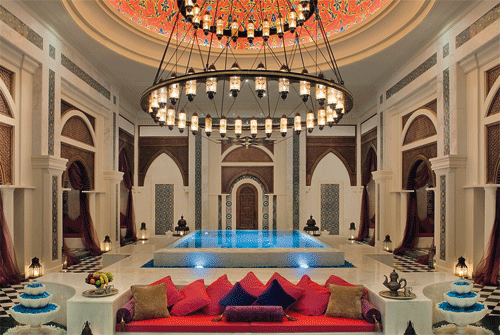
The Flame Towers is a standout project in Baku; a 299-bedroom
The charge of international hotel brands into the Caucasus – the region situated between the Black and Caspian Sea – is heavily focused on Baku, the capital of Azerbaijan on the southern shore of the Absheron Peninsula. It’s attracting the attention of Hyatt, Hilton, Fairmont, Marriott, Kempinski, Four Seasons and Starwood Hotels & Resorts – which are all drawn to this dynamic boomtown where ostentatious lifestyles and dramatic skyscrapers form the backdrop to an ancient walled-city that’s listed as a UNESCO World Heritage Site.
Baku, which has a population of around 2 million, has a rich history as the capital of a country that has straddled the territories of competing Arab, Persian, Turkish and Russian empires over the last two millennia. It gained independence in 1991, following the fall of the Soviet Union and today global interest has been stimulated by its extensive oil resources – in 2007 and 2008, Azerbaijan was the world’s largest oil producer. Modern living in the city has flourished, which gives the ancient metropolis a cosmopolitan feel with a strong business tourism market.
Tourism strategy Tourism is rapidly becoming an important part of the economy of Azerbaijan, although accurate statistics are illusive. Estimates by American Express suggest that in 2003-2004 the country was hosting more than 1 million tourist arrivals, mostly from near neighbour countries, such as Armenia, Russia, Iran and Turkey. The UN World Tourism Organization (UNWTO) is currently working with the country’s Ministry of Culture and Tourism to rectify the lack of statistics.
The ministry, established in 1953, is the government agency that oversees tourism development. Initially responsible for cultural preservation, its focus shifted over time to developing resorts until the collapse of the Soviet Union and the Nagorno-Karabakh civil war in the 1990s, which crippled the fledgling tourism industry.
The sector began to pick up pace once more in the early 2000s following the 2002 Mission Report on Tourism Marketing by the UNWTO, which successfully nurtured and whetted the government’s appetite to develop international leisure and business tourism. On the back of this in 2004, Azerbaijan’s Citizens Development Corps suggested a Rapid Assessment Strategy for tourism development.
Over the past eight years, the ministry has increasingly focused on creating an environment where international investment in tourism can flourish – including the building of core infrastructure and enhancement of hospitality skills and human capacity.
Today, its priorities are based on shaping Azerbaijan as an elite destination for spa and wellness tourism with a complementary strand focusing on religious tourism. The strategy has highlighted the Absheron Peninsula and, particularly the economically and vibrant city of Baku as the hub of development.
Investment surge By mid-2000, there were around 100 hotels in Azerbaijan: mostly concentrated in Baku and the two other major cities of Ganja and Sheki. At the top-end, hotel standards were comparable to those in western destinations. These included long-established, locally-owned boutique hotels such as Hotel Meridian and the Diplomat. While early international chain arrivals included Hyatt followed by Radisson in the 1990s.
In the past five years, however, there’s been an investment surge and 2011 was no exception. The 159-bedroom Park Hyatt invested us$330,000 (€254,000, £211,450) on refurbishing its spa that forms part of the hotel’s three-storey Club Oasis complex. The Armaiti Spa, still in its pre-opening phase, covers 310sq m (3,337sq ft) and features three treatment rooms. Hotel manager Kostas Batalas, is clearly inspired by the spa’s development, recognising its “power to capture new markets and retain existing business”.
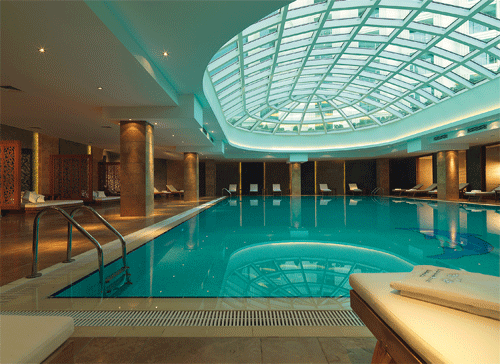
December saw the opening of the 3,500sq m (37,674sq ft) European-style spa at Kempinski Hotel Badamar Baku. The new Badamar complex is one of the largest developments in the Caucasus region and boasts an entertainment and retail centre and seasonal aqua park, as well as the 280-bedroom Kempinski hotel. The spa features 20 treatment rooms – six of which are doubles – and a beauty centre. The product house is Elemental Herbology. A lap pool, steamroom, sauna, hammam and fitness studio complete the offering.
Recognising the city’s potential, Kempinski has also signed a management agreement for a second site in Baku – the 221-bedroom Crescent Hotel: a glass, arch-shaped building that resembles a crescent moon. The hotel, designed by Korean firm Heerim Architects, will form part of the Caspian Plus development, which includes a further four buildings – three residential and one for office use.
Due for completion in 2015, The Caspian Plus will sit on the opposite peninsula to the equally impressive Full Moon Bay development (also by Heerim), which will feature the 35-storey Hotel Full Moon – built in a disc shape to look like the moon – as well as two separate residential apartment blocks.
Other new arrivals in 2011 included the 309-bedroom Hilton Baku with a 1,500sq m (16,146sq ft) eforea spa (see sb11/3 p28); and the 207-bedroom Sheraton Baku Airport hotel with a Gazelli Spa & Wellness facility.
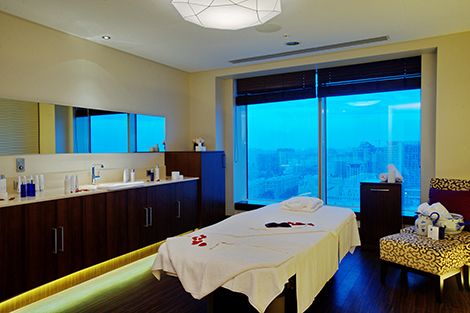
This year is set to be equally as busy. The 171-bedroom Four Seasons Hotel Baku, due to open in early 2012, is the setting for the 950sq m (10,226sq ft) Jaleh Spa which occupies a roof-top location and provides panoramic views of the city and sea.
Spa manager, Shawna Morneau, stresses the importance of the local market: “sixty-five per cent of our business will come from local and VIP guests taking advantage of our exclusive membership programme together with our unique VIP suite and private balcony.”
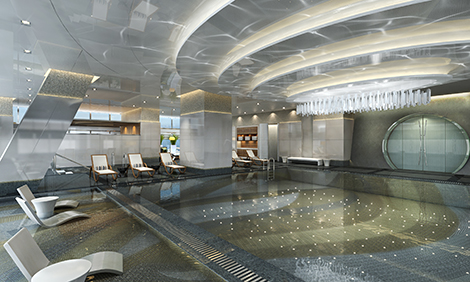
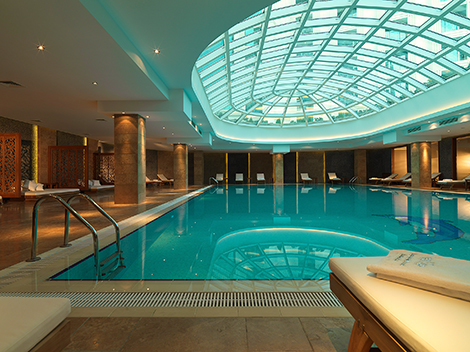
Designed by UK-based Reardon Smith architects and Spa Developments Consultancy, the spa has nine treatments rooms, plus the VIP suite. There are also male and female areas, with a hammam, a steamroom and whirlpools by Barr + Wray, a fitness centre and a pool that’s set in a two-storey atrium. Products will supplied by Sodashi and Kerstin Florian.
In January, Marriott is to make its debut with the launch of a 243-bedroom JW Marriott Absheron, also designed by Reardon Smith, in the heart of the city. The property will incorporate a health club and spa over three floors. The Absheron Spa will cover 1,700 sq m (18,300sq ft) and include four large single treatment rooms as well as couples’ suite. Products will be supplied by Anne Semonin and Charme d’Orient. There will also be a salon for hairdressing, make-up and manicure/pedicure services; a thermal suite comprising a steamroom, a rasul and a loofah room; a swimming pool and sun deck; and a gym with Precor equipment.
Also on the cards in early 2012, is the opening of the 299-bedroom Fairmont at the Flame Towers with an ESPA spa.
Challenges and improvements Despite the influx of international operators, Azerbaijan and Baku still face significant obstacles in developing their tourism economy – including environmental concerns as a result of the oil and petrochemical industries. But there have also been some big improvements – most notably investment in Baku International Airport and Azerbaijan Airlines to provide better links to western Europe and Asia by major airline carriers.
More than 35,000 people now work in tourism and degree programmes in tourism management have been established at Baku State University, Azerbaijan State Economic University and various vocational colleges and institutes. In September 2007, the Azerbaijan Institute of Tourism (AzTa) introduced a health, spa and wellness tourism specialism. In addition, it has agreed to cooperate with the American Hotel and Lodging Institute to develop the country’s skill base.
AzTa is also taking other measures to increase sector service quality, which include the tightening of tourism industry standards, VAT allowances and allocating resources to tourism. While Abulfaz Garayev, the country’s minister of culture and tourism, is urging existing operators to “send their employees on these [new tourism] courses” in order to met international standards.
A positive outlook Tourism marketing is a developing art in Azerbaijan and Baku, especially in terms of the positioning and branding of the country. It’s expected, however, that international hotel and spa operators will significantly contribute to improving brand awareness.
As a traditional cross roads between Europe and Asia and a meeting place of cultures, the country’s heritage has worldwide appeal; and because it straddles 11 of the earth’s climatic zones the country has extraordinary biodiversity and natural resources. Rural and eco-tourism have become interesting themes for recent development, with some projects being supported by international donor aid programmes.
The arrival of globally-recognised hotel brands and an international-standard spa and wellness product in Baku is certainly helping the country to reposition itself as a high-class destination. It is an approach that has captured consumer and media interest, yet there remains more to be done to consolidate and create a rounded tourism offer.
Nonetheless, Euromonitor International’s Azerbaijan Report 2011, unveiled in November, gives a positive outlook on the country’s tourism sector that’s driven by the revenues from the oil industry and sits comfortably in one of the world’s fastest growing economies. According to the report, the glut of international luxury resorts around Baku appears to be modelled on Dubai with “extravagant, futuristic, luxury hotel resorts including the Hotel Full Moon, Crescent Moon [Kempinski] and Flame Towers [Fairmont]”.
The most extravagant project, says Euromonitor, is the concept planned for Nargin Island, a former communist-era prison. It’s been reported online that the 1sq km island, located 14km off Baku’s coast, is to host a luxury, zero-carbon resort with 300 villas and a number of hotels. It will also include seven glass and metal structures modelled on Azerbaijan’s northern mountain range. Finance for the development, known as Zira Zero Island, is said to come from the AvroCityHolding Group with the Denmark architectural firm Bjarke Ingels Group leading the design.
High levels of business travel and the seductive appeal of an ancient yet thoroughly modernised city, is an intoxicating cocktail in which to grow an innovative spa product. Although the high-yielding business and leisure travel constitutes a relatively small proportion of the 1 million or so international arrivals, there are markets for an interesting, quality, spa and wellness experience.
A number of Azerbaijani websites have reported that the country has extraordinary ambitions to grow international arrivals to a staggering 20 million in 30 years. This is unlikely to be achieved, however, at a time when the UNWTO is predicting global international tourism arrivals will grow from 1 billion in 2011 to 1.8 billion by 2030, who is to argue against Azerbaijan securing a proportion of this uplift?
Read more from this issue of Spa Business magazine
Top team: Peninsula Hotels
Kath Hudson talks to key figures behind the leading Asian hotel chain about how they run their spas and exciting future plans
Profile: Cynthia Chua
The Singapore entrepreneur behind Ministry of Waxing and Browhaus has revolutionised personal grooming worldwide. She talks to Katie Barnes about the business of beauty and integration with spas
Hot springs: Chinese-style!
Lisa Starr tries out two hot spring spas - one catering to international visitors and the other to the domestic market - in China's Yunnan province
Bath time: The Chinese bathhouse
Lee David Stephens gives an insight into a traditional Chinese bathhouse and how Chinese people like to spa
Resort Spa: Sands of time
The Oitavos hotel and spa on Portugal's Estoril coast is 90 years in the making. Tom Walker pays a visit
Interview: Gary Henkin
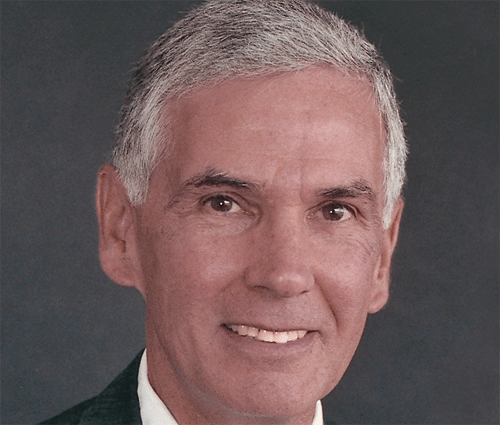
The president and founder of WTS International - the US-based spa management and consultancy firm - talks to Rhianon Howells about expanding globally
Ask an expert: Crisis control
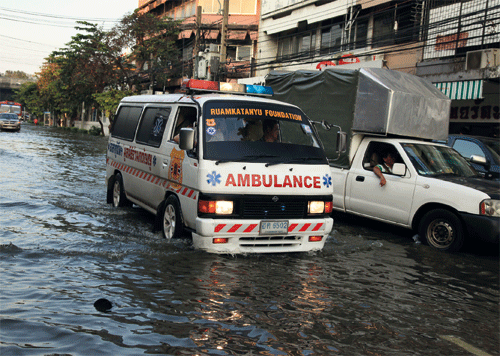
The Arab Spring, the Japanese tsunami and bombings in Mumbai - what's the best way of dealing with a crisis? We ask those who have first-hand experience of the events
New Zealand thermal spa: Pooling resources
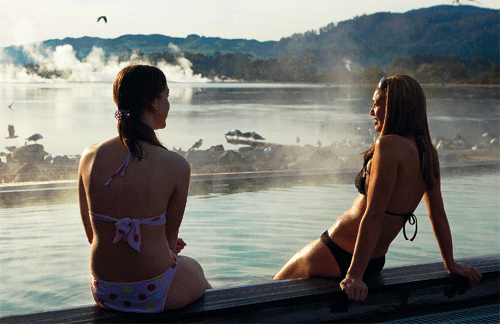
The Polynesian Spa in the geothermal town of Rotorua in New Zealand boasts 25 thermal pools and is one of the longest running attractions in the country. Chris McBeath takes a look
Tourism: Booming Baku
Terry Stevens reports on the Azerbaijan capital which has seen a surge of international hotel openings in the past two years
Fitness: Pilates pure vs applied
Pure vs applied - should pilates only ever involve the exercises designed by Joseph Pilates, or can his philosophy be applied while keeping the product moving with the times?
The Flame Towers is a standout project in Baku; a 299-bedroom
The charge of international hotel brands into the Caucasus – the region situated between the Black and Caspian Sea – is heavily focused on Baku, the capital of Azerbaijan on the southern shore of the Absheron Peninsula. It’s attracting the attention of Hyatt, Hilton, Fairmont, Marriott, Kempinski, Four Seasons and Starwood Hotels & Resorts – which are all drawn to this dynamic boomtown where ostentatious lifestyles and dramatic skyscrapers form the backdrop to an ancient walled-city that’s listed as a UNESCO World Heritage Site.
Baku, which has a population of around 2 million, has a rich history as the capital of a country that has straddled the territories of competing Arab, Persian, Turkish and Russian empires over the last two millennia. It gained independence in 1991, following the fall of the Soviet Union and today global interest has been stimulated by its extensive oil resources – in 2007 and 2008, Azerbaijan was the world’s largest oil producer. Modern living in the city has flourished, which gives the ancient metropolis a cosmopolitan feel with a strong business tourism market.
Tourism strategy Tourism is rapidly becoming an important part of the economy of Azerbaijan, although accurate statistics are illusive. Estimates by American Express suggest that in 2003-2004 the country was hosting more than 1 million tourist arrivals, mostly from near neighbour countries, such as Armenia, Russia, Iran and Turkey. The UN World Tourism Organization (UNWTO) is currently working with the country’s Ministry of Culture and Tourism to rectify the lack of statistics.
The ministry, established in 1953, is the government agency that oversees tourism development. Initially responsible for cultural preservation, its focus shifted over time to developing resorts until the collapse of the Soviet Union and the Nagorno-Karabakh civil war in the 1990s, which crippled the fledgling tourism industry.
The sector began to pick up pace once more in the early 2000s following the 2002 Mission Report on Tourism Marketing by the UNWTO, which successfully nurtured and whetted the government’s appetite to develop international leisure and business tourism. On the back of this in 2004, Azerbaijan’s Citizens Development Corps suggested a Rapid Assessment Strategy for tourism development.
Over the past eight years, the ministry has increasingly focused on creating an environment where international investment in tourism can flourish – including the building of core infrastructure and enhancement of hospitality skills and human capacity.
Today, its priorities are based on shaping Azerbaijan as an elite destination for spa and wellness tourism with a complementary strand focusing on religious tourism. The strategy has highlighted the Absheron Peninsula and, particularly the economically and vibrant city of Baku as the hub of development.
Investment surge By mid-2000, there were around 100 hotels in Azerbaijan: mostly concentrated in Baku and the two other major cities of Ganja and Sheki. At the top-end, hotel standards were comparable to those in western destinations. These included long-established, locally-owned boutique hotels such as Hotel Meridian and the Diplomat. While early international chain arrivals included Hyatt followed by Radisson in the 1990s.
In the past five years, however, there’s been an investment surge and 2011 was no exception. The 159-bedroom Park Hyatt invested us$330,000 (€254,000, £211,450) on refurbishing its spa that forms part of the hotel’s three-storey Club Oasis complex. The Armaiti Spa, still in its pre-opening phase, covers 310sq m (3,337sq ft) and features three treatment rooms. Hotel manager Kostas Batalas, is clearly inspired by the spa’s development, recognising its “power to capture new markets and retain existing business”.
December saw the opening of the 3,500sq m (37,674sq ft) European-style spa at Kempinski Hotel Badamar Baku. The new Badamar complex is one of the largest developments in the Caucasus region and boasts an entertainment and retail centre and seasonal aqua park, as well as the 280-bedroom Kempinski hotel. The spa features 20 treatment rooms – six of which are doubles – and a beauty centre. The product house is Elemental Herbology. A lap pool, steamroom, sauna, hammam and fitness studio complete the offering.
Recognising the city’s potential, Kempinski has also signed a management agreement for a second site in Baku – the 221-bedroom Crescent Hotel: a glass, arch-shaped building that resembles a crescent moon. The hotel, designed by Korean firm Heerim Architects, will form part of the Caspian Plus development, which includes a further four buildings – three residential and one for office use.
Due for completion in 2015, The Caspian Plus will sit on the opposite peninsula to the equally impressive Full Moon Bay development (also by Heerim), which will feature the 35-storey Hotel Full Moon – built in a disc shape to look like the moon – as well as two separate residential apartment blocks.
Other new arrivals in 2011 included the 309-bedroom Hilton Baku with a 1,500sq m (16,146sq ft) eforea spa (see sb11/3 p28); and the 207-bedroom Sheraton Baku Airport hotel with a Gazelli Spa & Wellness facility.
This year is set to be equally as busy. The 171-bedroom Four Seasons Hotel Baku, due to open in early 2012, is the setting for the 950sq m (10,226sq ft) Jaleh Spa which occupies a roof-top location and provides panoramic views of the city and sea.
Spa manager, Shawna Morneau, stresses the importance of the local market: “sixty-five per cent of our business will come from local and VIP guests taking advantage of our exclusive membership programme together with our unique VIP suite and private balcony.”
Designed by UK-based Reardon Smith architects and Spa Developments Consultancy, the spa has nine treatments rooms, plus the VIP suite. There are also male and female areas, with a hammam, a steamroom and whirlpools by Barr + Wray, a fitness centre and a pool that’s set in a two-storey atrium. Products will supplied by Sodashi and Kerstin Florian.
In January, Marriott is to make its debut with the launch of a 243-bedroom JW Marriott Absheron, also designed by Reardon Smith, in the heart of the city. The property will incorporate a health club and spa over three floors. The Absheron Spa will cover 1,700 sq m (18,300sq ft) and include four large single treatment rooms as well as couples’ suite. Products will be supplied by Anne Semonin and Charme d’Orient. There will also be a salon for hairdressing, make-up and manicure/pedicure services; a thermal suite comprising a steamroom, a rasul and a loofah room; a swimming pool and sun deck; and a gym with Precor equipment.
Also on the cards in early 2012, is the opening of the 299-bedroom Fairmont at the Flame Towers with an ESPA spa.
Challenges and improvements Despite the influx of international operators, Azerbaijan and Baku still face significant obstacles in developing their tourism economy – including environmental concerns as a result of the oil and petrochemical industries. But there have also been some big improvements – most notably investment in Baku International Airport and Azerbaijan Airlines to provide better links to western Europe and Asia by major airline carriers.
More than 35,000 people now work in tourism and degree programmes in tourism management have been established at Baku State University, Azerbaijan State Economic University and various vocational colleges and institutes. In September 2007, the Azerbaijan Institute of Tourism (AzTa) introduced a health, spa and wellness tourism specialism. In addition, it has agreed to cooperate with the American Hotel and Lodging Institute to develop the country’s skill base.
AzTa is also taking other measures to increase sector service quality, which include the tightening of tourism industry standards, VAT allowances and allocating resources to tourism. While Abulfaz Garayev, the country’s minister of culture and tourism, is urging existing operators to “send their employees on these [new tourism] courses” in order to met international standards.
A positive outlook Tourism marketing is a developing art in Azerbaijan and Baku, especially in terms of the positioning and branding of the country. It’s expected, however, that international hotel and spa operators will significantly contribute to improving brand awareness.
As a traditional cross roads between Europe and Asia and a meeting place of cultures, the country’s heritage has worldwide appeal; and because it straddles 11 of the earth’s climatic zones the country has extraordinary biodiversity and natural resources. Rural and eco-tourism have become interesting themes for recent development, with some projects being supported by international donor aid programmes.
The arrival of globally-recognised hotel brands and an international-standard spa and wellness product in Baku is certainly helping the country to reposition itself as a high-class destination. It is an approach that has captured consumer and media interest, yet there remains more to be done to consolidate and create a rounded tourism offer.
Nonetheless, Euromonitor International’s Azerbaijan Report 2011, unveiled in November, gives a positive outlook on the country’s tourism sector that’s driven by the revenues from the oil industry and sits comfortably in one of the world’s fastest growing economies. According to the report, the glut of international luxury resorts around Baku appears to be modelled on Dubai with “extravagant, futuristic, luxury hotel resorts including the Hotel Full Moon, Crescent Moon [Kempinski] and Flame Towers [Fairmont]”.
The most extravagant project, says Euromonitor, is the concept planned for Nargin Island, a former communist-era prison. It’s been reported online that the 1sq km island, located 14km off Baku’s coast, is to host a luxury, zero-carbon resort with 300 villas and a number of hotels. It will also include seven glass and metal structures modelled on Azerbaijan’s northern mountain range. Finance for the development, known as Zira Zero Island, is said to come from the AvroCityHolding Group with the Denmark architectural firm Bjarke Ingels Group leading the design.
High levels of business travel and the seductive appeal of an ancient yet thoroughly modernised city, is an intoxicating cocktail in which to grow an innovative spa product. Although the high-yielding business and leisure travel constitutes a relatively small proportion of the 1 million or so international arrivals, there are markets for an interesting, quality, spa and wellness experience.
A number of Azerbaijani websites have reported that the country has extraordinary ambitions to grow international arrivals to a staggering 20 million in 30 years. This is unlikely to be achieved, however, at a time when the UNWTO is predicting global international tourism arrivals will grow from 1 billion in 2011 to 1.8 billion by 2030, who is to argue against Azerbaijan securing a proportion of this uplift?
Read more from this issue of Spa Business magazine
Top team: Peninsula Hotels
Kath Hudson talks to key figures behind the leading Asian hotel chain about how they run their spas and exciting future plans
Profile: Cynthia Chua
The Singapore entrepreneur behind Ministry of Waxing and Browhaus has revolutionised personal grooming worldwide. She talks to Katie Barnes about the business of beauty and integration with spas
Hot springs: Chinese-style!
Lisa Starr tries out two hot spring spas - one catering to international visitors and the other to the domestic market - in China's Yunnan province
Bath time: The Chinese bathhouse
Lee David Stephens gives an insight into a traditional Chinese bathhouse and how Chinese people like to spa
Resort Spa: Sands of time
The Oitavos hotel and spa on Portugal's Estoril coast is 90 years in the making. Tom Walker pays a visit
Interview: Gary Henkin
The president and founder of WTS International - the US-based spa management and consultancy firm - talks to Rhianon Howells about expanding globally
Ask an expert: Crisis control
The Arab Spring, the Japanese tsunami and bombings in Mumbai - what's the best way of dealing with a crisis? We ask those who have first-hand experience of the events
New Zealand thermal spa: Pooling resources
The Polynesian Spa in the geothermal town of Rotorua in New Zealand boasts 25 thermal pools and is one of the longest running attractions in the country. Chris McBeath takes a look
Tourism: Booming Baku
Terry Stevens reports on the Azerbaijan capital which has seen a surge of international hotel openings in the past two years
Fitness: Pilates pure vs applied
Pure vs applied - should pilates only ever involve the exercises designed by Joseph Pilates, or can his philosophy be applied while keeping the product moving with the times?
Synergy – The Retreat Show, the global trade show for retreats, has launched a global research
initiative that will provide insights into the retreat sector from both consumer and industry
perspectives.
The Wellness Tourism Association (WTA) has published a non-regulatory global industry
framework designed to ensure the retreat market offers responsible experiences.
A new survey of UK and international spa practitioners shows that stress, burnout and
wellbeing concerns have caused one in three respondents to consider leaving the industry.
The UK's four Chief Medical Officers have published a refreshed edition of Physical activity
guidelines: UK Chief Medical Officers' report, updating the evidence that underpins the nation's
physical activity recommendations and placing greater emphasis on strength, balance, reducing
sedentary behaviour and, for the first time, supporting people taking weight loss medications.
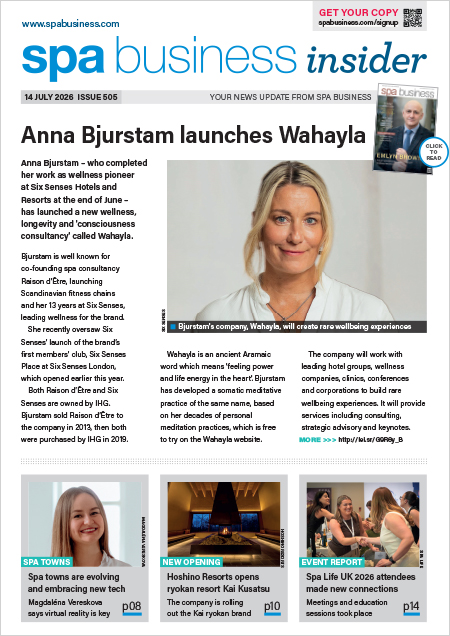
Anna Bjurstam has left her role as Wellness Pioneer at Six Senses Hotels and Resorts and
launched a new wellness, longevity and “consciousness consultancy” called Wahayla.
Fairmont Cheshire, The Mere, has opened today (10 July) in the Northwest of England
with a
1,715sq m Fairmont Spa that has been designed using a ‘Wellness without Walls’
concept.
Wellness hotels generating less than US$1 million (€932,700, £785,200) – or 10 per cent of
total revenue from wellness and leisure – recorded the strongest RevPAR and TRevPAR growth
in 2025 across categories when compared with 2024, according to the latest Wellness Real
Estate Report by RLA Global, produced in partnership with P and L benchmarking firm HotStats.
Lefay Resorts, the portfolio of two luxury wellness properties in Italy, has added emotional
dance classes and group cold plunge sessions in response to market demand for social
connection.