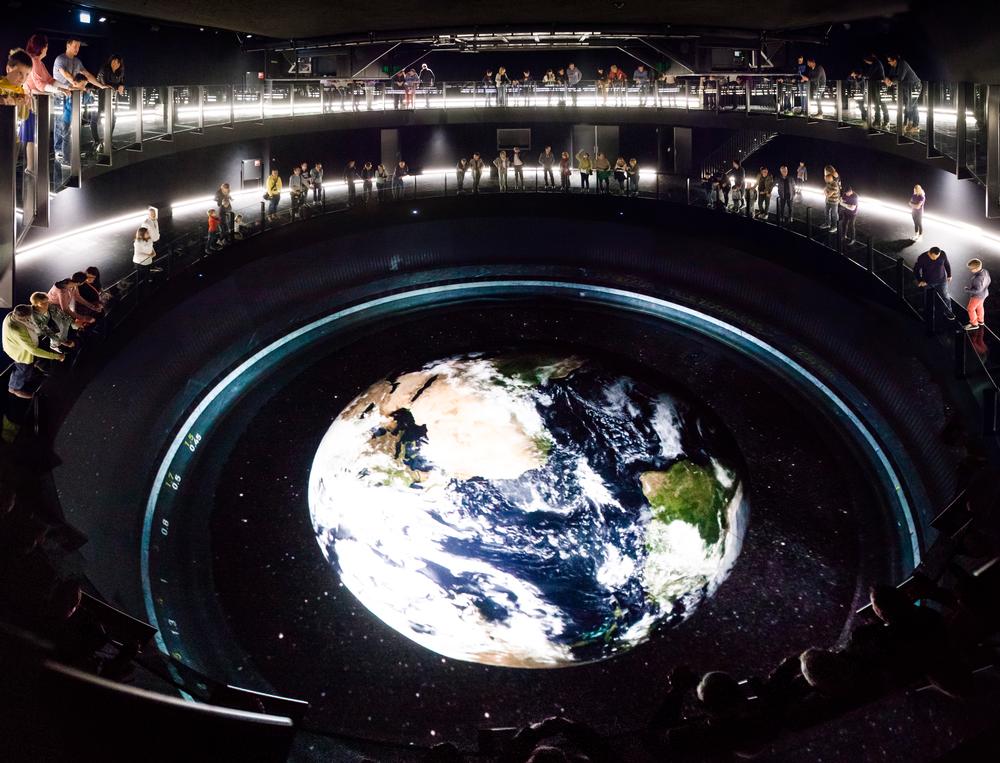
Columbus Earth Theatre
is an inverted planetarium, offering a view of the planet from above
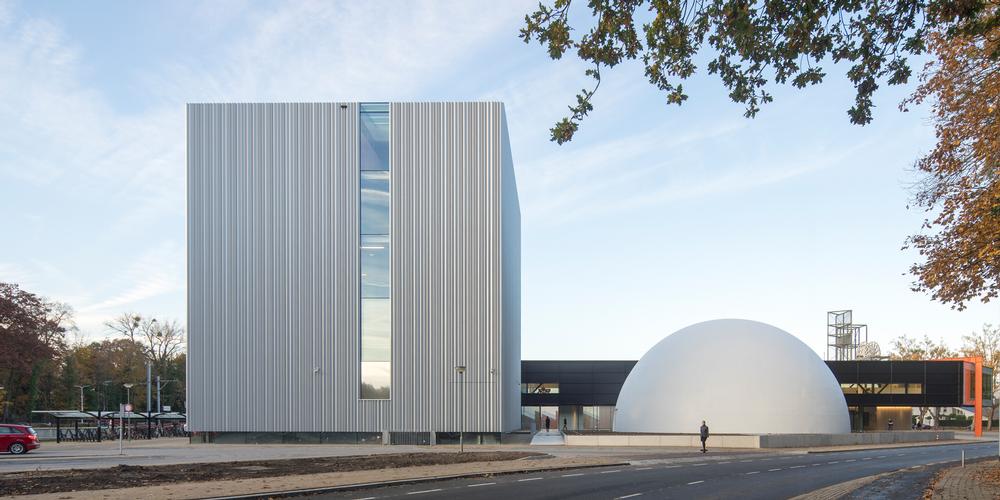
Where once there stood a single museum, dedicated to a Dutch mining region, there now stand three striking, geometric structures – a trio of modern attractions that together tell the story of humans and the planet.
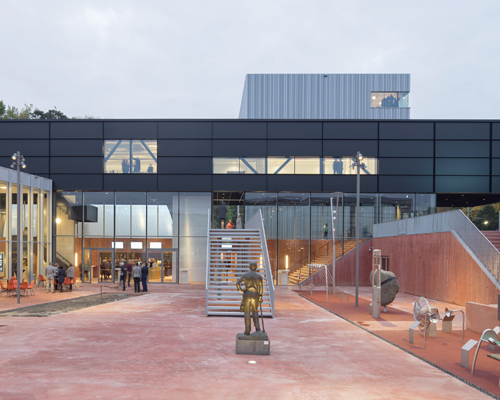
Museumplein Limburg is in Kerkrade, a border town in the Netherland’s most southern state. It’s made up of the Continium Discovery Centre – a science and technology museum, the Columbus Earth Theatre – the world’s first “inverted planetarium” and the Cube design museum.
The museum district has come a long way in a short time. The original attraction, Industrion, was a museum about Limburg’s industrial heritage, but by the time Hans Gubbels joined as director in 2004, visitor numbers were falling dramatically.
“We decided to change the direction of the museum to tell the whole story of the influence of science and technology on the daily lives of our visitors,” says Gubbels. “That approach worked and visitor numbers started to rise again.”
This led to the opening of a new wing to host temporary exhibitions, an overhaul of the permanent display and a name change.
“We chose Continium as it refers to the continuous development of our world and lives due to the continuous development of science and technology,” Gubbels says.
The museum was soon hitting attendance rates of 120,000 a year, with visitors spending an average of 4.5 hours at the attraction. However, it was time for a new strategy, one that would attract new audience groups, encourage repeat visitors and increase dwell times.
In 2014, Gubbels commissioned two new attractions on the square in front of Continium Discovery Centre. Although Gubbels and his team had no reference point of whether a project like this would work, it was felt the potential benefits made it a safe enough bet. The €21m ($24m, £17m) development was completed in October 2015.
“It was clear for us that the benefits – target group diversification, multiple ticket sales and the ability to market the two newcomers as state-of-the-art institutions – ruled out the risk that it would be difficult to open up the markets for the new institutions. We always look to other types of industry and in consumer marketing it’s quite normal and successful to diversify brands for special target groups. Why would this be different for museums?”
“We love to go off the beaten track, and by creating a museum square with three entities we have turned the location into a cultural hot spot,” he says.
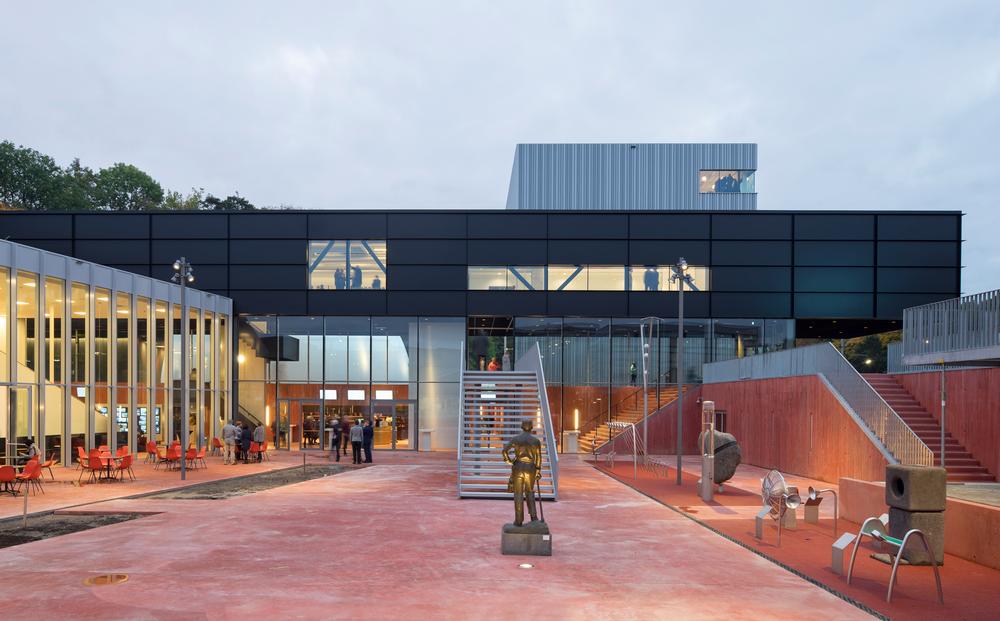
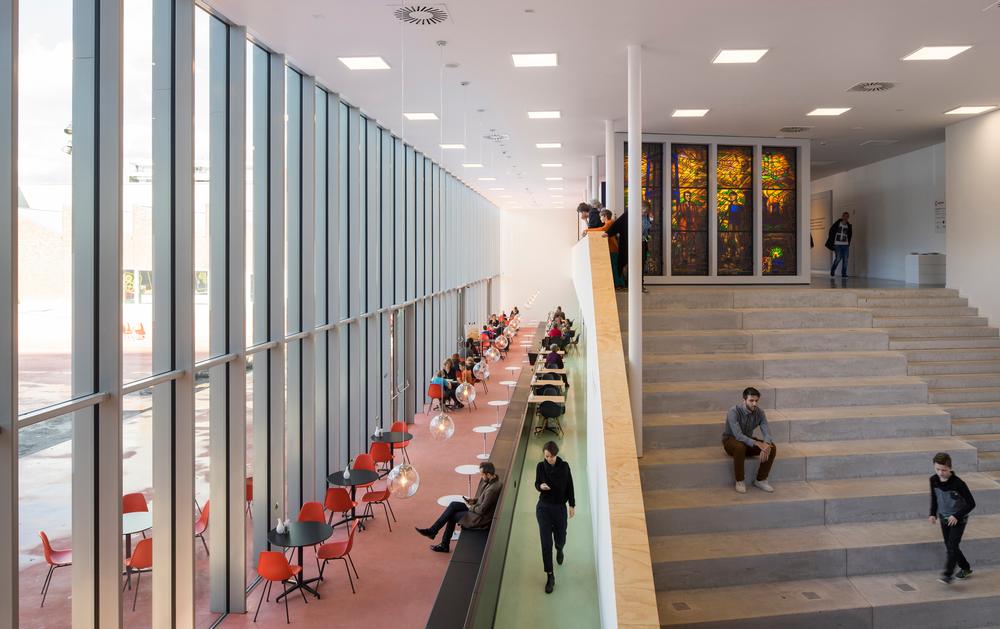
The three attractions at ground level represent a cube, a sphere and a beam, belying a 7,500sqm (81,000sq ft) network below ground level, expanded from the original museum’s design, that connects each element of Museumplein Limburg. This red concrete landscape includes a central visitor entrance, a restaurant, a patio and two tunnels that connect to the new attractions, as well as Europe’s first National Geographic 3D theatre. The architecture was carried out by Rotterdam-based Shift, whose youthful, industrial, urban aesthetic works to connect the attraction’s past with its progressive philosophy for the future.
“The three interconnected buildings each tell a different side to the oldest story in the world: that of the relationship between mankind and the Earth we are living on. Shift’s idea for an ensemble of elementary shapes referring to the content of the buildings and the way they connected the buildings won them the assignment,” Gubbels says.
Columbus Earth Theatre At the heart of Gubbel’s reinvention of this Kerkrade visitor attraction is a conversation he had at a dinner party during his tenure as Ecsite president.
“I was lucky enough to be sitting at a table with three astronauts,” he says. “They all explained how seeing Earth from space was a life-changing experience for them. Seeing that view made them realise how vulnerable our planet is and how we should take great care of it. I was struck by this and thought how valuable it would be if more people could have this experience. Would it stimulate them to take better care of the planet?”
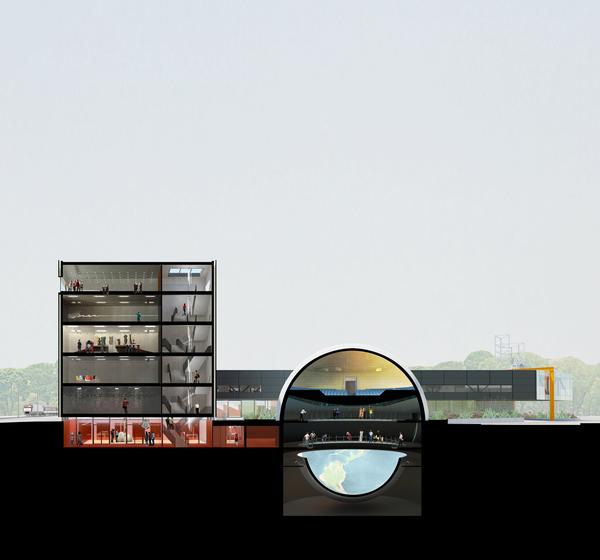
Gubbels patented the idea of an inverse large-screen theatre. Looking down at the Earth from space rather than up at space from the Earth, the experience mirrors that of a regular planetarium. Inside its spherical home, the screen is inverted below ground level, while the audience is positioned around the upper edge of the dome. It recreates what’s known as the overview effect – a cognitive shift in awareness that some astronauts have reported experiencing during spaceflight.
Designing and installing the inverted screen wasn’t easy, however. The projection screen had to be adapted from a spherical prototype to a cylindrical shape to allow omnidirectional viewing. Overhead projection also presented challenges.
Working with Lagotronics and Barco, the installation was custom-built – a process that involved a trip to the US to seek the advice of Doug Trumbull, a special effects legend, known as the inventor of the Showscan film process, as well as for his work on films 2001: A Space Odyssey, Star Trek: The Motion Picture and Blade Runner.
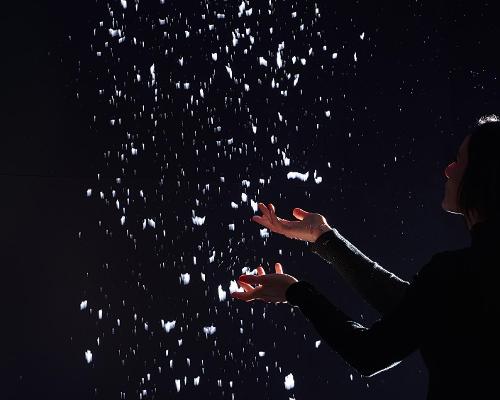
Visitors to Columbus Earth Theatre begin with a short pre-show experience before moving into the main auditorium. Standing on two levels of glass-floored balconies around the circumference of the 13-metres-deep (43-feet) dome, they watch the film play out below them, “as if they are floating above the Earth.”
“The aim is to give our visitors the ultimate immersive experience of how beautiful and fragile Earth is, how we live together with our planet, how we use resources and how that affects the Earth and how we protect her,” Gubbels says. “We want to bring emotion into the reality that we need to look after the planet, so visitors really start to care about the future.”
“Using data sets from both NASA and ESA we see our planet at a global scale,” he says. “But we also are experimenting with data visualisation supporting urban development in our local region, which has given valuable insight to decision makers and citizens in connecting geographically scattered projects. We are looking at more ways to use the unique projection for gaming applications and data visualisation.”
Cube Design Museum Cube is, indeed, a cube, measuring 21x21x21 metres (69x69x69 feet) and shrouded in a curtain of shimmering steel. Inside, the design is functional, allowing curators to programme the vertical space with a great degree of flexibility. The aim for Cube is to make it an internationally recognised design institute in the coming three years. To make that happen, it’s collaborating with the prestigious German Red Dot Award, the Design Museum in London and Cooper Hewitt, Smithsonian Design Museum in New York.
“Cube focuses on a global audience interested in the design process and designing for human ambitions. It’s a more museological institution than the other two attractions. The exhibitions presented here are more static,” says Gubbels.
“However, Cube also functions as a permanent laboratory where students and designers can co-create together with the audience. It focuses on education, business and the world of designers. The design laboratories offer the possibility for visitors to play an active role in the design processes the students and designers are working on and to interact with them.”
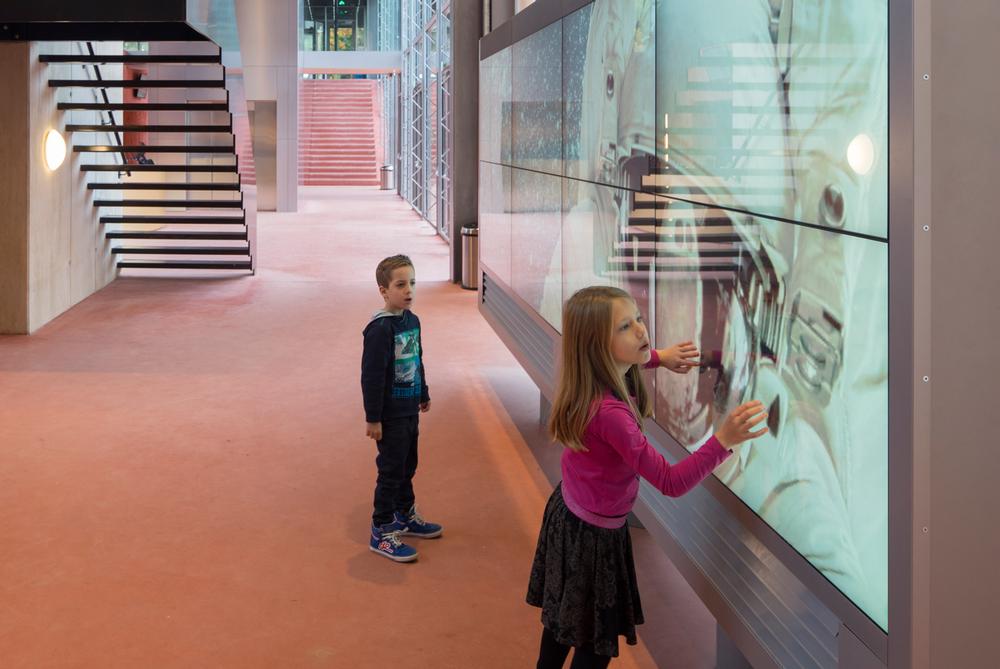
Continium Discovery Centre Continium, then, has a new lease of life as it reopened after a year’s closure for renovations. Filled with interactive exhibits – from racing against robots to using old telephones – the STEM-focused museum is a hit with families and schools.
The new beam-shaped building serves as a covered walkway connecting the existing attraction with the rest of the attractions and the train station, offering views of Museumplein to commuters, passers by and visitors. The Shift-designed reinvention of the public space embeds the trio of attractions deeper into the heart of the Kerkrade community. The facility is open to all, and Gubbels hopes its message – played out in the Columbus theatre from an astronaut’s point of view – will get through.
“In all three attractions, creating awareness for a sustainable future is important. Columbus shows this very directly by showing the effects on our planet,” he says. “But we believe that science, innovative technologies and design are the keys to saving our planet. We need new solutions to the problems we face and science can help us. We want to stimulate our audiences to think for themselves about the consequences of their choices and about which new developments to embrace and which to deny.”
Read more from this issue of Spa Business magazine
Promotional feature: IDEATTACK
IDEATTACK’s new project in Hainan, China,
introduces the storytelling elements of a
theme park to the oceanarium concept
Science Museums: Shaping Tomorrow
Brazil’s Museum of Tomorrow uses
constantly updating, real-time digital
collection to communicate with visitors.
We met members of the team
Promotional feature: EAS
This year, the Euro Attractions Show is
coming to the Spanish city of Barcelona
Disney Special: Shanghai Disney: The Best Yet?
As Disney opens its first resort in mainland
China, our special feature examines its
business model, its potential impact and
the modernisation of the Disney castle park
New Openings: Space Inversion
A new contemporary museum district
in the Netherlands – Museumplein
Limburg – features a science centre,
a design museum and an inverted
planetarium. We take a closer look
Promotional feature: Polin
Polin’s patented technologies, extensive R&D and creative flair have made it one of the world’s leading waterpark design and manufacturing companies
Waterparks: Taking the Plunge
Waterpark suppliers constantly develop
their product offers. We dive into the
world of waterpark R&D to find out more
Zoos & Aquariums: The Long Game
UK safari park Longleat is undertaking a
decade-long upgrade that starts by going
back to its roots. As the attraction turns
50, CEO Bob Montgomery explains how
he’s bridging the past and the future
In the fast-paced world of fitness and wellness, where high-intensity workouts push us to
our limits and the sweat pours, the importance of efficient recovery cannot be overstated. [more...]
The MSpa Oslo series is a perennial bestseller in global markets. With innovative
engineering and premium performance, this completely portable spa line-up is expertly
designed to meet the needs of customers worldwide. [more...]
+ More featured suppliers
COMPANY PROFILES
Starpool SRL
Founded in 1975 in the Italian Dolomites, Starpool is a company specialising in wellness, health and [more...]
Wellhub
Wellhub (formerly Gympass) is the
world’s leading corporate wellness
platform, trusted by 70,000+ [more...]
Columbus Earth Theatre
is an inverted planetarium, offering a view of the planet from above
Where once there stood a single museum, dedicated to a Dutch mining region, there now stand three striking, geometric structures – a trio of modern attractions that together tell the story of humans and the planet.
Museumplein Limburg is in Kerkrade, a border town in the Netherland’s most southern state. It’s made up of the Continium Discovery Centre – a science and technology museum, the Columbus Earth Theatre – the world’s first “inverted planetarium” and the Cube design museum.
The museum district has come a long way in a short time. The original attraction, Industrion, was a museum about Limburg’s industrial heritage, but by the time Hans Gubbels joined as director in 2004, visitor numbers were falling dramatically.
“We decided to change the direction of the museum to tell the whole story of the influence of science and technology on the daily lives of our visitors,” says Gubbels. “That approach worked and visitor numbers started to rise again.”
This led to the opening of a new wing to host temporary exhibitions, an overhaul of the permanent display and a name change.
“We chose Continium as it refers to the continuous development of our world and lives due to the continuous development of science and technology,” Gubbels says.
The museum was soon hitting attendance rates of 120,000 a year, with visitors spending an average of 4.5 hours at the attraction. However, it was time for a new strategy, one that would attract new audience groups, encourage repeat visitors and increase dwell times.
In 2014, Gubbels commissioned two new attractions on the square in front of Continium Discovery Centre. Although Gubbels and his team had no reference point of whether a project like this would work, it was felt the potential benefits made it a safe enough bet. The €21m ($24m, £17m) development was completed in October 2015.
“It was clear for us that the benefits – target group diversification, multiple ticket sales and the ability to market the two newcomers as state-of-the-art institutions – ruled out the risk that it would be difficult to open up the markets for the new institutions. We always look to other types of industry and in consumer marketing it’s quite normal and successful to diversify brands for special target groups. Why would this be different for museums?”
“We love to go off the beaten track, and by creating a museum square with three entities we have turned the location into a cultural hot spot,” he says.
The three attractions at ground level represent a cube, a sphere and a beam, belying a 7,500sqm (81,000sq ft) network below ground level, expanded from the original museum’s design, that connects each element of Museumplein Limburg. This red concrete landscape includes a central visitor entrance, a restaurant, a patio and two tunnels that connect to the new attractions, as well as Europe’s first National Geographic 3D theatre. The architecture was carried out by Rotterdam-based Shift, whose youthful, industrial, urban aesthetic works to connect the attraction’s past with its progressive philosophy for the future.
“The three interconnected buildings each tell a different side to the oldest story in the world: that of the relationship between mankind and the Earth we are living on. Shift’s idea for an ensemble of elementary shapes referring to the content of the buildings and the way they connected the buildings won them the assignment,” Gubbels says.
Columbus Earth Theatre At the heart of Gubbel’s reinvention of this Kerkrade visitor attraction is a conversation he had at a dinner party during his tenure as Ecsite president.
“I was lucky enough to be sitting at a table with three astronauts,” he says. “They all explained how seeing Earth from space was a life-changing experience for them. Seeing that view made them realise how vulnerable our planet is and how we should take great care of it. I was struck by this and thought how valuable it would be if more people could have this experience. Would it stimulate them to take better care of the planet?”
Gubbels patented the idea of an inverse large-screen theatre. Looking down at the Earth from space rather than up at space from the Earth, the experience mirrors that of a regular planetarium. Inside its spherical home, the screen is inverted below ground level, while the audience is positioned around the upper edge of the dome. It recreates what’s known as the overview effect – a cognitive shift in awareness that some astronauts have reported experiencing during spaceflight.
Designing and installing the inverted screen wasn’t easy, however. The projection screen had to be adapted from a spherical prototype to a cylindrical shape to allow omnidirectional viewing. Overhead projection also presented challenges.
Working with Lagotronics and Barco, the installation was custom-built – a process that involved a trip to the US to seek the advice of Doug Trumbull, a special effects legend, known as the inventor of the Showscan film process, as well as for his work on films 2001: A Space Odyssey, Star Trek: The Motion Picture and Blade Runner.
Visitors to Columbus Earth Theatre begin with a short pre-show experience before moving into the main auditorium. Standing on two levels of glass-floored balconies around the circumference of the 13-metres-deep (43-feet) dome, they watch the film play out below them, “as if they are floating above the Earth.”
“The aim is to give our visitors the ultimate immersive experience of how beautiful and fragile Earth is, how we live together with our planet, how we use resources and how that affects the Earth and how we protect her,” Gubbels says. “We want to bring emotion into the reality that we need to look after the planet, so visitors really start to care about the future.”
“Using data sets from both NASA and ESA we see our planet at a global scale,” he says. “But we also are experimenting with data visualisation supporting urban development in our local region, which has given valuable insight to decision makers and citizens in connecting geographically scattered projects. We are looking at more ways to use the unique projection for gaming applications and data visualisation.”
Cube Design Museum Cube is, indeed, a cube, measuring 21x21x21 metres (69x69x69 feet) and shrouded in a curtain of shimmering steel. Inside, the design is functional, allowing curators to programme the vertical space with a great degree of flexibility. The aim for Cube is to make it an internationally recognised design institute in the coming three years. To make that happen, it’s collaborating with the prestigious German Red Dot Award, the Design Museum in London and Cooper Hewitt, Smithsonian Design Museum in New York.
“Cube focuses on a global audience interested in the design process and designing for human ambitions. It’s a more museological institution than the other two attractions. The exhibitions presented here are more static,” says Gubbels.
“However, Cube also functions as a permanent laboratory where students and designers can co-create together with the audience. It focuses on education, business and the world of designers. The design laboratories offer the possibility for visitors to play an active role in the design processes the students and designers are working on and to interact with them.”
Continium Discovery Centre Continium, then, has a new lease of life as it reopened after a year’s closure for renovations. Filled with interactive exhibits – from racing against robots to using old telephones – the STEM-focused museum is a hit with families and schools.
The new beam-shaped building serves as a covered walkway connecting the existing attraction with the rest of the attractions and the train station, offering views of Museumplein to commuters, passers by and visitors. The Shift-designed reinvention of the public space embeds the trio of attractions deeper into the heart of the Kerkrade community. The facility is open to all, and Gubbels hopes its message – played out in the Columbus theatre from an astronaut’s point of view – will get through.
“In all three attractions, creating awareness for a sustainable future is important. Columbus shows this very directly by showing the effects on our planet,” he says. “But we believe that science, innovative technologies and design are the keys to saving our planet. We need new solutions to the problems we face and science can help us. We want to stimulate our audiences to think for themselves about the consequences of their choices and about which new developments to embrace and which to deny.”
Read more from this issue of Spa Business magazine
Promotional feature: IDEATTACK
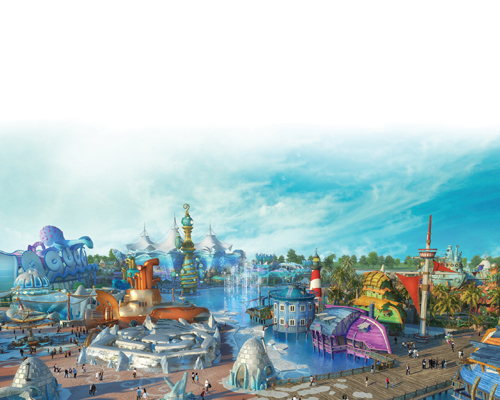
IDEATTACK’s new project in Hainan, China,
introduces the storytelling elements of a
theme park to the oceanarium concept
Science Museums: Shaping Tomorrow
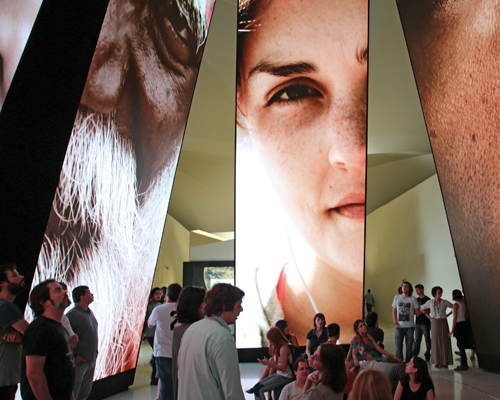
Brazil’s Museum of Tomorrow uses
constantly updating, real-time digital
collection to communicate with visitors.
We met members of the team
Promotional feature: EAS
This year, the Euro Attractions Show is
coming to the Spanish city of Barcelona
Disney Special: Shanghai Disney: The Best Yet?
As Disney opens its first resort in mainland
China, our special feature examines its
business model, its potential impact and
the modernisation of the Disney castle park
New Openings: Space Inversion
A new contemporary museum district
in the Netherlands – Museumplein
Limburg – features a science centre,
a design museum and an inverted
planetarium. We take a closer look
Promotional feature: Polin
Polin’s patented technologies, extensive R&D and creative flair have made it one of the world’s leading waterpark design and manufacturing companies
Waterparks: Taking the Plunge
Waterpark suppliers constantly develop
their product offers. We dive into the
world of waterpark R&D to find out more
Zoos & Aquariums: The Long Game
UK safari park Longleat is undertaking a
decade-long upgrade that starts by going
back to its roots. As the attraction turns
50, CEO Bob Montgomery explains how
he’s bridging the past and the future
Jessica Sloyan, a wellness operations and training expert, has established an independent
private training academy to provide professional qualifications for practitioners looking to offer
immersive wellness experiences.
The International Spa Association (ISPA) has published its full 2026 US Spa Industry Study,
providing further insights into the region’s total US$1 billion (€855 million, £780 million)
industry revenue increase from 2024 to 2025.
Ameyalli, the 78-acre wellbeing resort and residential community in Midway in Utah, US, has
broken ground on phase two of the hot spring development – the Ameyalli Resort and Spa –
which is due to open in 2028.
TLee Spas and Wellness has revealed the design concept for a high-tech spa with body
mapping scanners to improve public health, for AI company Midjourney.
Gran Hotel Taoro in northern Tenerife, Spain, has completed the final phase of its three-year
renovation with the debut of its Sandára Wellness Centre.
Hand and Stone Massage and Facial Spa, the spa business with more than 650 locations across
the US and Canada, has appointed franchise expert Carrie Walsh as CEO as the company plans
to expand.
Synergy – The Retreat Show, the global trade show for retreats, has launched a global research
initiative that will provide insights into the retreat sector from both consumer and industry
perspectives.
The Wellness Tourism Association (WTA) has published a non-regulatory global industry
framework designed to ensure the retreat market offers responsible experiences.
A new survey of UK and international spa practitioners shows that stress, burnout and
wellbeing concerns have caused one in three respondents to consider leaving the industry.
In the fast-paced world of fitness and wellness, where high-intensity workouts push us to
our limits and the sweat pours, the importance of efficient recovery cannot be overstated. [more...]
The MSpa Oslo series is a perennial bestseller in global markets. With innovative
engineering and premium performance, this completely portable spa line-up is expertly
designed to meet the needs of customers worldwide. [more...]
+ More featured suppliers
COMPANY PROFILES
Starpool SRL Founded in 1975 in the Italian Dolomites, Starpool is a company specialising in wellness, health and [more...]