Yes! Send me the FREE digital editions of Spa Business and Spa Business insider magazines and the FREE weekly Spa Business and Spa Business insider ezines and breaking news alerts!
In the second of an eight-part series by David Camp of D&J International Consulting, we look at how you see your audience and how your audience sees you
By David Camp | Published in Attractions Management 2016 issue 2
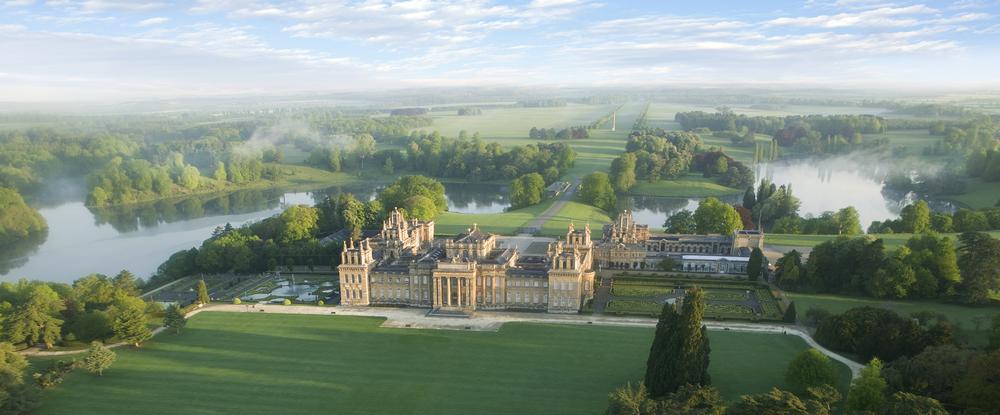
Cultural attractions, such as Blenheim Palace in the UK, are popular with all ages
There’s a wide range of types and categories of attractions. They’re all similar in that they compete for people’s leisure time, but there are significant differences in appeal, audiences and performance across the different attraction segments.
Generally, we can classify an attraction into one of three broad categories: culture, nature or entertainment. These are typically how customers see attractions and consider their visits. If a family decides on a cultural activity, they will select from a range of museums, historic properties, science centres or monuments in their target area.
I’ve lost count of the number of times I have heard “this is a unique attraction”. While it is undoubtedly true that every attraction is different – even rollout attractions such as SeaLife Centres, KidZanias or Disneyland parks that have the same genetic origins all have variations – potential customers rarely perceive the variations between historic houses, regional museums or country parks.
A clear message While all attractions want to stand out in the market, it’s also useful to be easily categorised or understood by the market. A tourist visiting an information centre is greeted with a baffling array of attractions and activities brochures. Having a clear, simple message is important in grabbing attention. The same is true for websites, listings, posters and other media. With some 250,000 attractions on offer around the world, potential customers need to quickly and easily understand what they may see at your attraction. If they can’t do that then they will not visit. The average length of time people spend viewing a Web page is 15 seconds; not much time to get people’s interest. In an information centre, people may spend longer, but they will only see the top third of a three-fold A4 brochure on a stand.
The Earth Centre in the UK and Bioscope in France are two attractions that failed where customer confusion was a major factor. People didn’t understand the offers and so chose to visit other attractions.
Who is your visitor? In addition to having a clear message and image it is important for attractions to understand their audience. There are distinct differences in visitor profiles to different types of attractions. We’ve grouped attractions into three broad categories for analysis through this series. Cultural attractions include museums, historic properties and heritage centres. Wildlife attractions encompass zoos, aquariums, parks, gardens and natural attractions. Entertainment attractions cover theme parks, waterparks, waxworks, observation towers and brand centres.
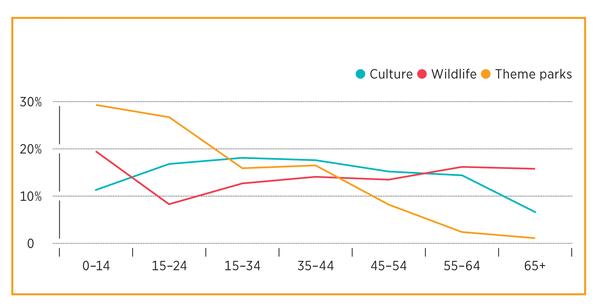
As a general rule, cultural attractions attract a more even age profile of visitors than the other types. Wildlife attractions appeal across all ages and entertainment attractions favour younger audiences, as shown in the chart (see Figure 1).
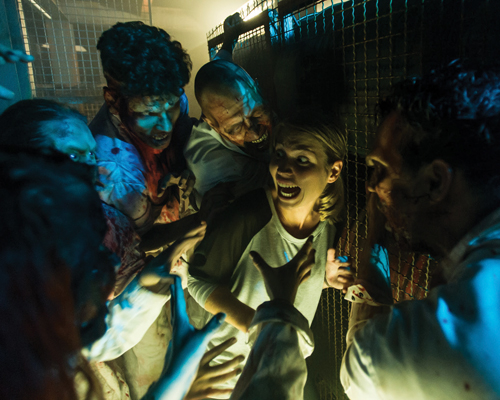
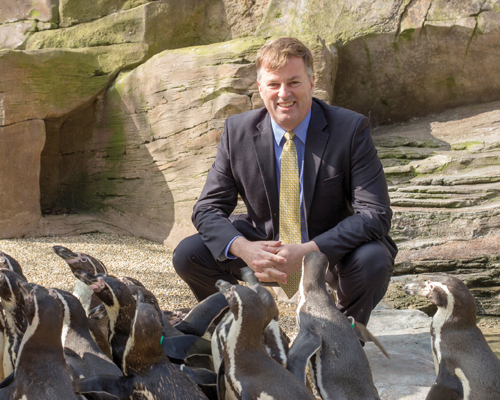
While it’s possible to extend or expand an audience this does not always work as expected. In 2009, London Zoo started opening in the summer evenings under an adult-only programme called Zoo Lates. The event proved very popular with the under-35 market and attracted up to 6,000 visitors on each evening. However, noisy, alcohol-fuelled millennials can get boisterous and after five seasons the zoo management team decided that the disruption to the animals outweighed the £800,000 ($1.1m, €1m) annual revenue the events generated. Zoo Lates has been replaced with the more family-friendly Sunset Safari programme.
Seasonal patterns Another important factor regarding audience profile is the impact that this has on the seasonal patterns of visits. School holidays, work patterns and weather all impact visitation and while adjustments can be made through events, promotions and targeted marketing it is difficult, and expensive, to significantly change people’s behaviour patterns.
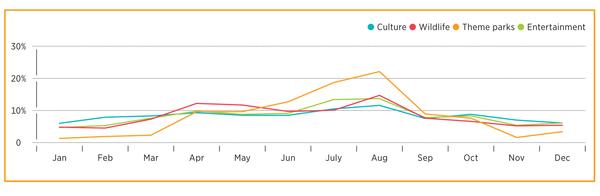
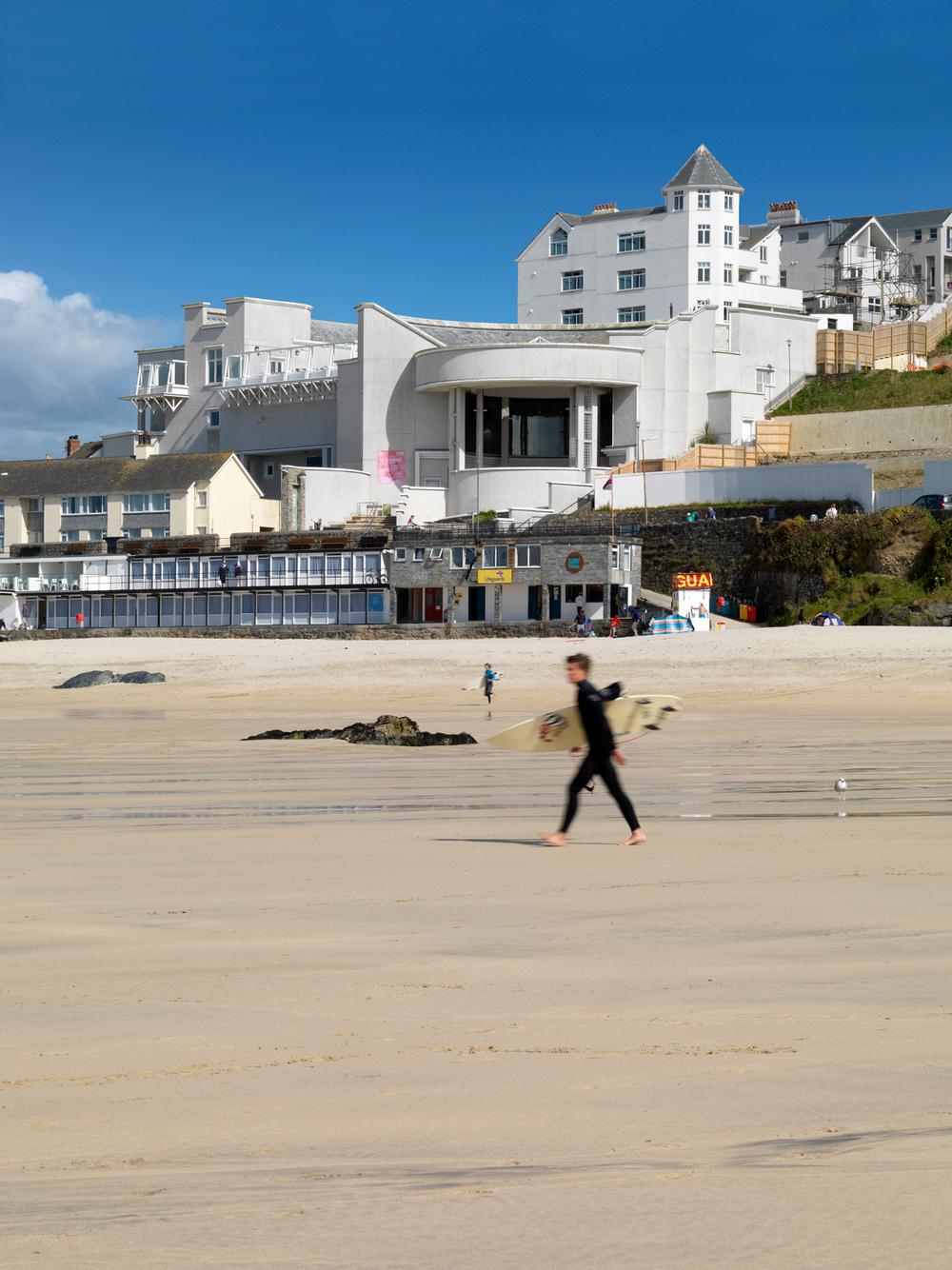
Attractions in cities generally benefit from a more even pattern of visitation than those in rural or coastal areas. An example of this is the Tate Modern in London, which receives 9-11 per cent of its annual visitors during August, while the Tate St Ives in Cornwall peaks at 16-18 per cent of annual visitors in August. Similar patterns are seen at theme parks where those targeting a local or regional resident market attract around 20 per cent of visits during a July or August peak month, while those in tourist areas may see in excess of 30 per cent of their yearly visits during a single peak month.
The chart shows the typical seasonal patterns for different types of northern hemisphere attractions (see Figure 2).
Most indoor attractions are open year-round, while outdoor attractions are generally only open for part of the year. However, this doesn’t mean that year-round attractions get more visitors than those that are open for part of the year, or that they make more money.
In 1995, Futuroscope in Poitiers, France, expanded its opening season by 50 per cent (from eight months to year-round opening) but their attendance only rose by 12 per cent. This led to an increase in revenues; however, there was a greater increase in operating costs resulting in a significant drop in operating profits. This meant that there was no money available for reinvestment and as a consequence visitor volumes plummeted from 2.8 million in 1995 to a low of 500,000 in 2003. It has since recovered, with support and investment from current owner Compagnie des Alpes.
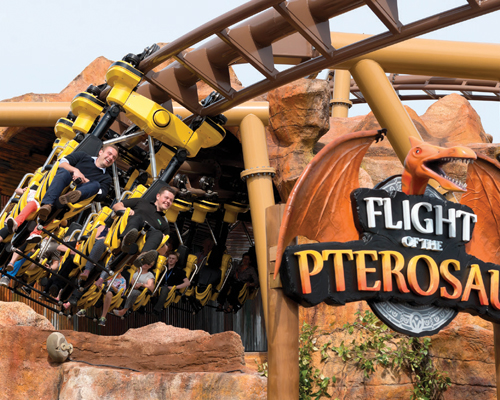
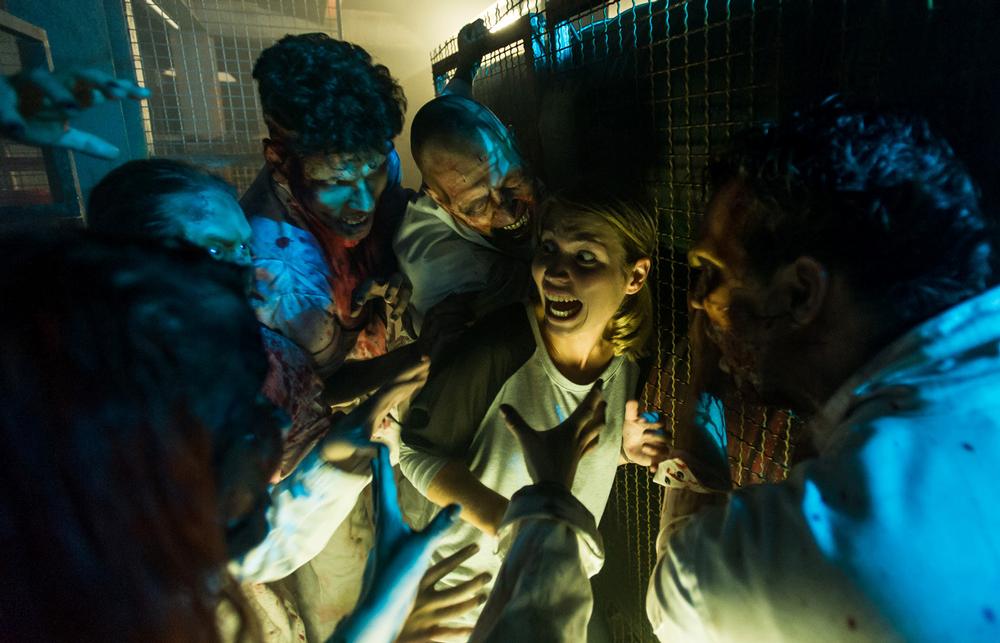
Special events Two developments in recent years have served to extend seasonality and grow theme park visits: Halloween and Christmas opening. The important thing about these events is that the offer is different at these times than for the rest of the year. In addition, as they are only run for a short period, they encourage people to revisit the parks for these events. At some parks these events have been able to increase attendance by up to 20 per cent over levels before the special events.
These events have become significant at parks such as Germany’s Europa Park and PortAventura in Salou, Spain. Many other parks have followed suit. Indeed, last year Europa Park’s busiest day came during their Halloween event and the number of visitors during October is now as great as it is in July. But these have taken a number of years and substantial investment to develop to this level.
Events can be used to impact attendance at other attractions too; they just need to be carefully planned, executed and marketed to be worthwhile. The key to success is understanding the target audience and their behaviour patterns and working with them, not against them.
Read more from this issue of Spa Business magazine
Promotional feature: IDEATTACK
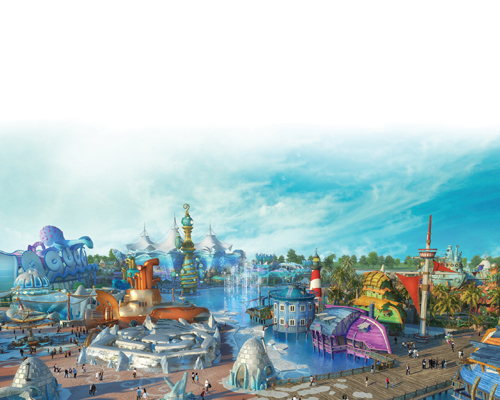
IDEATTACK’s new project in Hainan, China,
introduces the storytelling elements of a
theme park to the oceanarium concept
Science Museums: Shaping Tomorrow
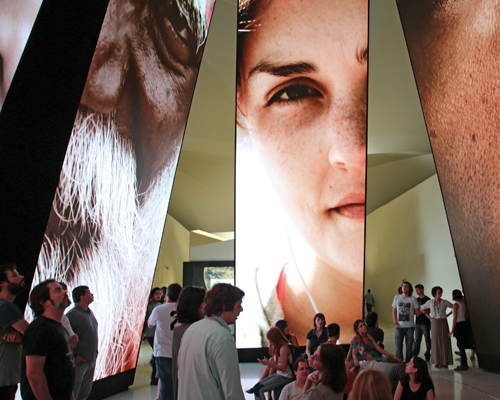
Brazil’s Museum of Tomorrow uses
constantly updating, real-time digital
collection to communicate with visitors.
We met members of the team
Promotional feature: EAS
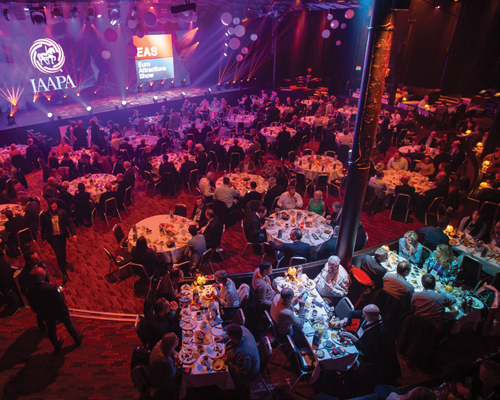
This year, the Euro Attractions Show is
coming to the Spanish city of Barcelona
Disney Special: Shanghai Disney: The Best Yet?
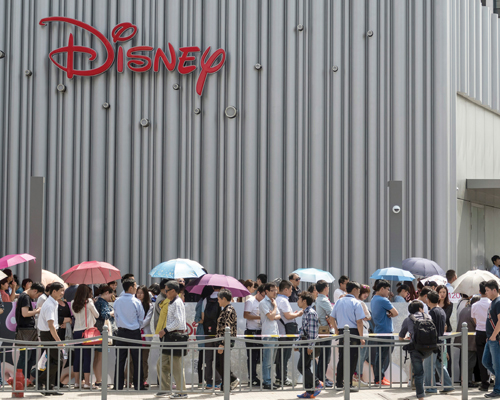
As Disney opens its first resort in mainland
China, our special feature examines its
business model, its potential impact and
the modernisation of the Disney castle park
New Openings: Space Inversion
A new contemporary museum district
in the Netherlands – Museumplein
Limburg – features a science centre,
a design museum and an inverted
planetarium. We take a closer look
Promotional feature: Polin
Polin’s patented technologies, extensive R&D and creative flair have made it one of the world’s leading waterpark design and manufacturing companies
Waterparks: Taking the Plunge
Waterpark suppliers constantly develop
their product offers. We dive into the
world of waterpark R&D to find out more
Zoos & Aquariums: The Long Game
UK safari park Longleat is undertaking a
decade-long upgrade that starts by going
back to its roots. As the attraction turns
50, CEO Bob Montgomery explains how
he’s bridging the past and the future
Series roadmap This eight-part series outlines the patterns and dynamics that define every attraction – from visitor behaviour and guest spending to operating costs and profitability
CONTENTS 1. An overview 2. How are you perceived? 3. Benchmarking 4. Planning a new attraction 5. Driving revenues 6. Controlling costs 7. Is it worth it? 8. Benefits and impacts
David Camp
Figure 1 Age Profile of Visitors
Figure 1
Figure 2 Seasonal Visitor Patterns
Figure 2
Get in touch with David Camp email: [email protected] website: www.djintcon.com
Sunset Safari is a family-focused evening event at London Zoo
Sunset Safari is a family-focused evening event at London Zoo
Sunset Safari is a family-focused evening event at London Zoo
Tate St Ives in Cornwall is busiest in August
Europa Park in Germany has hosted its annual Horror Nights since 2007 / PHOTO: MARKUS GARSCHA
Contrast therapy, based on the alternation of hot and cold rituals, has become one of the
most valued practices in the fields of wellness and recovery. [more...]
In the fast-paced world of fitness and wellness, where high-intensity workouts push us to
our limits and the sweat pours, the importance of efficient recovery cannot be overstated. [more...]
+ More featured suppliers
COMPANY PROFILES
Phytomer
Founded in Brittany, France, in 1972 by Jean Gédouin, Phytomer is a family-owned company now in its [more...]
Comfort Zone
Comfort Zone’s comprehensive face and body professional and retail range allows clients
to experien [more...]
In the second of an eight-part series by David Camp of D&J International Consulting, we look at how you see your audience and how your audience sees you
By David Camp | Published in Attractions Management 2016 issue 2
Cultural attractions, such as Blenheim Palace in the UK, are popular with all ages
There’s a wide range of types and categories of attractions. They’re all similar in that they compete for people’s leisure time, but there are significant differences in appeal, audiences and performance across the different attraction segments.
Generally, we can classify an attraction into one of three broad categories: culture, nature or entertainment. These are typically how customers see attractions and consider their visits. If a family decides on a cultural activity, they will select from a range of museums, historic properties, science centres or monuments in their target area.
I’ve lost count of the number of times I have heard “this is a unique attraction”. While it is undoubtedly true that every attraction is different – even rollout attractions such as SeaLife Centres, KidZanias or Disneyland parks that have the same genetic origins all have variations – potential customers rarely perceive the variations between historic houses, regional museums or country parks.
A clear message While all attractions want to stand out in the market, it’s also useful to be easily categorised or understood by the market. A tourist visiting an information centre is greeted with a baffling array of attractions and activities brochures. Having a clear, simple message is important in grabbing attention. The same is true for websites, listings, posters and other media. With some 250,000 attractions on offer around the world, potential customers need to quickly and easily understand what they may see at your attraction. If they can’t do that then they will not visit. The average length of time people spend viewing a Web page is 15 seconds; not much time to get people’s interest. In an information centre, people may spend longer, but they will only see the top third of a three-fold A4 brochure on a stand.
The Earth Centre in the UK and Bioscope in France are two attractions that failed where customer confusion was a major factor. People didn’t understand the offers and so chose to visit other attractions.
Who is your visitor? In addition to having a clear message and image it is important for attractions to understand their audience. There are distinct differences in visitor profiles to different types of attractions. We’ve grouped attractions into three broad categories for analysis through this series. Cultural attractions include museums, historic properties and heritage centres. Wildlife attractions encompass zoos, aquariums, parks, gardens and natural attractions. Entertainment attractions cover theme parks, waterparks, waxworks, observation towers and brand centres.
As a general rule, cultural attractions attract a more even age profile of visitors than the other types. Wildlife attractions appeal across all ages and entertainment attractions favour younger audiences, as shown in the chart (see Figure 1).
While it’s possible to extend or expand an audience this does not always work as expected. In 2009, London Zoo started opening in the summer evenings under an adult-only programme called Zoo Lates. The event proved very popular with the under-35 market and attracted up to 6,000 visitors on each evening. However, noisy, alcohol-fuelled millennials can get boisterous and after five seasons the zoo management team decided that the disruption to the animals outweighed the £800,000 ($1.1m, €1m) annual revenue the events generated. Zoo Lates has been replaced with the more family-friendly Sunset Safari programme.
Seasonal patterns Another important factor regarding audience profile is the impact that this has on the seasonal patterns of visits. School holidays, work patterns and weather all impact visitation and while adjustments can be made through events, promotions and targeted marketing it is difficult, and expensive, to significantly change people’s behaviour patterns.
Attractions in cities generally benefit from a more even pattern of visitation than those in rural or coastal areas. An example of this is the Tate Modern in London, which receives 9-11 per cent of its annual visitors during August, while the Tate St Ives in Cornwall peaks at 16-18 per cent of annual visitors in August. Similar patterns are seen at theme parks where those targeting a local or regional resident market attract around 20 per cent of visits during a July or August peak month, while those in tourist areas may see in excess of 30 per cent of their yearly visits during a single peak month.
The chart shows the typical seasonal patterns for different types of northern hemisphere attractions (see Figure 2).
Most indoor attractions are open year-round, while outdoor attractions are generally only open for part of the year. However, this doesn’t mean that year-round attractions get more visitors than those that are open for part of the year, or that they make more money.
In 1995, Futuroscope in Poitiers, France, expanded its opening season by 50 per cent (from eight months to year-round opening) but their attendance only rose by 12 per cent. This led to an increase in revenues; however, there was a greater increase in operating costs resulting in a significant drop in operating profits. This meant that there was no money available for reinvestment and as a consequence visitor volumes plummeted from 2.8 million in 1995 to a low of 500,000 in 2003. It has since recovered, with support and investment from current owner Compagnie des Alpes.
Special events Two developments in recent years have served to extend seasonality and grow theme park visits: Halloween and Christmas opening. The important thing about these events is that the offer is different at these times than for the rest of the year. In addition, as they are only run for a short period, they encourage people to revisit the parks for these events. At some parks these events have been able to increase attendance by up to 20 per cent over levels before the special events.
These events have become significant at parks such as Germany’s Europa Park and PortAventura in Salou, Spain. Many other parks have followed suit. Indeed, last year Europa Park’s busiest day came during their Halloween event and the number of visitors during October is now as great as it is in July. But these have taken a number of years and substantial investment to develop to this level.
Events can be used to impact attendance at other attractions too; they just need to be carefully planned, executed and marketed to be worthwhile. The key to success is understanding the target audience and their behaviour patterns and working with them, not against them.
Read more from this issue of Spa Business magazine
Promotional feature: IDEATTACK
IDEATTACK’s new project in Hainan, China,
introduces the storytelling elements of a
theme park to the oceanarium concept
Science Museums: Shaping Tomorrow
Brazil’s Museum of Tomorrow uses
constantly updating, real-time digital
collection to communicate with visitors.
We met members of the team
Promotional feature: EAS
This year, the Euro Attractions Show is
coming to the Spanish city of Barcelona
Disney Special: Shanghai Disney: The Best Yet?
As Disney opens its first resort in mainland
China, our special feature examines its
business model, its potential impact and
the modernisation of the Disney castle park
New Openings: Space Inversion
A new contemporary museum district
in the Netherlands – Museumplein
Limburg – features a science centre,
a design museum and an inverted
planetarium. We take a closer look
Promotional feature: Polin
Polin’s patented technologies, extensive R&D and creative flair have made it one of the world’s leading waterpark design and manufacturing companies
Waterparks: Taking the Plunge
Waterpark suppliers constantly develop
their product offers. We dive into the
world of waterpark R&D to find out more
Zoos & Aquariums: The Long Game
UK safari park Longleat is undertaking a
decade-long upgrade that starts by going
back to its roots. As the attraction turns
50, CEO Bob Montgomery explains how
he’s bridging the past and the future
Series roadmap This eight-part series outlines the patterns and dynamics that define every attraction – from visitor behaviour and guest spending to operating costs and profitability
CONTENTS 1. An overview 2. How are you perceived? 3. Benchmarking 4. Planning a new attraction 5. Driving revenues 6. Controlling costs 7. Is it worth it? 8. Benefits and impacts
David Camp
Figure 1 Age Profile of Visitors
Figure 1
Figure 2 Seasonal Visitor Patterns
Figure 2
Get in touch with David Camp email: [email protected] website: www.djintcon.com
Sunset Safari is a family-focused evening event at London Zoo
Sunset Safari is a family-focused evening event at London Zoo
Sunset Safari is a family-focused evening event at London Zoo
Tate St Ives in Cornwall is busiest in August
Europa Park in Germany has hosted its annual Horror Nights since 2007 / PHOTO: MARKUS GARSCHA
Jessica Sloyan, a wellness operations and training expert, has established an independent
private training academy to provide professional qualifications for practitioners looking to offer
immersive wellness experiences.
The International Spa Association (ISPA) has published its full 2026 US Spa Industry Study,
providing further insights into the region’s total US$1 billion (€855 million, £780 million)
industry revenue increase from 2024 to 2025.
Ameyalli, the 78-acre wellbeing resort and residential community in Midway in Utah, US, has
broken ground on phase two of the hot spring development – the Ameyalli Resort and Spa –
which is due to open in 2028.
TLee Spas and Wellness has revealed the design concept for a high-tech spa with body
mapping scanners to improve public health, for AI company Midjourney.
Gran Hotel Taoro in northern Tenerife, Spain, has completed the final phase of its three-year
renovation with the debut of its Sandára Wellness Centre.
Hand and Stone Massage and Facial Spa, the spa business with more than 650 locations across
the US and Canada, has appointed franchise expert Carrie Walsh as CEO as the company plans
to expand.
Synergy – The Retreat Show, the global trade show for retreats, has launched a global research
initiative that will provide insights into the retreat sector from both consumer and industry
perspectives.
The Wellness Tourism Association (WTA) has published a non-regulatory global industry
framework designed to ensure the retreat market offers responsible experiences.
A new survey of UK and international spa practitioners shows that stress, burnout and
wellbeing concerns have caused one in three respondents to consider leaving the industry.
Contrast therapy, based on the alternation of hot and cold rituals, has become one of the
most valued practices in the fields of wellness and recovery. [more...]
In the fast-paced world of fitness and wellness, where high-intensity workouts push us to
our limits and the sweat pours, the importance of efficient recovery cannot be overstated. [more...]
+ More featured suppliers
COMPANY PROFILES
Phytomer Founded in Brittany, France, in 1972 by Jean Gédouin, Phytomer is a family-owned company now in its [more...]