Yes! Send me the FREE digital editions of Spa Business and Spa Business insider magazines and the FREE weekly Spa Business and Spa Business insider ezines and breaking news alerts!
While spa revenues in US hotels edged upward in 2024, profits slipped slightly. CBRE’s Robert Mandelbaum and Andrea Grigg explore the shifting dynamics behind the numbers
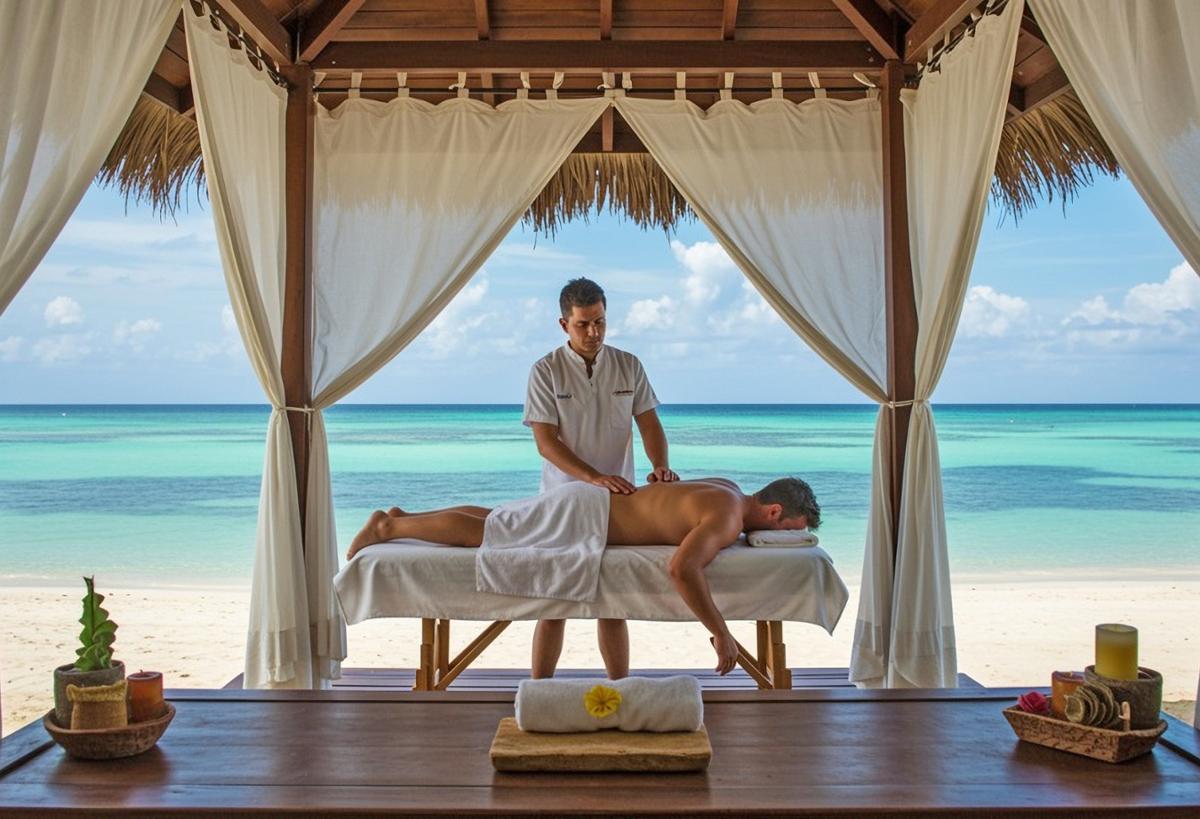
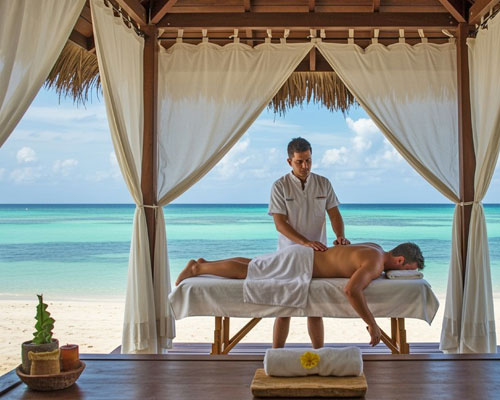
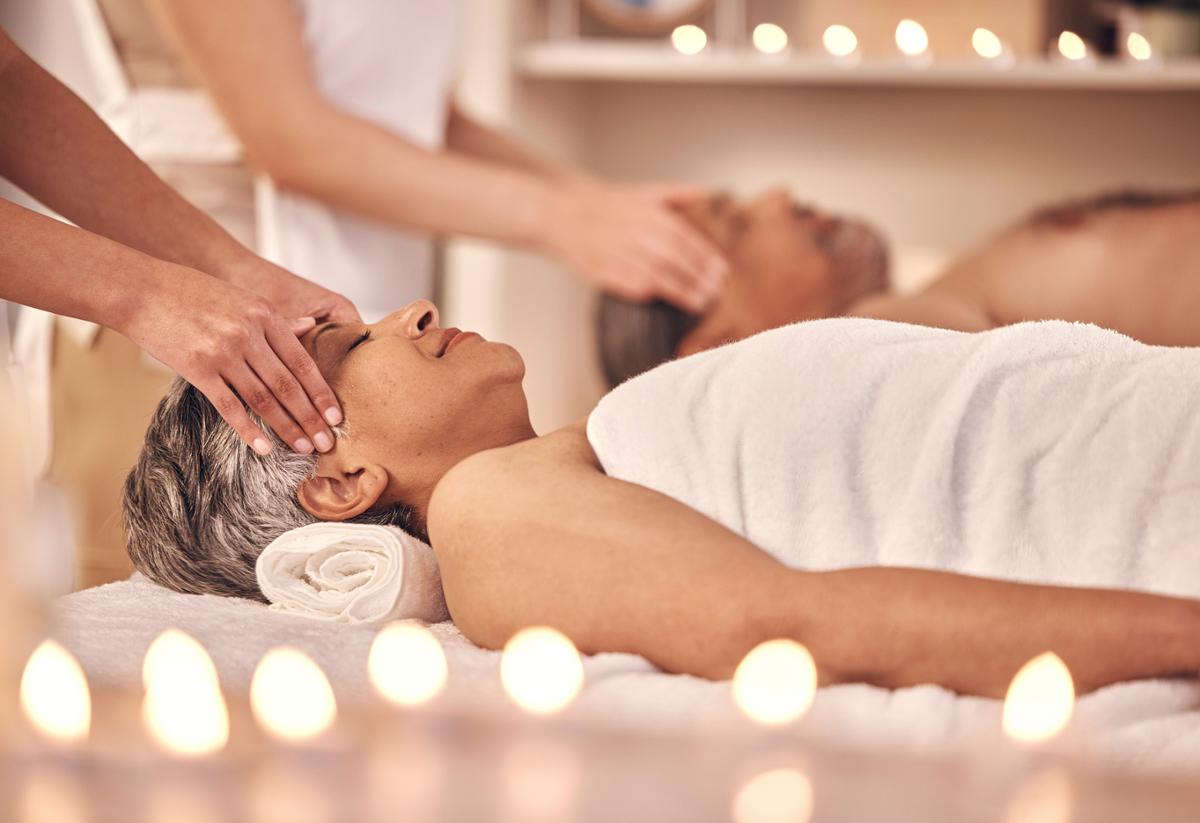
Cabana treatments are a great way to capture guests, notes CBRE / photo: Shutterstock AI
Spas are an expected amenity for most luxury and ultra luxury hotels, which greatly benefit from high-net-worth individuals who are increasingly investing in their wellbeing. In some cases, spas are mandatory under the brand standards for certain luxury and ultra-luxury operators and are also a requirement to comply with Forbes Five Star Standards.
However, they’re no longer exclusive to luxury properties. Urban hotels offer spas to entice locals and convention hotels use them to win group business. They’re a primary feature at high-end boutiques, while modest-priced family resorts offer spas to satisfy the needs of parents as kids play in the waterpark.
However, what are spas contributing to hotels from a financial point of view? To find out, CBRE analysed the performance of 297 US hotels that operate a spa and participated in its Trends in the Hotel Industry survey in 2023 and 2024.
In 2024, the hotels surveyed had 381 rooms on average, a 65.1 per cent occupancy and a US$375.64 (€331.60, £280.34) average daily rate (ADR). The sample consisted of 222 properties in resort markets and 75 in urban areas. The majority (176) of properties were luxury hotels, while the remainder sat in the upper-upscale, upscale and upper-midscale categories. Hotels which leased out their spa operations to third-party management companies were excluded from the analysis.
In 2024, hotels in the sample averaged US$6,061 (€5,350, £4,523) per available guestroom (PAR) in spa revenue, which includes income from all spa and salon services and also from retail sales.
Spa revenue PAR is greatest at hotels located in resort areas versus urban areas, while luxury hotels earn more than upper-upscale and upscale/upper-midscale properties.
Summary: spa revenue PAR by hotel type
• Hotels in resort areas: US$6,539 (€5772, £4,800).
• Hotels in urban areas: US$4,756 (€4,198, £3,549).
These trends are the same when measuring revenue on a dollar-per-occupied-room basis.
THE BIGGER PICTURE The financial impact of spas can be measured by analysing spa revenue as a percentage of total hotel revenue. Spa revenue at the hotels in CBRE’s sample averaged 3.4 per cent of total revenue in 2024. Spas were the greatest contributor of revenue at luxury hotels (4.2 per cent) and at resort sites (3.5 per cent).
Among the services offered, massages deliver upwards of 60-75 per cent of revenue and number of treatments. However, speciality services – ranging from mental health support to nutrition and hydrotherapy – are used to increase traffic and elevate the positioning of a property. Treatments in beach or poolside cabanas are an excellent way to bring attention to the spa and increase guest capture.
Considering the rising popularity of communal bathhouses, hotel spas with hydrothermal areas have an edge over competitors. Not only do they act as a differentiator, they also lead to increased spa traffic and repeat business.
With product sales accounting for 15-30 per cent of spa revenue, adding thoughtful retail features could be another way to yield profits, along with introducing curated wellness products to guestrooms. Items to boost turndown – such as a soothing eye mask or spray – could work especially well, for example.
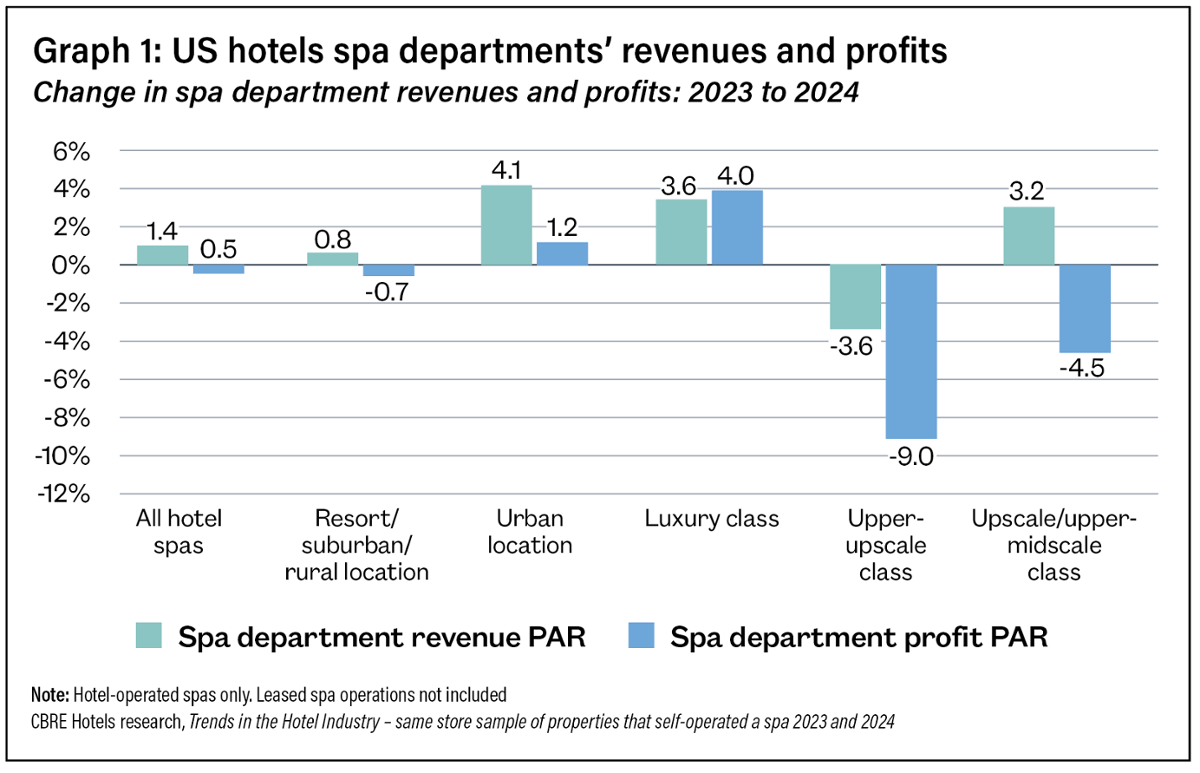
Depending on the hotel’s location and spa provisions, many properties are adding local memberships – giving access to facilities and service discounts – or offering day packages to boost income and increase traffic. This has proven key with the greatest increases in spa revenue in 2024 observed at luxury (plus 3.6 per cent) and urban properties (plus 4.1 per cent), which expanded their reach into local markets, as shown in Graph 1. In comparison, hotel spas in remote and rural resort locations, which couldn’t deploy this strategy, only saw revenues rise by 0.8 per cent.
CONTROLLING COSTS Consistent with the slowdown in the overall performance of US hotels during 2024, the average spa revenue growth rate in CBRE’s sample was 1.4 per cent (see Graph 1). Despite this increase, spa profits declined slightly by 0.5 per cent in line with another overall trend of greater expense vs revenue growth in properties.
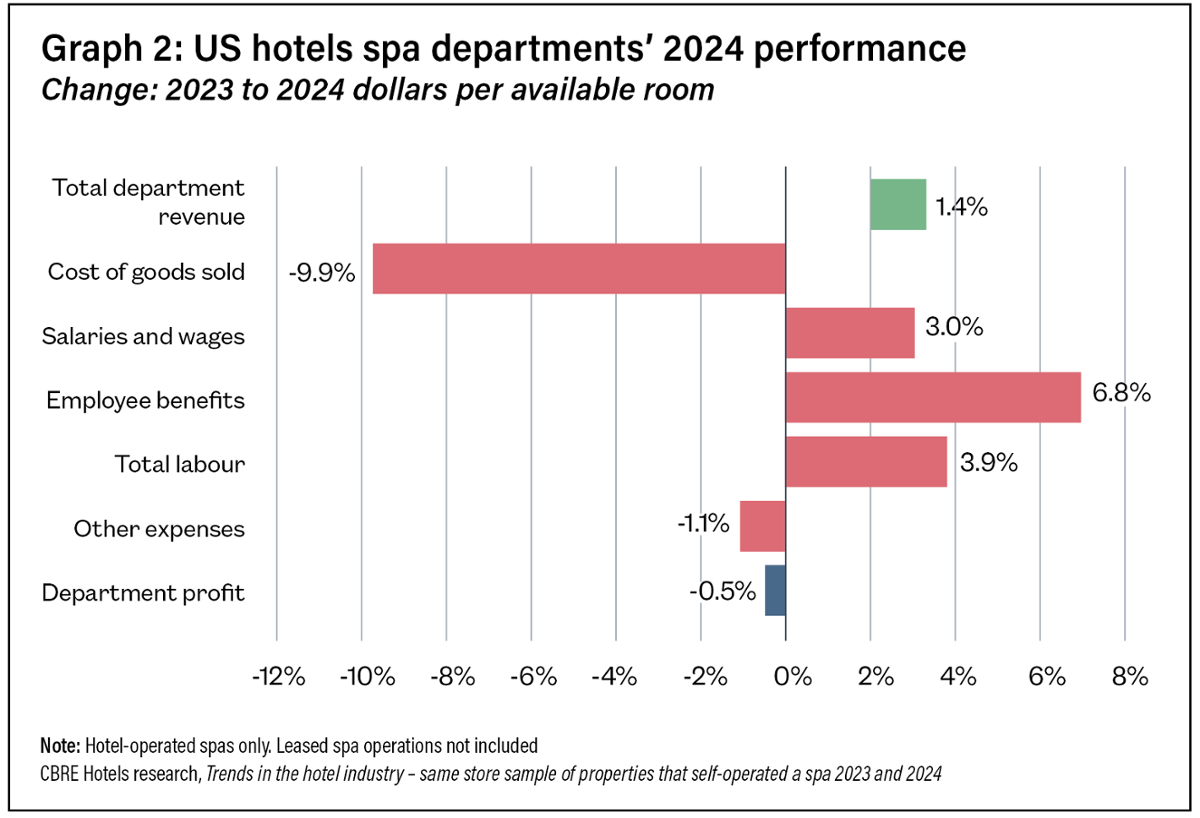
In 2024, total spa department expenses in CBRE’s sample increased by 2.1 per cent, primarily due to labour costs, which rose by 3.9 per cent (see Graph 2). To close the gap, spas were able to cut their costs of goods sold by 9.9 per cent and reduce other non-labour expenses by 1.1 per cent.
Within labour costs, a 6.8 per cent rise in spa employee benefits outpaced the 3 per cent increase in salaries and wages. One tactic managers deploy to control workforce expenses is to use contract staff. In 2024, payments made to contract employees averaged 9.6 per cent of total payroll, up slightly from the 9.3 per cent in 2023. Due to the greater availability of such technicians in built-up areas, this was 17.9 per cent at urban hotels.
Today, CBRE notes that spas are looking to incorporate touchless therapies – such as LED beds, cryotherapy, salt inhalation rooms and biohacking pods – and amenities which they can charge for but which don’t require a therapist. These bring in incremental revenue with minimal expenses.
The enhanced use of contract employees, combined with the ability to accommodate local residents, enabled urban hotels to achieve a 1.2% increase in spa department profits in 2024. Conversely, spa profits in resort area hotels declined by 0.7%.
From CBRE’s experience, if hotel spas are to ensure revenues per square foot and profitability are maximised, it’s imperative that operators have a disciplined approach to treatment room utilisation, breakdown revenue by service and monitor guest satisfaction very closely.
From an asset management perspective, it’s also paramount to ensure the operator and hotel leadership concentrate on selling the spa and spa services and incorporate spa and wellness in their property pitches every day.
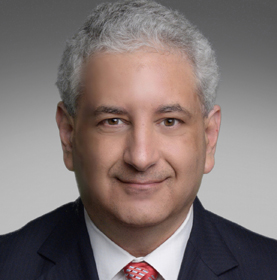
Andrea Grigg is a senior MD and global head of hotel asset management: [email protected]
About the author:
photo: CBRE
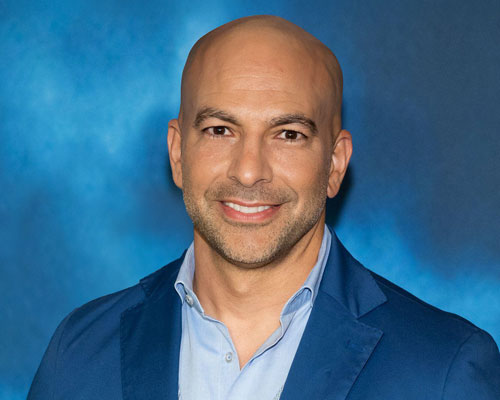
Robert Mandelbaum is director of hotels research for CBRE: [email protected]
Read more from this issue of Spa Business magazine
View contents of Spa Business 2025 issue 2
Editor’s letter: The Gen Z effect
With young adults reshaping our industry, affordable, community-based models are thriving, while traditional spas risk being left behind
Spa people: Novak Djokovic
Game, set, spa. The tennis star is poised to launch a biohacking pod while also entering a multi-year ambassador partnership with Aman
Spa people: Peter Attia
One of the most respected names in longevity medicine has co-founded preventative health clinic, Biograph
Spa people: Alexis Dean
The founder of Soak is on a mission to deliver social wellness without the hefty price tag across Australia
News report: Young influencers
Millennials and Gen Zers are redefining the wellness landscape according to new research by McKinsey
News report: Double vision
Fresh data from RLA Global reveals that hotels delivering wellness earn twice as much as those that don’t
Project preview: Laugarás Lagoon
Contrast bathing and fine dining are two USPs of a new geothermal destination in Iceland’s Golden Circle
Interview: Suzanne Holbrook
Marriott’s new global leader of spa, fitness and wellness talks candidly to Katie Barnes about her plans for the world’s largest hotel spa portfolio
Ask an expert: Vagus nerve
Insider insights into why this critical nerve is a key to wellbeing and how supportive treatments are set to shake up spa menus. Kath Hudson reports
Research: Marginally speaking
CBRE’s latest numbers show that spa revenues in US hotels have edged upward, profits have slipped slightly and costs are down
Investigation: Dealing with death
With a new openness emerging around the subject of end-of-life care, Julie Cramer investigates whether spas could offer death doula services
Trend: Head first
Judy Chapman tries out brain mapping at Gwinganna to see why it’s become so popular
First person: Relaxation rebooted
Does AI massage have a place in luxury spas? Cassandra Cavanah heads to The Ritz-Carlton Bacara, Santa Barbara to find out
Contrast therapy, based on the alternation of hot and cold rituals, has become one of the
most valued practices in the fields of wellness and recovery. [more...]
While spa revenues in US hotels edged upward in 2024, profits slipped slightly. CBRE’s Robert Mandelbaum and Andrea Grigg explore the shifting dynamics behind the numbers
Cabana treatments are a great way to capture guests, notes CBRE / photo: Shutterstock AI
Spas are an expected amenity for most luxury and ultra luxury hotels, which greatly benefit from high-net-worth individuals who are increasingly investing in their wellbeing. In some cases, spas are mandatory under the brand standards for certain luxury and ultra-luxury operators and are also a requirement to comply with Forbes Five Star Standards.
However, they’re no longer exclusive to luxury properties. Urban hotels offer spas to entice locals and convention hotels use them to win group business. They’re a primary feature at high-end boutiques, while modest-priced family resorts offer spas to satisfy the needs of parents as kids play in the waterpark.
However, what are spas contributing to hotels from a financial point of view? To find out, CBRE analysed the performance of 297 US hotels that operate a spa and participated in its Trends in the Hotel Industry survey in 2023 and 2024.
In 2024, the hotels surveyed had 381 rooms on average, a 65.1 per cent occupancy and a US$375.64 (€331.60, £280.34) average daily rate (ADR). The sample consisted of 222 properties in resort markets and 75 in urban areas. The majority (176) of properties were luxury hotels, while the remainder sat in the upper-upscale, upscale and upper-midscale categories. Hotels which leased out their spa operations to third-party management companies were excluded from the analysis.
In 2024, hotels in the sample averaged US$6,061 (€5,350, £4,523) per available guestroom (PAR) in spa revenue, which includes income from all spa and salon services and also from retail sales.
Spa revenue PAR is greatest at hotels located in resort areas versus urban areas, while luxury hotels earn more than upper-upscale and upscale/upper-midscale properties.
Summary: spa revenue PAR by hotel type
• Hotels in resort areas: US$6,539 (€5772, £4,800).
• Hotels in urban areas: US$4,756 (€4,198, £3,549).
These trends are the same when measuring revenue on a dollar-per-occupied-room basis.
THE BIGGER PICTURE The financial impact of spas can be measured by analysing spa revenue as a percentage of total hotel revenue. Spa revenue at the hotels in CBRE’s sample averaged 3.4 per cent of total revenue in 2024. Spas were the greatest contributor of revenue at luxury hotels (4.2 per cent) and at resort sites (3.5 per cent).
Among the services offered, massages deliver upwards of 60-75 per cent of revenue and number of treatments. However, speciality services – ranging from mental health support to nutrition and hydrotherapy – are used to increase traffic and elevate the positioning of a property. Treatments in beach or poolside cabanas are an excellent way to bring attention to the spa and increase guest capture.
Considering the rising popularity of communal bathhouses, hotel spas with hydrothermal areas have an edge over competitors. Not only do they act as a differentiator, they also lead to increased spa traffic and repeat business.
With product sales accounting for 15-30 per cent of spa revenue, adding thoughtful retail features could be another way to yield profits, along with introducing curated wellness products to guestrooms. Items to boost turndown – such as a soothing eye mask or spray – could work especially well, for example.
Depending on the hotel’s location and spa provisions, many properties are adding local memberships – giving access to facilities and service discounts – or offering day packages to boost income and increase traffic. This has proven key with the greatest increases in spa revenue in 2024 observed at luxury (plus 3.6 per cent) and urban properties (plus 4.1 per cent), which expanded their reach into local markets, as shown in Graph 1. In comparison, hotel spas in remote and rural resort locations, which couldn’t deploy this strategy, only saw revenues rise by 0.8 per cent.
CONTROLLING COSTS Consistent with the slowdown in the overall performance of US hotels during 2024, the average spa revenue growth rate in CBRE’s sample was 1.4 per cent (see Graph 1). Despite this increase, spa profits declined slightly by 0.5 per cent in line with another overall trend of greater expense vs revenue growth in properties.
In 2024, total spa department expenses in CBRE’s sample increased by 2.1 per cent, primarily due to labour costs, which rose by 3.9 per cent (see Graph 2). To close the gap, spas were able to cut their costs of goods sold by 9.9 per cent and reduce other non-labour expenses by 1.1 per cent.
Within labour costs, a 6.8 per cent rise in spa employee benefits outpaced the 3 per cent increase in salaries and wages. One tactic managers deploy to control workforce expenses is to use contract staff. In 2024, payments made to contract employees averaged 9.6 per cent of total payroll, up slightly from the 9.3 per cent in 2023. Due to the greater availability of such technicians in built-up areas, this was 17.9 per cent at urban hotels.
Today, CBRE notes that spas are looking to incorporate touchless therapies – such as LED beds, cryotherapy, salt inhalation rooms and biohacking pods – and amenities which they can charge for but which don’t require a therapist. These bring in incremental revenue with minimal expenses.
The enhanced use of contract employees, combined with the ability to accommodate local residents, enabled urban hotels to achieve a 1.2% increase in spa department profits in 2024. Conversely, spa profits in resort area hotels declined by 0.7%.
From CBRE’s experience, if hotel spas are to ensure revenues per square foot and profitability are maximised, it’s imperative that operators have a disciplined approach to treatment room utilisation, breakdown revenue by service and monitor guest satisfaction very closely.
From an asset management perspective, it’s also paramount to ensure the operator and hotel leadership concentrate on selling the spa and spa services and incorporate spa and wellness in their property pitches every day.
Andrea Grigg is a senior MD and global head of hotel asset management: [email protected]
About the author:
photo: CBRE
Robert Mandelbaum is director of hotels research for CBRE: [email protected]
Read more from this issue of Spa Business magazine
View contents of Spa Business 2025 issue 2
Editor’s letter: The Gen Z effect
With young adults reshaping our industry, affordable, community-based models are thriving, while traditional spas risk being left behind
Spa people: Novak Djokovic
Game, set, spa. The tennis star is poised to launch a biohacking pod while also entering a multi-year ambassador partnership with Aman
Spa people: Peter Attia
One of the most respected names in longevity medicine has co-founded preventative health clinic, Biograph
Spa people: Alexis Dean
The founder of Soak is on a mission to deliver social wellness without the hefty price tag across Australia
News report: Young influencers
Millennials and Gen Zers are redefining the wellness landscape according to new research by McKinsey
News report: Double vision
Fresh data from RLA Global reveals that hotels delivering wellness earn twice as much as those that don’t
Project preview: Laugarás Lagoon
Contrast bathing and fine dining are two USPs of a new geothermal destination in Iceland’s Golden Circle
Interview: Suzanne Holbrook
Marriott’s new global leader of spa, fitness and wellness talks candidly to Katie Barnes about her plans for the world’s largest hotel spa portfolio
Ask an expert: Vagus nerve
Insider insights into why this critical nerve is a key to wellbeing and how supportive treatments are set to shake up spa menus. Kath Hudson reports
Research: Marginally speaking
CBRE’s latest numbers show that spa revenues in US hotels have edged upward, profits have slipped slightly and costs are down
Investigation: Dealing with death
With a new openness emerging around the subject of end-of-life care, Julie Cramer investigates whether spas could offer death doula services
Trend: Head first
Judy Chapman tries out brain mapping at Gwinganna to see why it’s become so popular
First person: Relaxation rebooted
Does AI massage have a place in luxury spas? Cassandra Cavanah heads to The Ritz-Carlton Bacara, Santa Barbara to find out
Hand and Stone Massage and Facial Spa, the spa business with more than 650 locations across
the US and Canada, has appointed franchise expert Carrie Walsh as CEO as the company plans
to expand.
Synergy – The Retreat Show, the global trade show for retreats, has launched a global research
initiative that will provide insights into the retreat sector from both consumer and industry
perspectives.
The Wellness Tourism Association (WTA) has published a non-regulatory global industry
framework designed to ensure the retreat market offers responsible experiences.
A new survey of UK and international spa practitioners shows that stress, burnout and
wellbeing concerns have caused one in three respondents to consider leaving the industry.
The UK's four Chief Medical Officers have published a refreshed edition of Physical activity
guidelines: UK Chief Medical Officers' report, updating the evidence that underpins the nation's
physical activity recommendations and placing greater emphasis on strength, balance, reducing
sedentary behaviour and, for the first time, supporting people taking weight loss medications.
Anna Bjurstam has left her role as Wellness Pioneer at Six Senses Hotels and Resorts and
launched a new wellness, longevity and “consciousness consultancy” called Wahayla.
Fairmont Cheshire, The Mere, has opened today (10 July) in the Northwest of England
with a
1,715sq m Fairmont Spa that has been designed using a ‘Wellness without Walls’
concept.
Wellness hotels generating less than US$1 million (€932,700, £785,200) – or 10 per cent of
total revenue from wellness and leisure – recorded the strongest RevPAR and TRevPAR growth
in 2025 across categories when compared with 2024, according to the latest Wellness Real
Estate Report by RLA Global, produced in partnership with P and L benchmarking firm HotStats.
Contrast therapy, based on the alternation of hot and cold rituals, has become one of the
most valued practices in the fields of wellness and recovery. [more...]