Yes! Send me the FREE digital editions of Spa Business and Spa Business insider magazines and the FREE weekly Spa Business and Spa Business insider ezines and breaking news alerts!
As cities across the US start to hire chief wellness officers,
Mia Kyricos reveals what this means for our sector
and what other hidden opportunities lie ahead
Social bathing concepts are on the cusp of a renaissance, says Kyricos / photo: Six Senses
What is a chief wellness, or wellbeing, officer? Simply put, chief wellness officers (CWOs) focus on the health and wellness of a particular group of stakeholders, whether commercial (customers and guests) or internal (employees and leaders). The role of a chief wellbeing officer is slightly broader as they’re typically responsible for creating a healthy and positive work culture. In either case, community or planetary wellbeing can also be part of the job description. It depends on organisation. I explain the two titles and roles – as there’s clearly an overlap – in greater detail in my Gamechangers article (see www.spabusiness.com/cwo).
I conceived the role when I was SVP & global head of wellbeing for Hyatt back in 2018. It was the first role of its kind for a Fortune 1,000 company that spanned both commercial and colleague wellbeing (see www.spabusiness.com/kyricoshyatt). I witnessed the power of reporting to C-suite executives after years of holding related roles at a more junior level for other companies. Being part of the company’s senior leadership team made it much easier to accomplish meaningful work in shorter time frames – and to positively impact culture from the top down. At that time, Deloitte & Touche, a major consulting company, had the only other CWO I was aware of and we began to meet and compare notes as similar roles began to surface in other sectors.
What’s fuelling the rise of CWOs? At a micro level, there’s a much greater understanding of how important our individual health and wellness is to how we perform at work and in life. The same is true at a macro level. Organisations such as the Global Wellness Institute have defined and quantified the size of the global wellness economy, empowering leaders in the private and public sectors to make a business case for investment in wellness-driven enterprises. While ground-breaking research just revealed by Oxford University’s Wellbeing Research Centre shows companies with high employee wellbeing perform better on the stock market (see p122).
Finally, the public sector is starting to consider the economics associated with healthier populations and how they may positively impact them via city planning and programming – and that’s really exciting.
What industries are hiring CWOs? Over the last year, Kyricos & Associates has tracked the development of these kinds of roles via job postings on LinkedIn. While titles and job descriptions vary, we’ve seen higher education bodies (colleges and universities) and healthcare systems leading the charge in the recruitment of CWOs. Both industries have been burned out by caring for the health and wellness of their constituents.
At the same time, unfortunately, we’ve seen the hospitality and consulting sectors constrict or eliminate existing, wellness-driven roles. I believe this is because the roles have not yet been structured for success with the right scope, title or even organisational structure. Spa and wellness leaders focused on development and operations have often lived in brand or marketing teams, for example. Alternatively, they may be global in scope but located in a regional division.
I also feel those leaders haven’t been empowered to make the kind of decisions that truly impact culture, individual or business performance. And I know, first-hand, what happens when you’re empowered.
Where are the biggest opportunities for CWOs? There’s enormous potential in the public sector. For readers of Spa Business, it means the opportunity is bigger than spa, bigger than hotels and bigger than hospitality companies. I’m talking about towns, cities and even countries. For example, last July, Los Angeles hired its first chief wellness officer and my company has been in discussions with two other cities in the US which are considering if/how to follow suit. In the UK, Wales has hired a future generations commissioner to care for the wellbeing of its people and ultimately make the country a more attractive place to live.
Why is this all relevant to the spa and wellness industry? That’s the best part. Seasoned spa and wellness leaders, who know how to successfully navigate highly-matrixed organisations with multiple, competing stakeholders, can now put their skills and experience to use in an entirely different environment.
There’s a growing population in the public sector, healthcare providers in particular, which needs leaders with our view of wellness and prevention. This lifts the ceiling on what our existing leaders can do beyond operate facilities or even just consult or advise on future developments. Instead, with some guts and creativity, they can use their experience as a bridge into the public sector, where they stand to serve as even brighter beacons of light, making a more meaningful impact and leaving lasting legacies.
Your lifelong mission is to legitimise the business of wellness. How do you know you’re gaining ground? The fact that we’re even having this conversation proves progress is happening. In my first interview in Spa Business in 2010, I was the director of global spa brands for Starwood Hotels and focused mostly on wellness within the four walls of hotel spas and later the hotel itself. The wellness conversation has since expanded beyond hospitality to every industry. Governments and global organisations, from the World Travel & Tourism Council and World Economic Forum to the United Nations, now have wellness on their agenda in some shape or form. That’s progress indeed.
What other hidden opportunities are there? Touchless therapies stand to serve as great complements to existing spa and wellness operations. I understand some leaders and therapists are wary of their inclusion, but I believe they will alleviate labour shortages, provide largely passive revenue streams, enhance the guest experience and even attract investment because the economics are so good. In other words, touchless therapies should be perceived as an ‘and’, not an ‘or’.
I also think social bathing concepts are on the cusp of a true renaissance. They have highly compelling socio-economic models that are good for owners, developers, investors and – most importantly – consumers.
Is the climate good for investment in wellness? Yes! We’ve been through challenging elections around the globe, periods of inflation and ongoing war. Investors are seeking opportunities to invest in burgeoning industries and it’s clear that the US$6.3 trillion global wellness economy is not only resilient but growing rapidly as other markets shrink.
In addition, private equity and venture capitalist firms are bringing on seasoned wellness advisors to guide investment in this regard and I expect to see more of this in the months ahead.
Last year, you raised the case for ‘love’ as a business foundation. Do you still stand by this? I’m a huge believer in love as a business strategy and have been championing its power in the workplace since the dark days of 2020 (see www.hcmmag.com/love). The reason for this is simple: there’s evidence that love – which comes in many forms from hope to gratitude to awe – can impact business performance when institutionalised as a management practice. To me, wellness is ‘the what’ and love is ‘the how’ that continues to fuel our amazing industry.
Read more from this issue of Spa Business magazine
View contents of Spa Business 2025 issue 1
Editor's letter: Auto spas
Fully automated, self-service spas are set to enter the market, presenting a disruptive opportunity for investors and operators
Spa People: Christian Louboutin
The fashion designer teams up with his personal trainer to create a Brain Edit retreat at his hotel in Portugal
Spa People: Julien Alfred
Exercise, endurance and resilience are the focus of a programme being led by Olympic 100m winner Julien Alfred at BodyHoliday in St Lucia
News report: Emerging economies
Two fresh GWI reports highlight the potential of the wellness markets in the Maldives and Saudi Arabia
Interview: Paul Hawco
Katie Barnes talks to the man heading up wellbeing at Banyan Group as it prepares to open its 100th resort and reports a 16 per cent rise in revenue
Wellness design: Design of the times
Sixteen experts share their insights on how wellness design can be used to create more impactful and profitable spas in a new white paper by Accor
Opinion: High leverage learning
What three skills do people need to master to future-proof their spa careers? Jeremy McCarthy reports
Spa tourism: Hot on the trail
A famous pilgrimage route and natural hot springs are being combined in an innovative tourism package in Spain
Opinion: Beacons of light
As cities in the US start to hire chief wellness officers, Mia Kyricos reveals what this means for our sector
Sponsored: 111SKIN - Winning formulation
111SKIN’s spa/clinic concept is making waves globally – backed by a combination of medical expertise, intuitive partner support and potent products
Product focus: AI and robot massage
Spas around the world are starting to offer AI massage. We highlight the different types of equipment coming to market
Menu engineering: At your service
A dedicated brain health facility at Kamalaya and a menopause package by actor Naomi Watts feature in our programming pages this issue
Finishing touch: Big business
Companies investing in workers’ happiness outperform other portfolios in major global stock markets, according to new research
Kyricos has been tracking CWO roles closely over the last year / photo: Kyricos & Associates
There’s a much greater understanding of the value of healthy staff / photo: Six Senses
The CWO role ties into city planning and programming to make people healthier / photo: shutterstock/Prostock-studio
Kyricos (right) with Susie Ellis receiving Cornell’s Innovator of the Year award / Kyricos (right) with Susie Ellis receiving Cornell’s Innovator of the Year award
Touchless therapies should be perceived as an ‘and’, not an ‘or’ / photo: Gharieni
In the fast-paced world of fitness and wellness, where high-intensity workouts push us to
our limits and the sweat pours, the importance of efficient recovery cannot be overstated. [more...]
As cities across the US start to hire chief wellness officers,
Mia Kyricos reveals what this means for our sector
and what other hidden opportunities lie ahead
Social bathing concepts are on the cusp of a renaissance, says Kyricos / photo: Six Senses
What is a chief wellness, or wellbeing, officer? Simply put, chief wellness officers (CWOs) focus on the health and wellness of a particular group of stakeholders, whether commercial (customers and guests) or internal (employees and leaders). The role of a chief wellbeing officer is slightly broader as they’re typically responsible for creating a healthy and positive work culture. In either case, community or planetary wellbeing can also be part of the job description. It depends on organisation. I explain the two titles and roles – as there’s clearly an overlap – in greater detail in my Gamechangers article (see www.spabusiness.com/cwo).
I conceived the role when I was SVP & global head of wellbeing for Hyatt back in 2018. It was the first role of its kind for a Fortune 1,000 company that spanned both commercial and colleague wellbeing (see www.spabusiness.com/kyricoshyatt). I witnessed the power of reporting to C-suite executives after years of holding related roles at a more junior level for other companies. Being part of the company’s senior leadership team made it much easier to accomplish meaningful work in shorter time frames – and to positively impact culture from the top down. At that time, Deloitte & Touche, a major consulting company, had the only other CWO I was aware of and we began to meet and compare notes as similar roles began to surface in other sectors.
What’s fuelling the rise of CWOs? At a micro level, there’s a much greater understanding of how important our individual health and wellness is to how we perform at work and in life. The same is true at a macro level. Organisations such as the Global Wellness Institute have defined and quantified the size of the global wellness economy, empowering leaders in the private and public sectors to make a business case for investment in wellness-driven enterprises. While ground-breaking research just revealed by Oxford University’s Wellbeing Research Centre shows companies with high employee wellbeing perform better on the stock market (see p122).
Finally, the public sector is starting to consider the economics associated with healthier populations and how they may positively impact them via city planning and programming – and that’s really exciting.
What industries are hiring CWOs? Over the last year, Kyricos & Associates has tracked the development of these kinds of roles via job postings on LinkedIn. While titles and job descriptions vary, we’ve seen higher education bodies (colleges and universities) and healthcare systems leading the charge in the recruitment of CWOs. Both industries have been burned out by caring for the health and wellness of their constituents.
At the same time, unfortunately, we’ve seen the hospitality and consulting sectors constrict or eliminate existing, wellness-driven roles. I believe this is because the roles have not yet been structured for success with the right scope, title or even organisational structure. Spa and wellness leaders focused on development and operations have often lived in brand or marketing teams, for example. Alternatively, they may be global in scope but located in a regional division.
I also feel those leaders haven’t been empowered to make the kind of decisions that truly impact culture, individual or business performance. And I know, first-hand, what happens when you’re empowered.
Where are the biggest opportunities for CWOs? There’s enormous potential in the public sector. For readers of Spa Business, it means the opportunity is bigger than spa, bigger than hotels and bigger than hospitality companies. I’m talking about towns, cities and even countries. For example, last July, Los Angeles hired its first chief wellness officer and my company has been in discussions with two other cities in the US which are considering if/how to follow suit. In the UK, Wales has hired a future generations commissioner to care for the wellbeing of its people and ultimately make the country a more attractive place to live.
Why is this all relevant to the spa and wellness industry? That’s the best part. Seasoned spa and wellness leaders, who know how to successfully navigate highly-matrixed organisations with multiple, competing stakeholders, can now put their skills and experience to use in an entirely different environment.
There’s a growing population in the public sector, healthcare providers in particular, which needs leaders with our view of wellness and prevention. This lifts the ceiling on what our existing leaders can do beyond operate facilities or even just consult or advise on future developments. Instead, with some guts and creativity, they can use their experience as a bridge into the public sector, where they stand to serve as even brighter beacons of light, making a more meaningful impact and leaving lasting legacies.
Your lifelong mission is to legitimise the business of wellness. How do you know you’re gaining ground? The fact that we’re even having this conversation proves progress is happening. In my first interview in Spa Business in 2010, I was the director of global spa brands for Starwood Hotels and focused mostly on wellness within the four walls of hotel spas and later the hotel itself. The wellness conversation has since expanded beyond hospitality to every industry. Governments and global organisations, from the World Travel & Tourism Council and World Economic Forum to the United Nations, now have wellness on their agenda in some shape or form. That’s progress indeed.
What other hidden opportunities are there? Touchless therapies stand to serve as great complements to existing spa and wellness operations. I understand some leaders and therapists are wary of their inclusion, but I believe they will alleviate labour shortages, provide largely passive revenue streams, enhance the guest experience and even attract investment because the economics are so good. In other words, touchless therapies should be perceived as an ‘and’, not an ‘or’.
I also think social bathing concepts are on the cusp of a true renaissance. They have highly compelling socio-economic models that are good for owners, developers, investors and – most importantly – consumers.
Is the climate good for investment in wellness? Yes! We’ve been through challenging elections around the globe, periods of inflation and ongoing war. Investors are seeking opportunities to invest in burgeoning industries and it’s clear that the US$6.3 trillion global wellness economy is not only resilient but growing rapidly as other markets shrink.
In addition, private equity and venture capitalist firms are bringing on seasoned wellness advisors to guide investment in this regard and I expect to see more of this in the months ahead.
Last year, you raised the case for ‘love’ as a business foundation. Do you still stand by this? I’m a huge believer in love as a business strategy and have been championing its power in the workplace since the dark days of 2020 (see www.hcmmag.com/love). The reason for this is simple: there’s evidence that love – which comes in many forms from hope to gratitude to awe – can impact business performance when institutionalised as a management practice. To me, wellness is ‘the what’ and love is ‘the how’ that continues to fuel our amazing industry.
Read more from this issue of Spa Business magazine
View contents of Spa Business 2025 issue 1
Editor's letter: Auto spas
Fully automated, self-service spas are set to enter the market, presenting a disruptive opportunity for investors and operators
Spa People: Christian Louboutin
The fashion designer teams up with his personal trainer to create a Brain Edit retreat at his hotel in Portugal
Spa People: Julien Alfred
Exercise, endurance and resilience are the focus of a programme being led by Olympic 100m winner Julien Alfred at BodyHoliday in St Lucia
News report: Emerging economies
Two fresh GWI reports highlight the potential of the wellness markets in the Maldives and Saudi Arabia
Interview: Paul Hawco
Katie Barnes talks to the man heading up wellbeing at Banyan Group as it prepares to open its 100th resort and reports a 16 per cent rise in revenue
Wellness design: Design of the times
Sixteen experts share their insights on how wellness design can be used to create more impactful and profitable spas in a new white paper by Accor
Opinion: High leverage learning
What three skills do people need to master to future-proof their spa careers? Jeremy McCarthy reports
Spa tourism: Hot on the trail
A famous pilgrimage route and natural hot springs are being combined in an innovative tourism package in Spain
Opinion: Beacons of light
As cities in the US start to hire chief wellness officers, Mia Kyricos reveals what this means for our sector
Sponsored: 111SKIN - Winning formulation
111SKIN’s spa/clinic concept is making waves globally – backed by a combination of medical expertise, intuitive partner support and potent products
Product focus: AI and robot massage
Spas around the world are starting to offer AI massage. We highlight the different types of equipment coming to market
Menu engineering: At your service
A dedicated brain health facility at Kamalaya and a menopause package by actor Naomi Watts feature in our programming pages this issue
Finishing touch: Big business
Companies investing in workers’ happiness outperform other portfolios in major global stock markets, according to new research
Kyricos has been tracking CWO roles closely over the last year / photo: Kyricos & Associates
There’s a much greater understanding of the value of healthy staff / photo: Six Senses
The CWO role ties into city planning and programming to make people healthier / photo: shutterstock/Prostock-studio
Kyricos (right) with Susie Ellis receiving Cornell’s Innovator of the Year award / Kyricos (right) with Susie Ellis receiving Cornell’s Innovator of the Year award
Touchless therapies should be perceived as an ‘and’, not an ‘or’ / photo: Gharieni
Gran Hotel Taoro in northern Tenerife, Spain, has completed the final phase of its three-year
renovation with the debut of its Sandára Wellness Centre.
Hand and Stone Massage and Facial Spa, the spa business with more than 650 locations across
the US and Canada, has appointed franchise expert Carrie Walsh as CEO as the company plans
to expand.
Synergy – The Retreat Show, the global trade show for retreats, has launched a global research
initiative that will provide insights into the retreat sector from both consumer and industry
perspectives.
The Wellness Tourism Association (WTA) has published a non-regulatory global industry
framework designed to ensure the retreat market offers responsible experiences.
A new survey of UK and international spa practitioners shows that stress, burnout and
wellbeing concerns have caused one in three respondents to consider leaving the industry.
The UK's four Chief Medical Officers have published a refreshed edition of Physical activity
guidelines: UK Chief Medical Officers' report, updating the evidence that underpins the nation's
physical activity recommendations and placing greater emphasis on strength, balance, reducing
sedentary behaviour and, for the first time, supporting people taking weight loss medications.
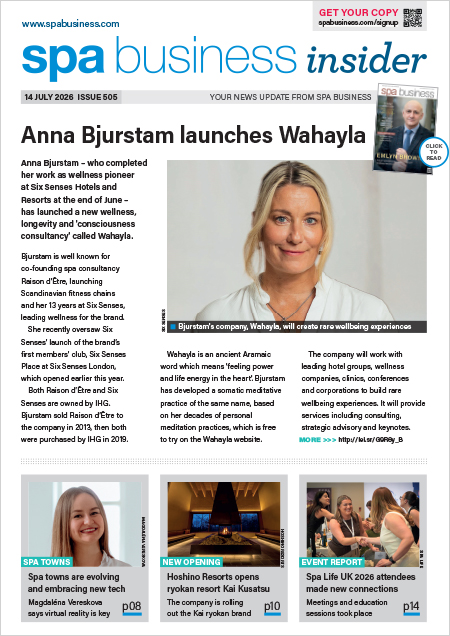
Anna Bjurstam has left her role as Wellness Pioneer at Six Senses Hotels and Resorts and
launched a new wellness, longevity and “consciousness consultancy” called Wahayla.
Fairmont Cheshire, The Mere, has opened today (10 July) in the Northwest of England
with a
1,715sq m Fairmont Spa that has been designed using a ‘Wellness without Walls’
concept.
In the fast-paced world of fitness and wellness, where high-intensity workouts push us to
our limits and the sweat pours, the importance of efficient recovery cannot be overstated. [more...]